
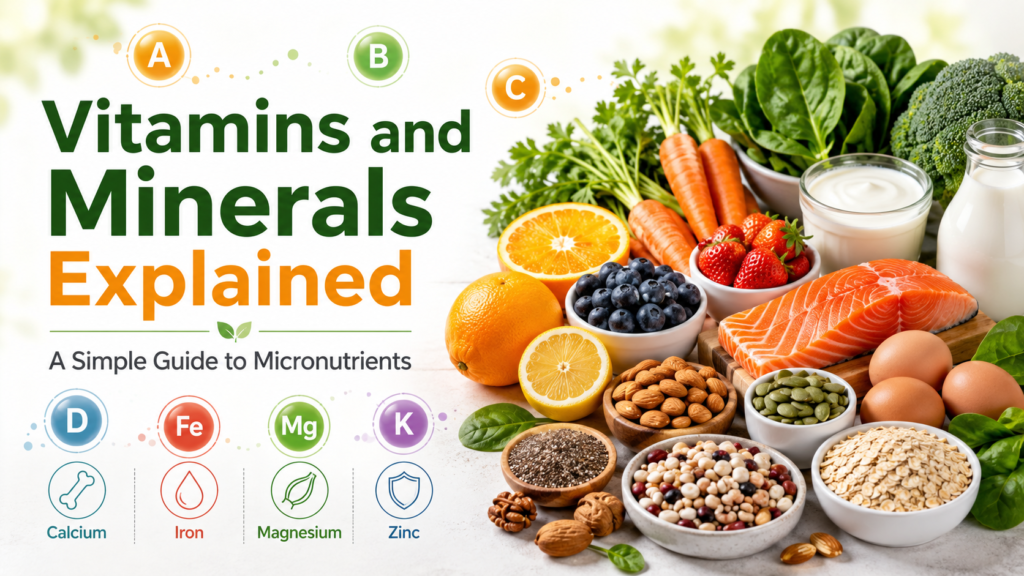
What Are Vitamins and Minerals? A Simple Guide to Micronutrients
Vitamins and minerals are essential micronutrients your body needs in small amounts to stay healthy. They help your body grow, repair tissue, release energy from food, build bones, support immunity, make blood cells, and regulate many body processes.
The simple answer: vitamins are organic nutrients made by plants or animals, while minerals are inorganic elements that come from soil and water. You need both, but they work in different ways.
This matters because micronutrient gaps can affect energy, immunity, growth, pregnancy health, bone strength, blood health, and long-term well-being. CDC describes vitamins and minerals as micronutrients that are vital for healthy development, growth, disease prevention, and well-being.
Table of Contents
ToggleWhat Are Vitamins and Minerals in Simple Terms?
Vitamins and minerals are nutrients your body needs in small amounts to function properly. They do not provide calories like carbohydrates, protein, or fat, but they help your body use energy and maintain normal body processes.
Vitamins are compounds involved in many biological reactions. Minerals are elements used for structure, fluid balance, nerve signaling, oxygen transport, and enzyme function.
In practical terms:
- Vitamins help with immunity, metabolism, vision, skin health, blood formation, and cell protection.
- Minerals help build bones, regulate heartbeat, support muscles, carry oxygen, and balance fluids.
- Both are essential because your body cannot make enough of many of them on its own.
MedlinePlus explains that vitamins are substances the body needs to grow and develop normally, and it lists 13 vitamins the body needs. MedlinePlus also notes that the body uses minerals to build bones, make hormones, and regulate heartbeat.
Why Are Vitamins and Minerals Called Micronutrients?
Vitamins and minerals are called micronutrients because the body needs them in small amounts compared with macronutrients. Macronutrients include carbohydrates, protein, and fat, which the body needs in larger amounts and uses for energy.
“Micro” does not mean unimportant. It means the required amount is small.
A useful comparison:
| Nutrient type | Needed in | Main role |
|---|---|---|
| Macronutrients | Larger amounts | Provide energy and body structure |
| Micronutrients | Smaller amounts | Support body functions and prevent deficiency |
| Vitamins | Small amounts | Help chemical reactions and body regulation |
| Minerals | Small amounts | Support structure, fluids, nerves, blood, and enzymes |
Two main classifications of micronutrients are vitamins and minerals, and both have important roles in human health.
What Is the Difference Between Vitamins and Minerals?
The main difference is that vitamins are organic compounds, while minerals are inorganic elements. Vitamins can be broken down by heat, air, or acid, while minerals keep their chemical structure.
This difference affects cooking, storage, absorption, and how the body uses each nutrient.
| Feature | Vitamins | Minerals |
|---|---|---|
| Basic nature | Organic compounds | Inorganic elements |
| Source | Plants, animals, and some body processes | Soil, water, plants, and animals |
| Stability | Can be damaged by heat, air, or light | More chemically stable |
| Examples | Vitamin C, vitamin D, B12, vitamin A | Calcium, iron, zinc, potassium |
| Main roles | Metabolism, immunity, cells, vision, blood | Bones, nerves, muscles, fluids, oxygen transport |
A simple example: vitamin C can be reduced by long cooking or exposure to air, but calcium in food remains calcium.
What Are the Main Types of Vitamins?
The main types of vitamins are fat-soluble vitamins and water-soluble vitamins. This classification matters because it affects how vitamins are absorbed, stored, and removed from the body.
There are 13 essential vitamins: vitamins A, C, D, E, K, and eight B vitamins. MedlinePlus lists the B vitamins as thiamine, riboflavin, niacin, pantothenic acid, biotin, vitamin B6, vitamin B12, and folate.
What Are Fat-Soluble Vitamins?
Fat-soluble vitamins are vitamins that dissolve in fat and can be stored in the body. The fat-soluble vitamins are vitamins A, D, E, and K.
Because these vitamins can be stored in the liver, fatty tissue, and muscles, high-dose supplements can create a higher risk of excess intake. MedlinePlus explains that vitamins A, D, E, and K are fat-soluble and are absorbed more easily when dietary fat is present.
Fat-soluble vitamins include:
- Vitamin A: supports vision, immunity, skin, and cell growth.
- Vitamin D: supports calcium absorption, bones, muscles, and immune function.
- Vitamin E: acts as an antioxidant and helps protect cells.
- Vitamin K: supports normal blood clotting and bone-related proteins.
Food examples include eggs, dairy, fatty fish, liver, leafy greens, nuts, seeds, and fortified foods.
What Are Water-Soluble Vitamins?
Water-soluble vitamins dissolve in water and are generally not stored in large amounts. The water-soluble vitamins are vitamin C and the B vitamins.
Because excess amounts often leave the body through urine, these vitamins usually need regular intake. The major exception is vitamin B12, which can be stored in the liver for years. MedlinePlus notes that water-soluble vitamins include vitamin C and all B vitamins.
Water-soluble vitamins include:
- Vitamin C: supports collagen formation, wound healing, antioxidant protection, and iron absorption.
- Thiamine, or B1: helps convert food into energy.
- Riboflavin, or B2: supports energy metabolism and cell function.
- Niacin, or B3: supports energy metabolism and skin, nerve, and digestive health.
- Pantothenic acid, or B5: helps make coenzyme A for metabolism.
- Vitamin B6: supports brain development, immune function, and protein metabolism.
- Biotin, or B7: supports metabolism of fats, carbohydrates, and protein.
- Folate, or B9: supports DNA formation and is especially important before and during pregnancy.
- Vitamin B12: supports nerves, red blood cells, and DNA formation.
Food examples include fruits, vegetables, whole grains, legumes, meat, fish, eggs, dairy, and fortified foods.
What Are the Main Types of Minerals?
The main types of minerals are major minerals and trace minerals. Major minerals are needed in larger amounts, while trace minerals are needed in smaller amounts.
This does not mean trace minerals are less important. Iron, iodine, zinc, and selenium are needed in tiny amounts, but deficiencies can still cause serious problems.
What Are Major Minerals?
Major minerals are minerals the body needs in relatively larger amounts. They include calcium, phosphorus, magnesium, sodium, potassium, chloride, and sulfur.
Major minerals help with:
- Bone and tooth structure
- Muscle contraction
- Nerve signals
- Fluid balance
- Heart rhythm
- Acid-base balance
- Energy metabolism
Common examples:
| Major mineral | Main function | Food sources |
|---|---|---|
| Calcium | Bones, teeth, muscles, nerves | Dairy, fortified plant milks, tofu, sardines, leafy greens |
| Potassium | Fluid balance, nerves, blood pressure support | Potatoes, beans, bananas, yogurt, spinach |
| Magnesium | Muscles, nerves, blood sugar, enzymes | Nuts, seeds, legumes, whole grains, greens |
| Sodium | Fluid balance, nerve signals | Salt, processed foods, soups, sauces |
| Phosphorus | Bones, teeth, energy metabolism | Meat, dairy, beans, nuts, whole grains |
What Are Trace Minerals?
Trace minerals are minerals the body needs in very small amounts. They include iron, zinc, iodine, selenium, copper, manganese, fluoride, chromium, and molybdenum.
Trace minerals help with:
- Oxygen transport
- Thyroid hormone production
- Immune defense
- Antioxidant systems
- Growth and development
- Enzyme function
- Wound healing
Common examples:
| Trace mineral | Main function | Food sources |
|---|---|---|
| Iron | Helps carry oxygen in blood | Meat, seafood, beans, lentils, fortified grains |
| Zinc | Immunity, wound healing, growth | Meat, shellfish, beans, nuts, dairy |
| Iodine | Thyroid hormone production | Iodized salt, seafood, dairy, seaweed |
| Selenium | Antioxidant enzymes, thyroid support | Brazil nuts, seafood, meat, eggs |
| Copper | Iron metabolism, connective tissue | Shellfish, nuts, seeds, whole grains |
Why Does the Body Need Vitamins and Minerals?
The body needs vitamins and minerals because they support essential biological functions. Without enough micronutrients, the body may struggle to grow, repair tissue, fight infection, maintain bones, produce blood cells, and regulate metabolism.
Vitamins and minerals act like support workers in the body. They do not replace food energy, but they help the body use food properly.
Important roles include:
- Energy metabolism: B vitamins help the body use carbohydrates, protein, and fat.
- Bone health: calcium, vitamin D, phosphorus, magnesium, and vitamin K support bones.
- Blood health: iron, folate, vitamin B12, and vitamin K support blood formation or clotting.
- Immune function: vitamins A, C, D, E, zinc, selenium, and iron support immune defenses.
- Nerve function: B vitamins, magnesium, sodium, potassium, and calcium support nerve signaling.
- Thyroid function: iodine and selenium support thyroid hormone production.
- Cell protection: vitamins C and E, selenium, and other nutrients help protect cells from oxidative stress.
CDC reports that micronutrient deficiencies can have significant consequences for health and well-being.
Which Vitamins and Minerals Are Commonly Important for Everyday Health?
All essential vitamins and minerals matter, but some receive special public health attention because many people do not get enough. Vitamin D, calcium, potassium, iron, iodine, folate, vitamin B12, and zinc are commonly discussed because they support major body systems and can be low in specific groups.
The 2025 Dietary Guidelines Advisory Committee reported that many people consume below requirements for nutrients including calcium, potassium, magnesium, iron, zinc, and vitamin D. CDC also highlights iron deficiency among U.S. women and global vitamin and mineral deficiencies among young children.
Commonly important micronutrients include:
| Nutrient | Why it matters | Who may need extra attention |
|---|---|---|
| Vitamin D | Bones, muscles, immune function | People with low sun exposure, older adults, some darker-skinned populations |
| Calcium | Bones, teeth, muscles, nerves | Children, teens, older adults, people avoiding dairy |
| Iron | Oxygen transport, energy, pregnancy health | Menstruating people, pregnant people, infants, some vegetarians |
| Vitamin B12 | Nerves, red blood cells, DNA | Vegans, older adults, people with absorption issues |
| Folate | DNA formation, pregnancy health | People who may become pregnant |
| Iodine | Thyroid hormones | Pregnant people, people avoiding iodized salt or seafood |
| Potassium | Fluid balance, muscles, blood pressure support | People with low fruit and vegetable intake |
| Zinc | Immunity, wound healing, growth | People with restricted diets or absorption problems |
This does not mean everyone should supplement these nutrients. It means these nutrients deserve attention in food choices and medical care when relevant.
What Foods Are Good Sources of Vitamins and Minerals?
The best food sources of vitamins and minerals are nutrient-dense foods such as vegetables, fruits, legumes, whole grains, dairy or fortified alternatives, eggs, seafood, lean meats, nuts, and seeds. A varied diet usually gives better micronutrient coverage than relying on one “superfood.”
Good sources by food group:
- Vegetables: vitamin A precursors, vitamin C, folate, potassium, magnesium.
- Fruits: vitamin C, potassium, folate, antioxidants.
- Whole grains: B vitamins, magnesium, iron, zinc.
- Beans and lentils: iron, folate, magnesium, potassium, zinc.
- Dairy foods: calcium, riboflavin, vitamin B12, iodine; some are fortified with vitamin D.
- Fish and seafood: vitamin D, iodine, selenium, zinc, vitamin B12.
- Eggs: vitamin B12, choline, selenium, vitamin D in smaller amounts.
- Nuts and seeds: vitamin E, magnesium, zinc, selenium, healthy fats.
- Fortified foods: added vitamin D, calcium, iron, folic acid, or B12 depending on the product.
A food-first approach works because whole foods provide micronutrients along with protein, fiber, healthy fats, and protective plant compounds.
Can You Get Enough Vitamins and Minerals From Food?
Many people can get enough vitamins and minerals from a varied, balanced diet, but not everyone does. Nutrient needs depend on age, sex, pregnancy status, health conditions, medications, diet pattern, absorption, and food access.
A person eating a limited diet, avoiding major food groups, or dealing with a medical condition may have a higher risk of low intake.
People who may need closer attention include:
- Pregnant people
- Infants and young children
- Older adults
- People with heavy menstrual bleeding
- Vegans or strict vegetarians
- People after bariatric surgery
- People with digestive disorders or malabsorption
- People with food insecurity
- People taking medications that affect nutrient absorption
- People with very low-calorie or restrictive diets
CDC states that infants, children, adolescent girls, women of reproductive age, and pregnant women are among the groups most likely to have deficiencies.
What Happens If You Do Not Get Enough Vitamins and Minerals?
If you do not get enough vitamins and minerals, deficiency can develop. Deficiency symptoms depend on the nutrient and can range from mild fatigue to serious health problems.
Deficiencies are not always obvious at first. Some build slowly over time.
Examples include:
| Low nutrient | Possible consequence |
|---|---|
| Iron | Iron deficiency anemia, fatigue, weakness |
| Vitamin B12 | Anemia, nerve problems, numbness or tingling |
| Folate | Anemia; increased risk of neural tube defects in pregnancy |
| Vitamin D | Poor bone mineralization, bone or muscle problems |
| Calcium | Reduced bone strength over time |
| Iodine | Thyroid problems and developmental concerns in pregnancy |
| Vitamin C | Poor wound healing; severe deficiency can cause scurvy |
| Vitamin A | Vision and immune problems; severe deficiency can cause blindness |
Globally, micronutrient deficiency remains a major public health issue. CDC reports that more than half of children younger than 5 worldwide suffer from vitamin and mineral deficiencies.
Can Too Many Vitamins or Minerals Be Harmful?
Yes, too many vitamins or minerals can be harmful, especially from high-dose supplements. More is not automatically better.
The risk is higher with fat-soluble vitamins because they can be stored in body tissues. Some minerals can also cause harm at high doses or interfere with other nutrients.
Examples of possible problems:
- Too much vitamin A can be toxic and is especially risky during pregnancy.
- Too much vitamin D can raise calcium levels too much.
- Too much iron can be dangerous, especially for children.
- Too much zinc can interfere with copper status.
- Too much iodine can affect thyroid function in sensitive people.
- Too much calcium from supplements may not be appropriate for everyone.
This is why supplement labels and upper limits matter. Do not treat high-dose supplements like harmless wellness products.
Do You Need Vitamin or Mineral Supplements?
You may need vitamin or mineral supplements if your diet, life stage, health status, or lab results show a real need. But supplements are not a substitute for a healthy diet.
Supplements can be useful in specific cases, such as:
- Folic acid before and during early pregnancy
- Vitamin B12 for many people eating vegan diets
- Vitamin D for people with low levels or limited sun exposure
- Iron for diagnosed iron deficiency
- Calcium when food intake is consistently too low
- Iodine in pregnancy when recommended by a healthcare professional
But the supplement market has a blind spot many beginners miss: supplements are not reviewed like medicines before sale. FDA says it is not authorized to approve dietary supplements for safety and effectiveness before they are marketed. NIH’s Office of Dietary Supplements also explains that medicines require FDA approval before marketing, while supplements do not require this approval.
A practical rule:
- Use food as the foundation.
- Use supplements to fill a specific gap.
- Avoid megadoses unless prescribed.
- Ask a healthcare professional if you are pregnant, taking medication, managing a disease, or considering iron, vitamin A, vitamin D, iodine, or multiple supplements.
How Do You Read Vitamins and Minerals on a Food Label?
Read vitamins and minerals on a food label by checking the Daily Value and Percent Daily Value. The %DV tells you how much one serving contributes to the recommended daily amount for that nutrient.
FDA explains that Daily Values are reference amounts to consume or not exceed each day, and %DV shows how much a nutrient in one serving contributes to the total daily diet.
Simple label rules:
- 5% DV or less is considered low.
- 20% DV or more is considered high.
- Always check the serving size first.
- Compare similar foods using %DV.
- Look for nutrients you may need more of, such as vitamin D, calcium, iron, and potassium.
FDA states that 5% DV or less is low and 20% DV or more is high, and it encourages choosing foods higher in dietary fiber, vitamin D, calcium, iron, and potassium more often.
Example:
If a cereal has 20% DV for iron per serving, one serving provides a high amount of the Daily Value for iron. If you eat two servings, you may get about 40% DV, assuming the serving size is accurate.
What Common Mistakes Do People Make About Vitamins and Minerals?
The biggest mistake is thinking supplements automatically fix a poor diet. Supplements can help fill gaps, but they do not replace balanced meals, fiber, protein, healthy fats, or overall diet quality.
Common mistakes include:
- Assuming “natural” means safe.
Natural substances can still cause side effects or interact with medications. - Taking high doses without a reason.
More nutrients do not always create more benefit. - Ignoring food sources.
Food usually provides a broader nutrient package than pills. - Not checking serving size or %DV.
Label numbers only apply to the listed serving. - Taking iron without medical need.
Iron is useful when needed but can be harmful in excess. - Forgetting interactions.
Calcium can interfere with iron absorption when taken together in large amounts; some supplements can interact with medications. - Believing one “superfood” solves everything.
Micronutrient adequacy comes from dietary pattern, not one food. - Using supplements to compensate for extreme dieting.
A multivitamin does not make an overly restrictive diet healthy.
What Should You Remember About Vitamins and Minerals?
Vitamins and minerals are essential micronutrients, and your body needs them in small but consistent amounts. The best strategy is to eat a varied diet first and use supplements only when there is a clear reason.
Key takeaway:
- Vitamins and minerals are micronutrients.
- Vitamins are organic; minerals are inorganic.
- Vitamins are grouped as fat-soluble or water-soluble.
- Minerals are grouped as major minerals or trace minerals.
- Food should be the main source for most people.
- Deficiencies can harm health.
- Excess intake from supplements can also be harmful.
- %DV helps you understand nutrient amounts on labels.
- Supplements should be targeted, not random.
The honest version: most people do not need complicated supplement stacks. They need better food patterns, smarter label reading, and medical testing when deficiency is suspected.
What Questions Do People Ask About Vitamins and Minerals?
Are vitamins and minerals the same thing?
No. Vitamins are organic compounds, while minerals are inorganic elements. Both are essential micronutrients, but they differ in structure, stability, sources, and body roles.
Why are vitamins and minerals important?
Vitamins and minerals are important because they support growth, immunity, bones, blood, nerves, metabolism, thyroid function, and cell repair.
What are the 13 essential vitamins?
The 13 essential vitamins are vitamins A, C, D, E, K, and the B vitamins: thiamine, riboflavin, niacin, pantothenic acid, biotin, vitamin B6, vitamin B12, and folate.
What is the difference between fat-soluble and water-soluble vitamins?
Fat-soluble vitamins dissolve in fat and can be stored in the body. Water-soluble vitamins dissolve in water and usually need regular intake because excess amounts often leave through urine.
What are the most important minerals?
All essential minerals matter. Commonly discussed minerals include calcium, iron, magnesium, potassium, zinc, iodine, selenium, sodium, and phosphorus.
Can I get all vitamins and minerals from food?
Many people can get enough from a varied diet, but some people need supplements because of pregnancy, vegan diets, medical conditions, low intake, absorption problems, or diagnosed deficiencies.
Are vitamin and mineral supplements safe?
Supplements can be safe when used correctly, but high doses can be harmful. Supplements can also interact with medications, so targeted use is better than random use.
How do I know if I have a vitamin or mineral deficiency?
Symptoms can suggest a deficiency, but blood tests and medical evaluation are often needed for confirmation. Do not diagnose deficiency based only on fatigue or internet symptom lists.