
How Long Does It Take to Walk 70 Miles or 250 Miles?
Walking 70 or 250 miles is a serious physical challenge. The time it takes depends mainly on your walking speed, endurance, and how many hours per day you walk.
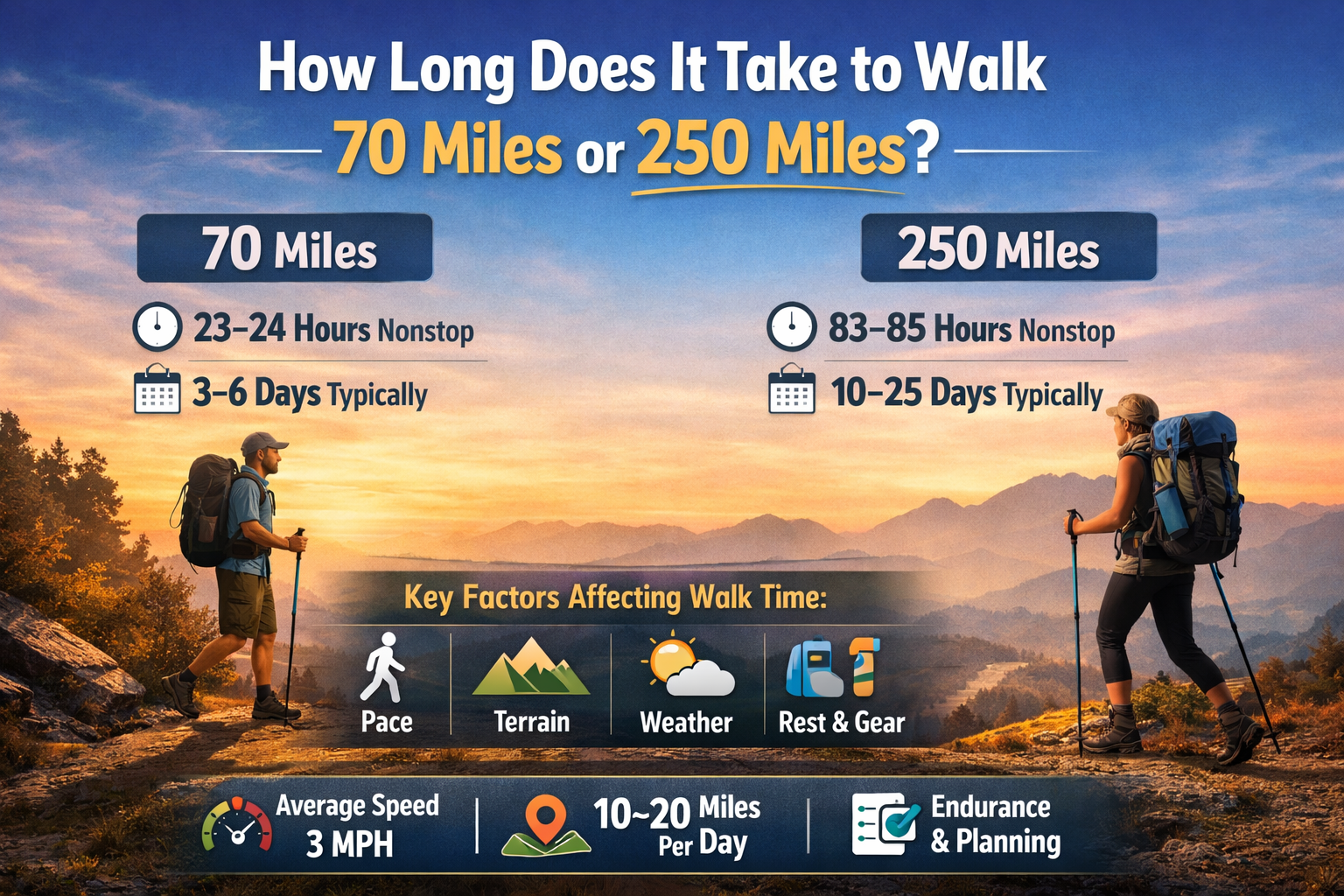
- 70 miles takes about 23–24 hours nonstop or 3–6 days realistically
- 250 miles takes about 83–85 hours nonstop or 10–25 days realistically
These estimates assume an average walking speed of 3 miles per hour (mph), which is standard for most adults.
Let’s break it down clearly so you can understand both the math and real-world expectations.
What Is the Average Walking Speed in Miles Per Hour?
The average walking speed for most people is about 3 mph (4.8 km/h).
This is the baseline used for most walking time estimates.
Typical walking speeds:
- Slow pace: 2 mph
- Average pace: 3 mph
- Fast pace: 4 mph
What this means:
- At 3 mph → you walk 3 miles every hour
- At 4 mph → you walk 4 miles every hour
Important: Long distances usually slow you down due to fatigue, so real-world speeds often drop below 3 mph over time.
How Long Does It Take to Walk 70 Miles?
How many hours does it take to walk 70 miles nonstop?
It takes about 23–24 hours to walk 70 miles nonstop at 3 mph.
Calculation:
- 70 ÷ 3 = 23.3 hours
Variations:
- At 2 mph → 35 hours
- At 4 mph → 17.5 hours
Explanation:
This assumes no sleep and minimal breaks, which is physically very demanding and unrealistic for most people.
How many days does it take to walk 70 miles realistically?
Most people will take 3 to 6 days to walk 70 miles.
Typical daily walking ranges:
- Beginner: 10–15 miles/day → 5–7 days
- Moderate walker: 15–20 miles/day → 3–5 days
- Experienced walker: 20–30 miles/day → 2–3 days
Example:
- 15 miles/day → 70 ÷ 15 = ~5 days
Real-world insight:
Fatigue, soreness, and recovery time make multi-day walking much slower than theoretical calculations.
How Long Does It Take to Walk 250 Miles?
How many hours does it take to walk 250 miles nonstop?
It takes about 83–85 hours to walk 250 miles nonstop at 3 mph.
Calculation:
- 250 ÷ 3 = 83.3 hours
Variations:
- At 2 mph → 125 hours
- At 4 mph → 62.5 hours
Important:
Walking nonstop for this long is nearly impossible without extreme endurance training.
How many days does it take to walk 250 miles realistically?
Most people will take 10 to 25 days to walk 250 miles.
Typical scenarios:
- 10 miles/day → 25 days
- 15 miles/day → 16–17 days
- 20 miles/day → 12–13 days
- 25 miles/day → 10 days
Example:
- 15 miles/day → 250 ÷ 15 = ~17 days
Real-world insight:
Long-distance walkers (like thru-hikers) often average 15–20 miles per day with rest days included.
What Factors Change How Long It Takes to Walk Long Distances?
Walking time varies widely based on physical and environmental factors.
Key factors:
1. Fitness level
- Trained walkers maintain a faster pace longer
- Beginners slow down quickly
2. Terrain
- Flat roads → faster
- Hills or trails → slower
- Sand or mud → much slower
3. Breaks and rest
- Frequent breaks increase total time
- Multi-day walks require recovery
4. Weather conditions
- Heat → fatigue and dehydration
- Cold → slower movement
- Rain → difficult terrain
5. Load (backpack weight)
- Heavy packs reduce speed significantly
6. Injury and fatigue
- Blisters, muscle soreness, and joint pain all reduce pace
How Do Walking Speed and Time Compare for 70 vs 250 Miles?
| Distance | 2 mph | 3 mph | 4 mph |
|---|---|---|---|
| 70 miles | 35 hrs | 23.3 hrs | 17.5 hrs |
| 250 miles | 125 hrs | 83.3 hrs | 62.5 hrs |
Key insight:
Time increases linearly, but fatigue increases exponentially, making longer distances disproportionately harder.
How Many Miles Can a Person Walk in a Day?
Most people can walk 10 to 20 miles per day comfortably.
General ranges:
- Beginner: 8–12 miles/day
- Average: 12–18 miles/day
- Fit walker: 15–25 miles/day
- Elite hikers: 25–35+ miles/day
Important:
Walking 20+ miles daily requires conditioning and proper recovery.
What Is a Realistic Plan for Walking 70 or 250 Miles?
A realistic plan spreads the distance across multiple days with rest and recovery.
For 70 miles:
- 15 miles/day → 5 days
- Include 1 rest day if needed
For 250 miles:
- 15 miles/day → ~17 days
- Add rest days every 5–7 days
Tips:
- Start slow and build pace
- Stay hydrated
- Wear proper footwear
- Track your distance daily
What Are Common Mistakes When Estimating Walking Time?
Most people underestimate how long long-distance walking actually takes.
Common mistakes:
- Ignoring fatigue buildup
- Assuming constant speed
- Not accounting for breaks
- Overestimating daily mileage
- Ignoring terrain difficulty
Reality check:
Walking speed decreases significantly after several hours or days.
Key Takeaways About Walking Long Distances
- 70 miles takes ~1 day nonstop or 3–6 days realistically
- 250 miles takes ~3.5 days nonstop or 10–25 days realistically
- The average walking speed is 3 mph
- Most people walk 10–20 miles per day
- Terrain, fitness, and breaks greatly affect time
FAQs About Walking 70 and 250 Miles
How long does it take to walk 70 miles at 3 mph?
About 23–24 hours nonstop, or 3–6 days with normal daily walking.
Can you walk 250 miles in a week?
Only if you walk 35+ miles per day, which is extremely difficult and requires high fitness.
What is the fastest someone can walk 250 miles?
Elite endurance walkers can do it in 7–10 days, depending on conditions.
Is walking 70 miles in one day possible?
Yes, but it requires extreme endurance and is not typical for most people.
How many miles can a beginner walk per day?
Most beginners can handle 8–12 miles per day comfortably.
Does walking speed decrease over long distances?
Yes, fatigue, soreness, and terrain typically slow you down over time.
How many hours should you walk per day on a long trip?
Most people walk 6–10 hours per day during multi-day journeys.
Conclusion
Walking 70 or 250 miles is less about simple math and more about endurance, planning, and pacing. While calculations give you a baseline, real-world conditions always extend the timeline.
If you’re planning such a journey, focus on consistency rather than speed—and your body will thank you.