
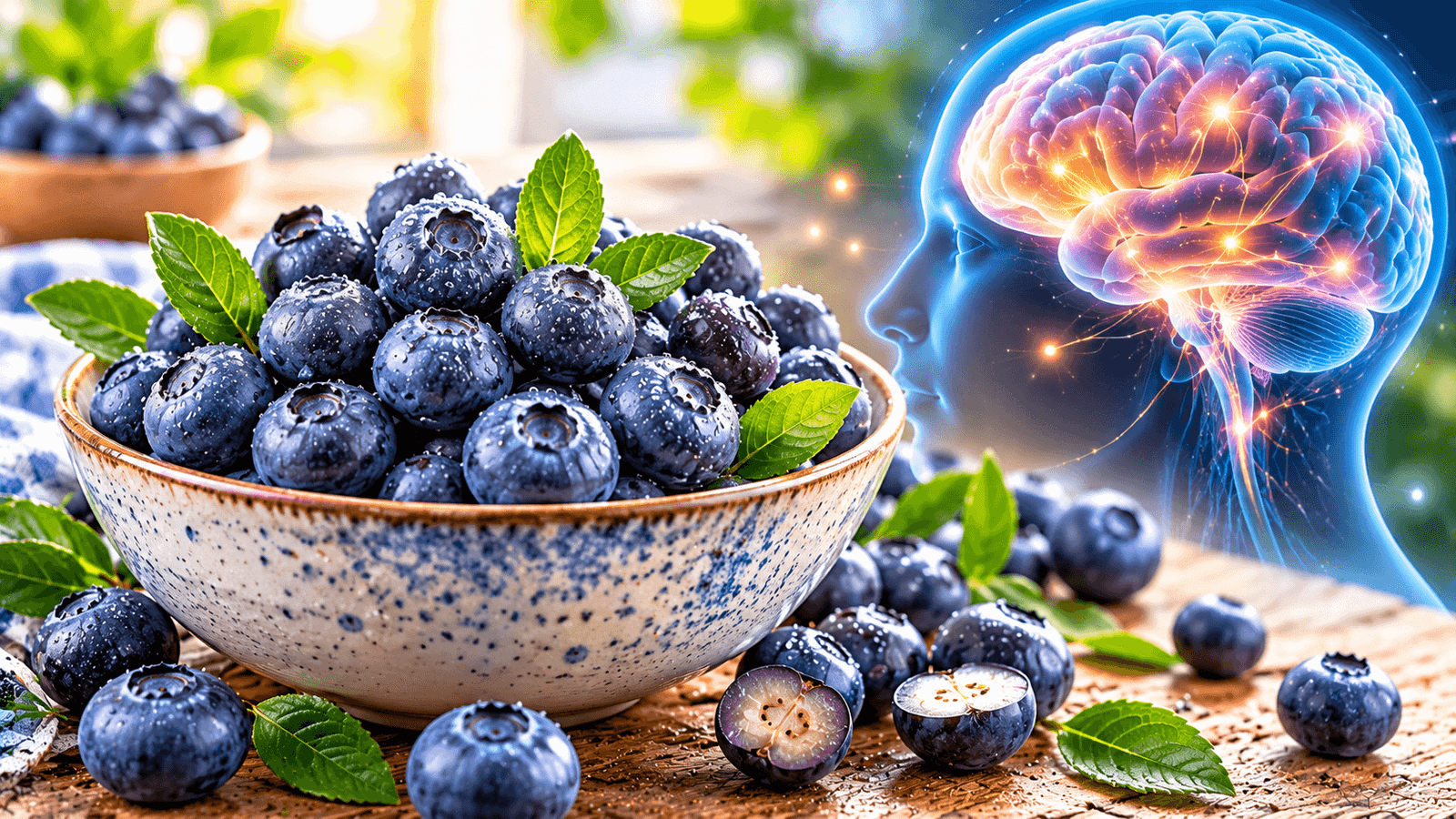
Why Might Blueberries Help Your Memory?
Blueberries are rich in anthocyanins, a group of naturally occurring plant pigments belonging to the flavonoid family. These compounds give blueberries their distinctive blue-purple color and have attracted researchers’ attention for their potential effects on brain health.
Scientists are investigating several possible explanations for their cognitive benefits.
1. They May Help Protect Brain Cells From Oxidative Stress
Your brain uses a considerable amount of energy, making it vulnerable to oxidative stress, a process involving reactive molecules that can damage cells.
Blueberries contain anthocyanins and other polyphenols that have antioxidant properties. Laboratory research suggests these compounds may influence the body’s antioxidant defenses and cellular signaling.
However, eating blueberries doesn’t mean their antioxidants travel directly to your brain and immediately improve memory. Human biology is more complicated, and researchers are still investigating how blueberry compounds and their metabolites affect brain function.
2. They May Support Healthy Blood Vessel Function
Good circulation matters for brain health because blood delivers oxygen and nutrients to brain tissue.
Some clinical research suggests blueberry polyphenols can improve how blood vessels respond and relax. Scientists believe vascular health could be one pathway linking blueberries with cognitive performance.
Still, better blood vessel function doesn’t automatically mean better memory. The relationship requires further investigation.
3. They May Influence Inflammation and Brain Signaling
Chronic inflammation and changes in communication between nerve cells are among the processes researchers study in relation to cognitive aging.
Anthocyanins and their metabolites may influence inflammatory pathways and cellular signaling involved in learning and memory.
Much of the detailed evidence for these mechanisms comes from laboratory and animal studies. Whether these effects translate into meaningful, long-term memory improvements in humans remains uncertain.
What Does Research Say About Blueberries and Memory?
The most interesting evidence comes from clinical trials involving older adults, particularly those experiencing mild cognitive difficulties.
A 2023 Study Found Improvements in Certain Cognitive Tests
In a randomized controlled trial published in The American Journal of Clinical Nutrition, researchers studied 61 healthy adults aged 65 to 80.
Participants consumed either wild blueberry powder or a placebo daily for 12 weeks. The blueberry powder was equivalent to approximately 178 grams of fresh blueberries.
Compared with the placebo group, participants receiving blueberries showed improvements in immediate verbal recall and accuracy on a task-switching test. Researchers also observed improvements in certain measures of vascular function.
These findings were encouraging, but the trial was relatively small. It also doesn’t establish that blueberries can prevent memory loss over many years.
A 2025 Review Found Benefits for Episodic Memory
A systematic review and meta-analysis published in Biogerontology examined nine randomized controlled trials involving 513 participants.
The researchers reported a statistically significant improvement in episodic memory among older adults with mild cognitive impairment or subjective cognitive decline.
Episodic memory is your ability to remember personal experiences and events, such as what you ate yesterday or a conversation you had last week.
However, the review did not find significant improvements in every cognitive area. Working memory, processing speed, recognition memory, and visuospatial learning did not show clear benefits.
That distinction matters: blueberries may support specific memory functions without improving every aspect of cognition.
Not Every Study Has Found a Memory Benefit
The evidence isn’t entirely positive.
A six-month randomized trial involving adults with metabolic syndrome found no strong overall improvements in cognitive function after blueberry supplementation.
Similarly, a broader review of anthocyanin trials found promising results in individual studies, but pooled results did not establish consistent improvements in several memory measures.
These mixed findings suggest that age, health status, study duration, blueberry dose, and the type of memory test may influence the results.
How Many Blueberries Should You Eat for Memory?
About ½ to 1 cup of blueberries a day is a practical amount to include in a balanced diet, although scientists haven’t established a specific daily serving that reliably improves memory.
A cup of fresh blueberries contains approximately 84 calories and provides fiber, vitamin C, vitamin K, manganese, and various polyphenols.
Some clinical trials have used blueberry powders equivalent to roughly one or two cups of fresh berries. Others have tested different amounts and preparations.
The important point is that research doses are not the same as an established medical recommendation.
You don’t need to eat an unusually large amount of blueberries to enjoy their nutritional benefits.
Are Fresh or Frozen Blueberries Better for Brain Health?
Both fresh and frozen blueberries can be nutritious choices.
Fresh blueberries are convenient for snacking, while frozen berries are often more affordable and available year-round. Freezing generally preserves many of the berries’ nutrients and polyphenols, although amounts can vary with storage and processing.
Choose plain frozen blueberries without added sugar when possible.
Blueberry juice, sweetened dried blueberries, and blueberry-flavored products aren’t necessarily nutritionally equivalent to whole berries. Some contain added sugar, and juice typically provides less fiber.
For everyday eating, whole fresh or frozen blueberries are excellent options.
Can Blueberries Prevent Dementia or Alzheimer’s Disease?
No scientific evidence currently proves that eating blueberries prevents Alzheimer’s disease or dementia.
Although researchers have found encouraging results for certain memory tests, improvements in short-term cognitive performance are not the same as preventing a progressive neurological disease.
Alzheimer’s disease involves complex biological changes that cannot be addressed by a single food.
The National Institute on Aging emphasizes that no individual food has been proven to prevent Alzheimer’s disease or age-related cognitive decline.
Blueberries can be part of a brain-supportive eating pattern, but they should not replace medical evaluation or treatment for persistent memory problems.
What Is the Best Way to Eat Blueberries for Brain Health?
The best approach is to eat blueberries regularly as part of a varied, nutritious diet rather than treating them like a memory supplement.
Here are a few simple ideas:
With Greek yogurt: Combine blueberries with plain Greek yogurt for protein, fiber, and a naturally sweet breakfast or snack.
In oatmeal: Stir blueberries into oatmeal with walnuts for a combination of whole grains, fruit, and healthy fats.
In a smoothie: Blend frozen blueberries with milk or unsweetened yogurt. Keep the whole fruit rather than straining out the fiber.
With nuts: Pair fresh blueberries with a small handful of walnuts or almonds for a satisfying snack.
Straight from the bowl: Rinse fresh blueberries and enjoy them on their own.
Consistency and overall dietary quality matter more than any special blueberry recipe.
Frequently Asked Questions
Do blueberries improve short-term memory?
Some studies have reported improvements in particular memory tasks after blueberry consumption, but results are inconsistent. Current research does not show that blueberries reliably improve short-term memory in everyone.
Are blueberries good for memory after age 60?
They may offer benefits for certain older adults. Clinical trials involving people over 60 have reported improvements in specific measures of recall and executive function. Larger, longer studies are needed to determine whether these improvements last.
How long does it take for blueberries to improve memory?
Some experiments have examined cognitive performance within hours of consuming blueberries, while others have studied daily intake over several weeks or months. There is no established timeline for a noticeable memory improvement.
Are wild blueberries better for memory than regular blueberries?
Wild blueberries can be rich in anthocyanins, and several clinical trials have studied them. However, research has not established that wild blueberries consistently improve memory more than cultivated blueberries when consumed in comparable amounts.
Can you eat blueberries every day?
Yes. For most people, blueberries can be enjoyed daily as part of a balanced diet. A serving of ½ to 1 cup is an easy way to add fruit, fiber, and beneficial plant compounds to your meals.
The Bottom Line
Blueberries are a nutritious fruit with promising, but not conclusive, evidence for memory benefits.
Their anthocyanins and other polyphenols may influence pathways related to vascular health, inflammation, and cognitive function. Some studies have found improvements in recall and episodic memory, especially among older adults, while others have reported little or no effect.
Eating blueberries regularly is a reasonable dietary choice, but they aren’t a guaranteed memory booster or a proven way to prevent dementia.
Enjoy them for their flavor, nutrients, and potential benefits—and remember that overall diet, physical activity, sleep, and cardiovascular health are also important for keeping your brain healthy as you age.
References
American Journal of Clinical Nutrition (2023) – Research on blueberries, memory, and brain function in older adults. Read Study
Biogerontology (2025) – A review of clinical trials examining blueberries and memory improvement. Read Study
National Institutes of Health (NIH) – Scientific guidance on diet, brain health, and Alzheimer’s prevention. Read More
National Library of Medicine (2024) – Clinical research on blueberry consumption and cognitive health. Read Study
USDA FoodData Central – Nutritional information about blueberries, including calories, vitamins, and fiber. View Source






One Response