
Does Walking in Place Count as Steps?
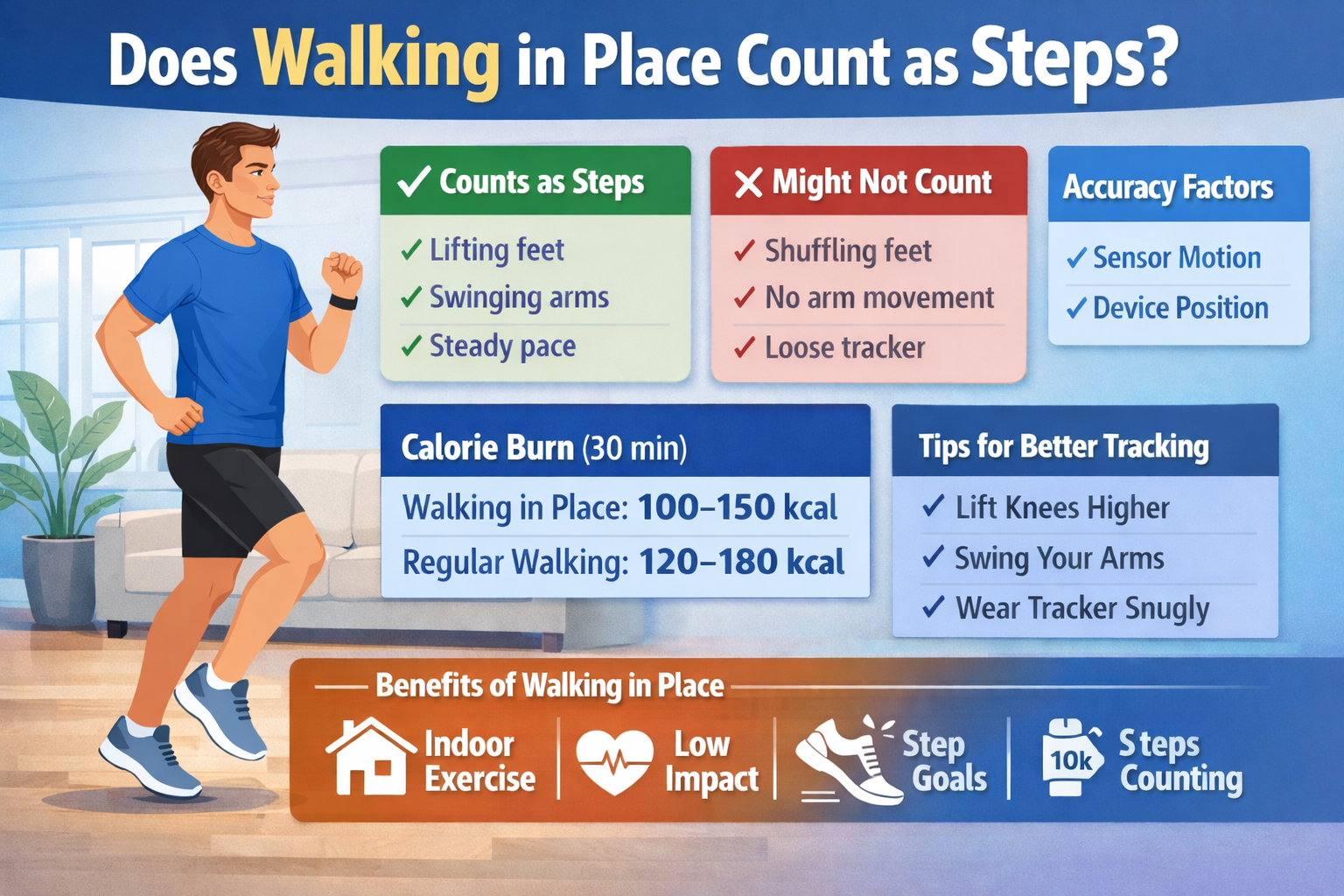
Yes, walking in place does count as steps on most fitness trackers and smartphones—as long as the movement mimics real walking.
Devices detect motion patterns, not location, so stepping in place can still register as steps if your body moves naturally.
However, accuracy depends on how you move, how your device is worn, and the sensitivity of the tracker.
Walking in place matters because it offers a simple way to stay active indoors, especially for people with limited space, bad weather, or sedentary routines.
Learn More: 10 Proven Benefits of Walking Every Day (Backed by Science)
Does walking in place count as steps on fitness trackers?
Yes, walking in place usually counts as steps because fitness trackers measure motion patterns, not distance traveled.
Most devices use sensors (accelerometers) to detect rhythmic movement similar to walking.
When does walking in place get counted correctly?
Walking in place is counted accurately when your movement closely resembles natural walking.
It works best when:
- You lift your feet clearly off the ground
- You swing your arms naturally
- You maintain a steady rhythm (cadence)
- The device is worn on your wrist or hip
Example: Marching in place with arm movement is often tracked just like normal walking.
When might walking in place not count?
Walking in place may not register properly if the movement is too subtle or unnatural.
Common issues:
- Minimal foot lift (shuffling)
- No arm movement (especially for wrist trackers)
- Holding onto something (like a desk or treadmill rail)
- Device worn loosely or incorrectly
How do step counters detect steps in the first place?
Fitness trackers count steps using motion sensors like accelerometers and gyroscopes.
These sensors detect:
- Repetitive up-and-down motion
- Forward/backward acceleration
- Rhythm patterns similar to walking
According to general guidance from health organizations like the Centers for Disease Control and Prevention, step tracking is an estimate of movement, not a perfect measurement of distance or effort.
Key point:
Step counters don’t need you to move forward—they only need consistent motion patterns.
Is walking in place as effective as regular walking?
Yes, walking in place can be effective, but it is usually slightly less beneficial than regular walking outdoors.
Both activities improve:
- Circulation
- Daily movement levels
- Calorie burn
- Cardiovascular health (if done consistently)
However, regular walking often provides:
- More muscle engagement (due to terrain and forward motion)
- Better balance and coordination
- Higher overall intensity
How many calories does walking in place burn compared to walking?
Walking in place burns calories, but usually slightly fewer than walking at the same speed over a distance.
Comparison table
| Activity | Estimated Calories Burned (30 min)* | Notes |
|---|---|---|
| Walking in place | 100–150 kcal | Depends on intensity |
| Walking (moderate pace) | 120–180 kcal | More consistent movement |
| Brisk walking | 180–250 kcal | Higher intensity |
*Estimates vary based on weight, age, and intensity. Source ranges align with general physical activity guidance from the Mayo Clinic.
Insight:
The faster and more dynamic your movement, the closer walking in place gets to real walking in calorie burn.
When is walking in place a good alternative?
Walking in place is a practical and effective alternative when traditional walking isn’t possible.
Best use cases:
- Bad weather (rain, heat, pollution)
- Limited indoor space
- Desk breaks during work
- Watching TV or multitasking
- Rehabilitation or low-impact exercise
It also supports NEAT (Non-Exercise Activity Thermogenesis), which helps reduce sedentary time.
How can you make sure walking in place counts as steps?
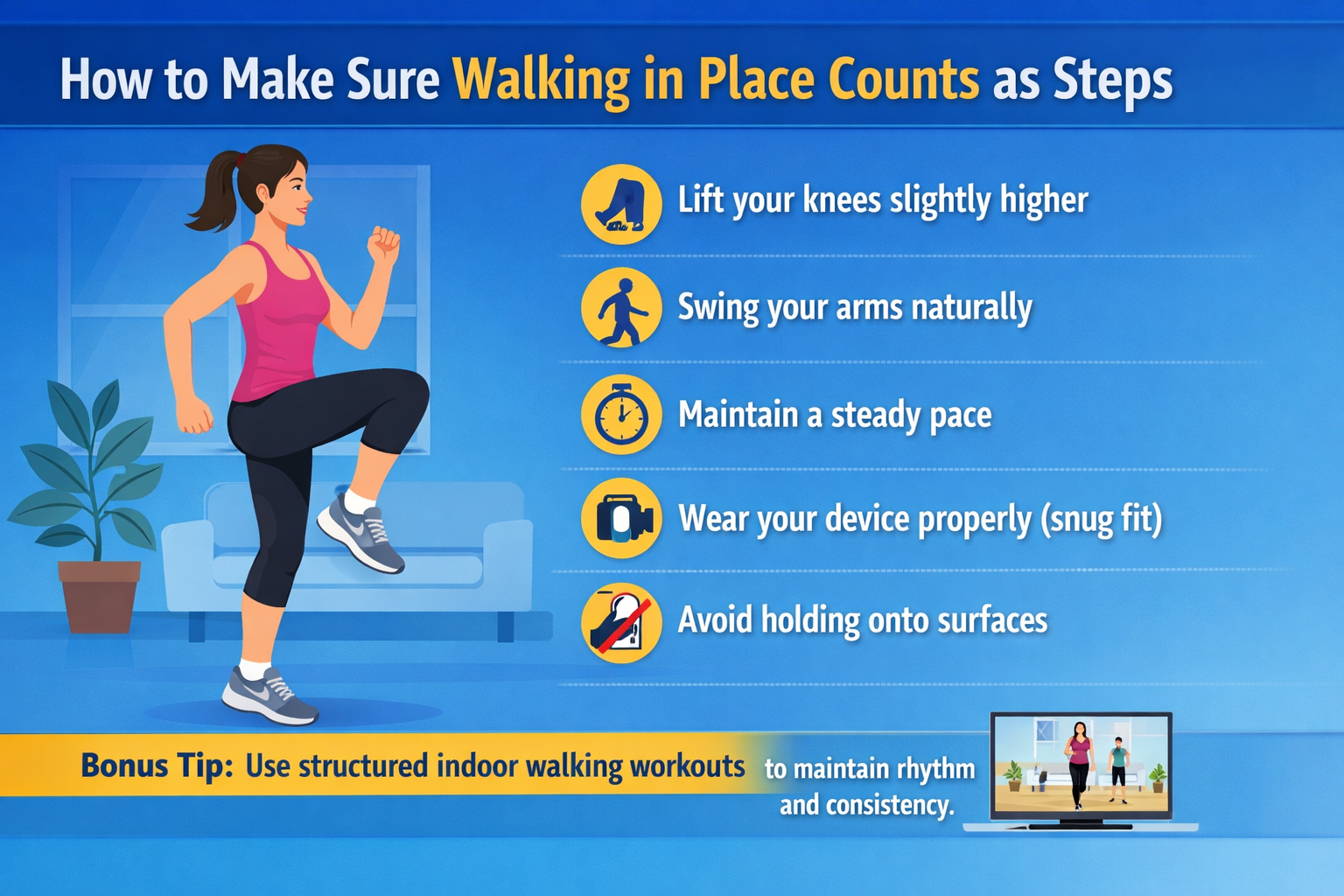
To ensure your steps are tracked accurately, you need to mimic real walking as closely as possible.
Best practices:
- Lift your knees slightly higher
- Swing your arms naturally
- Maintain a steady pace
- Wear your device properly (snug fit)
- Avoid holding onto surfaces
Bonus tip:
Use structured indoor walking workouts to maintain rhythm and consistency.
What are common mistakes when counting steps indoors?
Many people overestimate or underestimate steps due to incorrect movement.
Common mistakes:
- Shuffling feet without lifting
- Standing and shifting weight (not real steps)
- Assuming all movement counts as steps
- Ignoring device placement
Reality check:
Not all movement equals steps—trackers look for specific motion patterns.
What is the difference between walking in place and real walking?
Walking in place and real walking share similarities but differ in key ways.
| Factor | Walking in Place | Real Walking |
|---|---|---|
| Movement direction | Stationary | Forward motion |
| Muscle engagement | Moderate | Higher |
| Balance challenge | Low | Higher |
| Step tracking | Usually accurate | Highly accurate |
| Outdoor benefits | None | Sunlight, environment |
Conclusion:
Walking in place is a useful substitute, but not a complete replacement for outdoor walking.
What are the key takeaways about walking in place and step counts?
- Yes, walking in place does count as steps if the movement is natural
- Fitness trackers rely on motion, not distance
- Accuracy depends on arm movement and rhythm
- It’s a good indoor alternative, but slightly less effective than real walking
- Consistency matters more than perfection
FAQs about walking in place and step tracking
Does marching in place count as steps?
Yes, marching in place usually counts as steps because it mimics a walking motion.
Why is my smartwatch not counting steps when I walk in place?
Your movement may be too subtle, or your arms may not be moving enough.
Is walking in place good for weight loss?
Yes, it can support weight loss when combined with a calorie deficit and regular activity.
Can I reach 10,000 steps by walking in place?
Yes, you can reach step goals indoors if your movement is consistent and tracked correctly.
Does walking in place improve fitness?
Yes, especially for beginners or sedentary individuals, it increases daily activity levels.
Is walking in place better than sitting?
Yes, it significantly improves circulation and calorie burn compared to sitting.
Do all fitness trackers count steps the same way?
No, different devices use different algorithms, so results may vary slightly.
Conclusion
Walking in place is a simple, accessible way to stay active—and yes, it counts as steps in most cases.
While it may not fully replace outdoor walking, it’s a powerful tool for maintaining daily movement, especially in indoor or restricted environments.