Table of Contents
ToggleWhat Is Protein and Why Does Your Body Need It?
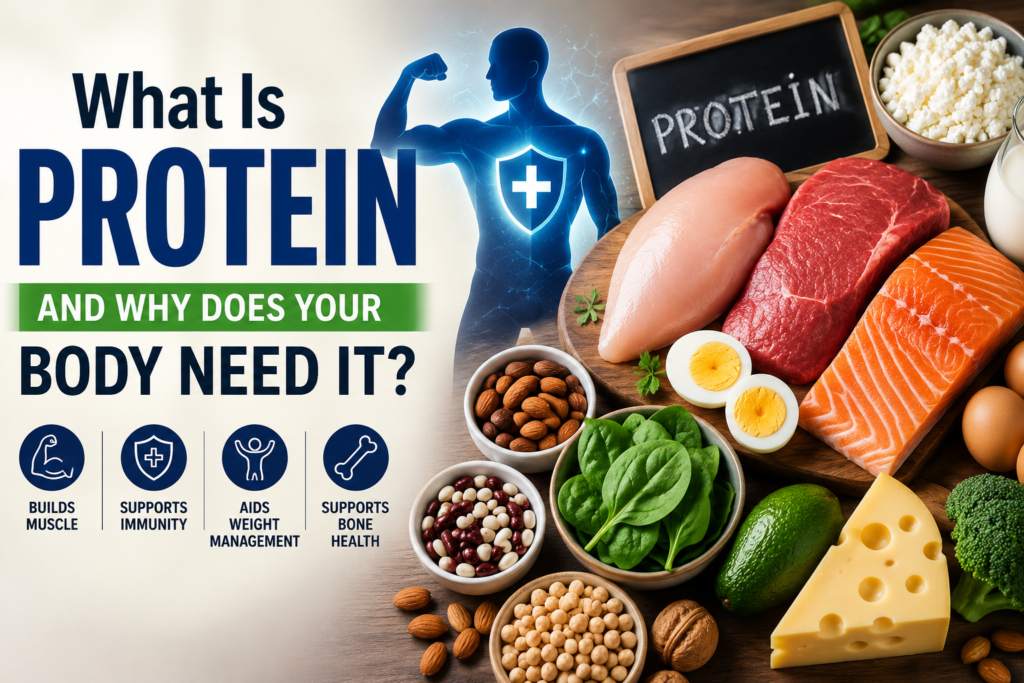
Protein is an essential macronutrient made from smaller units called amino acids. The body uses proteins to build and repair tissues, create enzymes and antibodies, transport substances, send cellular signals, and maintain the structure and function of organs.
Protein is not only a “muscle nutrient.” Proteins perform much of the work inside cells and are involved in nearly every major biological process. Every cell in the human body contains protein.
Dietary protein comes from foods such as fish, eggs, meat, milk, yoghurt, beans, lentils, soy foods, nuts and seeds. A well-planned diet can provide enough protein from animal foods, plant foods or a combination of both.
What Is Protein in Simple Terms?
Protein is a nutrient your body breaks down into amino acids and then uses to build, maintain and repair itself.
A useful way to think about protein is to imagine a long necklace. The complete necklace represents a protein, while each bead represents an amino acid. Different numbers, types and arrangements of amino acids create proteins with different structures and jobs.
Protein is one of the three main macronutrients:
- Protein
- Carbohydrate
- Fat
The term macronutrient means the body needs the nutrient in relatively large quantities. One gram of protein provides approximately four calories of energy.
What Is the Difference Between Dietary Protein and Body Protein?
Dietary protein is the protein present in food, while body proteins are the working and structural molecules created by cells.
When you eat protein, the body does not normally move the food protein directly into your muscles. Digestion breaks it into amino acids. The body absorbs those amino acids and rearranges them to create the specific proteins it needs.
Examples of body proteins include:
- Collagen in connective tissue
- Actin in muscle and other cells
- Antibodies used by the immune system
- Enzymes that control chemical reactions
- Ferritin, which stores iron
- Some hormones that transmit biological signals
Protein structure matters. The order of amino acids determines how a protein folds into its three-dimensional shape, and that shape influences what the protein can do.
What Are Amino Acids?
Amino acids are small molecules that join together to form proteins. After dietary protein is digested, amino acids are absorbed and used for growth, tissue repair, and many other body functions.
Twenty common amino acids are used to create human proteins. Nutrition professionals usually group amino acids into three categories:
| Amino-acid category | What it means | Dietary significance |
|---|---|---|
| Essential | The body cannot make enough of them | They must come from food |
| Nonessential | The body can normally make them | They do not have to be obtained directly from every meal |
| Conditionally essential | Usually made by the body but may be needed in greater amounts during illness or stress | Requirements can change under specific conditions |
Which Amino Acids Are Essential?
Nine amino acids are considered essential for humans because the body cannot produce enough of them.
They are:
- Histidine
- Isoleucine
- Leucine
- Lysine
- Methionine
- Phenylalanine
- Threonine
- Tryptophan
- Valine
These amino acids must be supplied through the overall diet. They do not all have to come from a single food or be consumed together at every meal.
What Are Nonessential and Conditionally Essential Amino Acids?
Nonessential amino acids can normally be produced by the body, while conditionally essential amino acids may become more important during illness, injury or physiological stress.
The word nonessential does not mean unimportant. It only means the body can normally manufacture the amino acid rather than depending entirely on food.
Conditionally essential amino acids include amino acids such as glutamine and arginine. Under certain medical or metabolic conditions, the body’s production may not fully match its needs.
What Does Protein Do in the Body?
Protein builds and repairs tissues, but it also supports immunity, metabolism, communication, movement and transport throughout the body.
Different proteins have different functions because their amino-acid sequences and three-dimensional structures are different.
| Protein function | What the protein does | Example |
| Growth and repair | Helps make and renew cells and tissues | Proteins used in muscle, skin and organs |
| Structural support | Gives cells and tissues shape and strength | Collagen and actin |
| Enzyme activity | Speeds up chemical reactions | Digestive and metabolic enzymes |
| Immune defence | Recognises and binds to harmful particles | Antibodies |
| Communication | Carries signals between cells and organs | Some hormones and receptors |
| Transport and storage | Moves or stores molecules | Ferritin and transport proteins |
| Movement | Supports muscular and cellular movement | Actin and myosin |
| Energy | Provides four calories per gram when used for energy | Dietary protein |
MedlinePlus explains that proteins are required for the structure, function, and regulation of tissues and organs. Protein molecules can act as antibodies, enzymes, messengers, structural components, and transport or storage molecules.
How Does the Body Digest and Use Protein?
The digestive system breaks dietary protein into amino acids, which are absorbed through the small intestine and carried in the blood to tissues throughout the body.
The basic process is:
- You eat a protein-containing food.
- Digestion breaks the food protein into smaller peptides and amino acids.
- The small intestine absorbs the amino acids.
- The bloodstream transports the amino acids around the body.
- Cells use them to build the proteins required for repair, growth, enzymes, signalling and other functions.
The body can also use amino acids as an energy source. However, the main value of dietary protein is supplying the nitrogen and amino-acid building blocks required to create and maintain body proteins.
How Much Protein Do You Need Each Day?
A common baseline recommendation for healthy adults is approximately 0.8 grams of protein per kilogram of body weight per day.
The US National Academies uses 0.8 grams per kilogram as the adult Recommended Dietary Allowance. The European Food Safety Authority sets a closely comparable adult Population Reference Intake of 0.83 grams per kilogram per day. These figures are general population reference values, not personalised targets for every medical, athletic or life-stage situation.
How Can You Calculate Your Basic Protein Requirement?
Use this formula:
Body weight in kilograms × 0.8 = approximate grams of protein per day
| Body weight | Baseline calculation | Approximate protein |
| 50 kg | 50 × 0.8 | 40 g |
| 60 kg | 60 × 0.8 | 48 g |
| 70 kg | 70 × 0.8 | 56 g |
| 80 kg | 80 × 0.8 | 64 g |
| 90 kg | 90 × 0.8 | 72 g |
| 100 kg | 100 × 0.8 | 80 g |
For example, a healthy adult weighing 70 kilograms would have a basic reference intake of approximately 56 grams per day.
This calculation is a starting point. Protein requirements may change according to age, body composition, activity, pregnancy, recovery, illness and medical conditions.
Protein can also be expressed as a percentage of energy intake. MedlinePlus notes that protein may provide approximately 10% to 35% of an adult’s daily calories, although that broad range should not replace an individual assessment.
Who May Need a Different Amount of Protein?
Children, pregnant people, athletes, older adults, and people recovering from illness or surgery may have requirements that differ from the standard adult reference value.
Protein needs can be influenced by:
- Growth and development
- Pregnancy
- Resistance training
- High levels of physical activity
- Older age
- Injury or surgery
- Undernutrition
- Cancer treatment
- Kidney disease
- Dialysis
- Other medical conditions
A 2022 systematic review and meta-analysis found that increasing protein intake can produce modest additional improvements in lean body mass, particularly when protein intake is combined with resistance exercise. Protein alone, however, is not a substitute for training.
Anyone managing a medical condition should receive individual advice from a doctor or registered dietitian rather than applying a general online formula.
Which Foods Are High in Protein?
Protein is found in both animal and plant foods, including fish, meat, eggs, dairy products, beans, lentils, soy, nuts and seeds.
The protein content of a food depends on the product, serving size, brand and preparation method. The following figures are approximate:
| Food | Example serving | Approximate protein |
| Chicken | 100–120 g | 25–30 g |
| Salmon or mackerel | 100–140 g | 21–30 g |
| Canned tuna | 60 g | 15–20 g |
| Eggs | 2 large eggs | 15 g |
| Milk | 200 ml | 7 g |
| Yoghurt | 120–150 g | 5–7 g |
| Cheddar cheese | 30 g | 8 g |
| Lentils, chickpeas or kidney beans | 120 g | 10 g |
| Tofu | 80 g | About 6.5 g |
| Soya milk | 200 ml | About 6 g |
| Mixed nuts or seeds | 28 g | About 7 g |
| Nut butter | 20 g | About 4.5 g |
These values are adapted from a 2025 NHS protein guide and should be treated as estimates. Nutrition labels provide the most accurate information for a specific product.
Which Animal Foods Provide Protein?
Common animal protein sources include fish, seafood, eggs, poultry, lean meat, milk, yoghurt and cheese.
These foods can also provide nutrients such as:
- Vitamin B12
- Iron
- Zinc
- Calcium
- Iodine
- Omega-3 fatty acids, depending on the food
The total nutritional value matters more than protein alone. For example, fish, skinless poultry and lean meat generally have a different fat and sodium profile from sausages, bacon and other processed meats.
The NHS recommends choosing lean cuts where possible, eating less red and processed meat, and including beans, pulses, fish, eggs and other protein foods as part of a balanced diet.
Which Plant Foods Provide Protein?
Beans, lentils, chickpeas, soy foods, peas, nuts, seeds and whole grains can all contribute meaningful amounts of protein.
Useful plant sources include:
- Lentils
- Chickpeas
- Kidney beans
- Black beans
- Peas
- Tofu
- Tempeh
- Edamame
- Soya milk
- Nuts
- Seeds
- Peanut butter
- Tahini
- Quinoa
- Oats
- Wholegrain bread
Plant protein foods often provide fibre and other nutrients alongside protein. Pulses such as beans, peas and lentils are especially useful because they contribute both protein and dietary fibre.
Current dietary guidance emphasises building eating patterns around whole, nutrient-dense foods rather than judging foods by one nutrient alone.
Is Plant Protein or Animal Protein Better?
Neither plant protein nor animal protein is automatically best for everyone. A protein source should be judged by its amino-acid contribution, digestibility and the complete nutritional package of the food.
Animal foods generally provide concentrated protein and all nine essential amino acids in proportions that meet human needs. Plant foods also contain essential amino acids, although the amount and proportion vary among foods.
| Factor | Animal protein foods | Plant protein foods |
| Essential amino acids | Usually provide all nine in favourable proportions | Proportions vary between foods |
| Protein concentration | Often relatively high | Varies considerably |
| Fibre | Usually little or none | Often contributes fibre |
| Saturated fat | Can be low or high depending on the food | Usually lower, although products vary |
| Other nutrients | May provide B12, iron, zinc, calcium or omega-3 | May provide fibre, folate, potassium and plant compounds |
| Healthy examples | Fish, eggs, yoghurt, lean poultry | Beans, lentils, tofu, nuts and seeds |
| Less desirable examples | Some processed and high-fat meats | Highly processed products high in salt or added fat |
The labels “complete” and “incomplete” can be oversimplified because they judge a single food in isolation. The British Dietetic Association notes that overall daily amino-acid intake matters more than whether each food independently provides every essential amino acid in ideal proportions.
Can Vegans Get Enough Protein?
Yes. A varied vegan diet that provides enough food and calories can supply sufficient protein and essential amino acids.
A practical vegan protein pattern can include:
- Beans or lentils
- Tofu, tempeh or edamame
- Soya milk or soya yoghurt
- Peas
- Nuts and seeds
- Whole grains
- Seitan, where suitable
- Nut or seed butters
The key is variety and adequate total intake. MedlinePlus states that animal products are not required to obtain enough dietary protein.
People with highly restrictive diets, food allergies, low appetite or increased medical needs may benefit from advice from a registered dietitian.
Must Plant Proteins Be Combined at Every Meal?
No. Plant proteins do not have to be carefully combined at every meal. Consuming varied protein foods across the day is generally sufficient.
For example, a person may eat oats and nuts at breakfast, chickpeas at lunch, and tofu with rice at dinner. The foods contribute to the day’s combined amino-acid intake.
MedlinePlus specifically notes that the balance across the whole day is more important than pairing complementary proteins at a single meal.
Does Protein Help Build Muscle?
Protein supplies the amino acids needed to repair and build muscle, but resistance exercise provides the main signal that encourages muscle adaptation.
Eating large quantities of protein without training does not automatically create larger muscles. Muscle development depends on several connected factors:
- Resistance exercise
- Sufficient protein
- Adequate total energy
- Training progression
- Recovery
- Sleep
- Age and health status
Research indicates that adding protein to an appropriate resistance-training programme can produce a modest additional improvement in lean body mass. The effect is influenced by a person’s existing intake, age, training programme and total diet.
For most recreational exercisers, consistently meeting daily needs and including protein-rich foods throughout the day is more important than obsessing over a narrow “anabolic window.”
Can Protein Support Weight Management?
Protein may support weight management by helping meals feel satisfying and by supporting lean tissue, but protein does not cause fat loss by itself.
Weight change is influenced by overall energy intake, activity, sleep, health, medications and eating behaviour. Adding protein to an existing diet without adjusting anything else can also add calories.
A practical weight-management meal combines:
- A suitable protein source
- Vegetables or fruit
- A fibre-rich carbohydrate
- An appropriate amount of fat
Examples include:
- Lentil curry with vegetables and brown rice
- Grilled fish with potatoes and salad
- Tofu with vegetables and noodles
- Eggs with wholegrain toast and fruit
- Yoghurt with oats, fruit and seeds
Protein can be useful, but the quality and balance of the complete meal remain important.
What Happens When You Do Not Get Enough Protein?
Persistently inadequate protein and energy intake can contribute to loss of muscle and strength, impaired growth, weakness and slower recovery.
Low protein intake often occurs as part of broader undernutrition rather than as an isolated problem. Possible causes include:
- Insufficient food intake
- A highly restrictive diet
- Poor appetite
- Difficulty chewing or swallowing
- Digestive or absorption disorders
- Chronic illness
- Increased needs during recovery
- Food insecurity
Possible warning signs of undernutrition include:
- Unintentional weight loss
- Weakness
- Persistent tiredness
- Loss of muscle strength
- Reduced appetite
- Frequent illness
- Slow recovery
- Poor growth or inadequate weight gain in children
The NHS identifies unintentional weight loss, weakness, tiredness, frequent illness and delayed recovery as important signs of malnutrition. The World Health Organization defines malnutrition as deficiencies, excesses or imbalances in nutrient intake or use.
These symptoms are not specific to protein deficiency and may have many causes. Anyone experiencing unexplained weight loss or persistent weakness should seek medical advice.
Can You Eat Too Much Protein?
More protein is not automatically better, and very high-protein diets are not appropriate for everyone.
A poorly planned high-protein diet may:
- Add more calories than a person needs
- Replace fruit, vegetables or whole grains
- Reduce dietary fibre
- Rely heavily on processed meats
- Provide excessive saturated fat or sodium
- Create difficulties for people with certain kidney conditions
The source matters. Eating more beans, fish or plain yoghurt is nutritionally different from increasing processed meat, fried foods or highly sweetened protein products.
People with chronic kidney disease require individual guidance. The National Kidney Foundation explains that people with kidney disease who are not receiving dialysis may be advised to limit protein, while people receiving dialysis may need more. The correct amount depends on kidney function, body size, nutritional status, and treatment.
Do not start a restrictive low-protein or very-high-protein diet for kidney disease without professional supervision.
Do You Need Protein Powder?
Most people do not need protein powder if they can meet their requirements through ordinary food. Protein powder is a convenient supplement, not an essential food group.
A powder may be useful when someone:
- Has difficulty eating enough food
- Has limited time to prepare meals
- Has high requirements
- Has a poor appetite
- Is recovering under professional guidance
- Needs a portable protein option
- Follows a diet that makes requirements difficult to meet
Whole foods often provide additional nutrients that isolated powders do not, including fibre, vitamins, minerals and healthy fats.
When choosing a protein product:
- Check the protein content per serving.
- Read the full ingredient list.
- Check added sugar and sodium.
- Consider milk, soy or other allergens.
- Avoid products making disease-treatment claims.
- Check whether independent testing can be verified.
- Discuss regular supplement use with a healthcare professional when taking medication or managing a medical condition.
Supplement regulation varies by country. In the United States, the FDA does not approve dietary supplements before they are sold. Manufacturers are responsible for product safety and truthful labelling, while regulators can act against unsafe or misleading products after they enter the market.
Competitive athletes should verify third-party certification through the certifier’s database rather than trusting a logo printed on the packaging.
What Are the Most Common Protein Myths?
Myth 1: Protein Is Only Needed for Muscle
Fact: Protein also forms enzymes, antibodies, transport proteins, structural tissues and biological messengers.
Myth 2: Only Meat Contains Protein
Fact: Beans, lentils, chickpeas, tofu, soy milk, nuts, seeds and grains all contribute protein.
Myth 3: Vegans Cannot Get Enough Protein
Fact: A varied plant-based diet that supplies enough food can meet protein and essential amino-acid requirements.
Myth 4: Rice and Beans Must Be Eaten Together
Fact: Complementary plant foods do not have to be consumed in the same meal. Overall intake across the day is more important.
Myth 5: More Protein Always Means More Muscle
Fact: Protein supports muscle development, but training provides the primary stimulus. Extra protein has diminishing value when intake is already sufficient.
Myth 6: Protein Powder Is Better Than Food
Fact: Powder can be convenient, but it is not inherently superior. Ordinary foods can provide protein along with a wider range of nutrients.
What Is the Key Takeaway About Protein?
Protein is an essential macronutrient made from amino acids, and it supports nearly every part of the body—not just muscle.
Remember these key points:
- Protein helps build, maintain, and repair tissues.
- Proteins also function as enzymes, antibodies, messengers and transport molecules.
- Nine amino acids must be supplied through food.
- Both plant and animal foods can provide protein.
- Healthy adults commonly use 0.8 grams per kilogram as a baseline reference.
- Individual needs can vary substantially.
- A varied plant-based diet can provide sufficient protein.
- Protein powder is optional rather than essential.
- The complete food and overall diet matter more than protein quantity alone.
What Questions Do People Ask About Protein?
Is protein a vitamin?
No. Protein is a macronutrient, while vitamins are micronutrients needed in much smaller quantities.
Is protein only found in meat?
No. Protein is also found in fish, eggs, dairy products, beans, lentils, tofu, soy, nuts, seeds and grains.
How much protein does an egg contain?
Two large eggs provide approximately 15 grams of protein, although the exact amount varies with egg size.
Does protein turn into muscle?
Not directly. Protein is digested into amino acids, which the body may use to repair and build muscle when supported by resistance exercise, adequate energy, and recovery.
Can the body use plant protein?
Yes. The body digests plant proteins into amino acids and can use those amino acids to make body proteins. Variety across the day helps provide an appropriate amino-acid balance.
Is protein powder safe?
Many people use protein powder without problems, but safety depends on the ingredients, dose, allergies, medications, and product quality. Supplements are not necessary for most people and should not replace a balanced diet.
When is the best time to eat protein?
Daily intake and consistency are generally more important than one exact time. Including protein in meals across the day is a practical approach.
Can children eat protein-rich foods?
Yes. Children need protein for normal growth and development. Suitable foods can include eggs, dairy products, beans, lentils, fish, lean meat, tofu, nuts and seeds in age-appropriate forms.
Sources and References
MedlinePlus. (n.d.). Protein in Diet. U.S. National Library of Medicine. https://medlineplus.gov/ency/article/002467.htm. Accessed 25 July 2026.
MedlinePlus Genetics. (n.d.). What Are Proteins and What Do They Do? U.S. National Library of Medicine. https://medlineplus.gov/genetics/understanding/howgeneswork/protein/. Accessed 25 July 2026.
MedlinePlus. (n.d.). Amino Acids. U.S. National Library of Medicine. https://medlineplus.gov/ency/article/002222.htm. Accessed 25 July 2026.
National Academies of Sciences, Engineering, and Medicine. (2005). Dietary Reference Intakes for Energy, Carbohydrate, Fibre, Fat, Fatty Acids, Cholesterol, Protein, and Amino Acids. National Academies Press. https://nap.nationalacademies.org/catalog/10490/. Accessed 25 July 2026.
European Food Safety Authority. (2012). Scientific Opinion on Dietary Reference Values for Protein. EFSA Journal, 10(2), 2557. https://www.efsa.europa.eu/en/efsajournal/pub/2557. Accessed 25 July 2026.
National Health Service. (n.d.). The Eatwell Guide. https://www.nhs.uk/live-well/eat-well/food-guidelines-and-food-labels/the-eatwell-guide/. Accessed 25 July 2026.
University Hospitals Sussex NHS Foundation Trust. (n.d.). Protein Fact Sheet. https://www.uhsussex.nhs.uk/resources/protein-fact-sheet/. Accessed 25 July 2026.
British Dietetic Association. (n.d.). Nutritional Considerations for Dietitians: Protein and Plant-Based Diets. https://www.bda.uk.com/news-campaigns/campaigns/sustainable-september/nutritional-considerations-for-dietitians.html. Accessed 25 July 2026.
Nunes, E. A., Colenso-Semple, L., McKellar, S. R., et al. (2022). Systematic review and meta-analysis of protein intake to support muscle mass and function in healthy adults. Journal of Cachexia, Sarcopenia and Muscle, 13(2), 795–810. https://doi.org/10.1002/jcsm.12922.
National Health Service. (n.d.). Malnutrition. https://www.nhs.uk/conditions/malnutrition/. Accessed 25 July 2026.
National Kidney Foundation. (n.d.). CKD Diet: How Much Protein Is the Right Amount? https://www.kidney.org/kidney-topics/ckd-diet-how-much-protein-right-amount. Accessed 25 July 2026.
U.S. Food and Drug Administration. (n.d.). FDA 101: Dietary Supplements. https://www.fda.gov/consumers/consumer-updates/fda-101-dietary-supplements. Accessed 25 July 2026.
U.S. Anti-Doping Agency. (n.d.). Always Verify Third-Party Certified Logos on Supplements. https://www.usada.org/athlete-advisory/verify-third-party-logos-supplements/. Accessed 25 July 2026.
Medical Disclaimer
This article is intended for general educational purposes only and should not be considered medical or nutritional advice. Individual protein requirements can vary according to age, health, activity level, pregnancy, medical conditions and treatment. Consult a doctor or registered dietitian for personalised guidance.