How Many Calories Do I Burn a Day? A Complete Guide to Daily Calorie Burn
Your body burns calories 24 hours a day—even while you are sleeping. Most daily calorie expenditure does not necessarily come from workouts; your body continuously needs energy for breathing, circulation, temperature regulation, cellular processes, and other essential functions.
The exact number of calories you burn per day depends on factors including your age, sex, height, weight, body composition and physical activity. Your total daily energy expenditure (TDEE) includes resting metabolism, the energy used to process food, and calories expended through physical activity.
That distinction matters because asking “How many calories should I burn exercising?” is different from asking “How many calories does my body burn in an entire day?”
How Many Calories Do You Burn in a Day?
Your daily calorie burn is your total daily energy expenditure—the total energy your body uses over approximately 24 hours. There is no single calorie number that applies to everyone.
Age, body size, body composition, sex and physical activity all affect energy needs. NIDDK likewise notes that daily calorie requirements vary with factors such as age, weight, height, metabolism, sex and activity level.
A person who spends most of the day sitting will generally expend less energy through activity than a similarly sized person who regularly walks, performs physical work or exercises.
Most importantly, total calorie burn is not the same as workout calorie burn.
Your body may expend a substantial amount of energy during a day even if you perform no formal exercise because basic physiological functions themselves require energy.
What Makes Up Your Total Daily Calorie Burn?
Total daily energy expenditure is primarily composed of resting energy expenditure, the thermic effect of food and physical activity energy expenditure.
Understanding those components makes daily calorie expenditure much easier to interpret.
Resting Metabolic Rate
Resting metabolic rate (RMR) is the energy your body uses while at rest to maintain normal physiological functions.
Your heart continues beating. Your lungs continue breathing. Your nervous system remains active. Cells maintain normal processes and your body regulates temperature.
The National Academies describes resting energy expenditure as generally the largest contributor to total energy expenditure.
Basal metabolic rate, or BMR, is closely related but technically refers to energy expenditure measured under more tightly controlled basal conditions. In everyday calorie discussions, BMR and RMR are sometimes used interchangeably even though their measurement conditions differ.
Thermic Effect of Food
The thermic effect of food (TEF) is the energy your body spends digesting, absorbing, metabolizing and storing nutrients.
The National Academies reports that TEF typically represents approximately 10% of total daily energy expenditure, although the amount varies with factors such as meal size and nutrient composition.
This means eating itself requires energy—but the thermic effect of food should not be interpreted as a shortcut that makes calories irrelevant.
Physical Activity and Exercise
Physical activity increases energy expenditure above resting levels and is the most variable major component of daily calorie burn.
Physical activity includes structured exercise such as running or cycling, but it also includes walking, climbing stairs, household tasks and occupational movement.
For perspective, CDC estimates that a 154-pound (70-kg) person uses about 140 calories during 30 minutes of walking at 3.5 mph, compared with about 295 calories during 30 minutes of jogging at 5 mph. Actual expenditure varies with body size and activity conditions.
Non-Exercise Activity Thermogenesis
Non-exercise activity thermogenesis, or NEAT, is energy used for physical activity that is not deliberate exercise.
NEAT includes spontaneous and everyday movement. Walking around your workplace, doing household tasks and other routine movement can therefore contribute to total daily energy expenditure even when you never enter a gym.
This is one reason two people with similar formal workout schedules can still have different daily activity expenditure.
How Many Calories Would I Naturally Burn a Day?
You naturally burn calories all day because resting metabolism alone requires energy. The exact amount cannot be determined accurately from one universal number.
Body size and composition matter substantially. Resting metabolism is especially related to fat-free mass, while age, physiological state, health conditions and other factors can also influence energy expenditure.
If by “naturally” you mean without deliberate exercise, your body still expends energy through:
- resting metabolism
- digestion and nutrient processing
- standing and changing posture
- walking around your home or workplace
- household activities
- other spontaneous movement
Your resting calorie expenditure and your entire daily calorie expenditure are therefore different numbers.
What Determines How Many Calories You Burn?
Daily calorie expenditure is determined by a combination of biological characteristics and physical activity rather than exercise alone.
Body Size and Composition
Larger bodies generally require more energy to maintain and move. Body composition matters as well because fat-free tissue is an important determinant of resting energy expenditure.
Age and Sex
Age and sex are among the variables used when estimating calorie requirements. However, they should be considered alongside body size, composition and activity rather than treated as isolated predictors.
Daily Activity
Daily movement can produce substantial variation in activity energy expenditure.
A desk-based day and a day involving prolonged walking or physical labor may therefore produce different total energy expenditures even for the same person.
Exercise Intensity and Duration
Generally, increasing exercise duration or intensity increases the energy cost of an activity.
The 2024 Compendium of Physical Activities assigns activities MET values to classify their energy costs. For example, moderate transportation walking at roughly 2.8–3.2 mph is listed at 3.5 METs, while many more demanding activities have higher MET values.
MET-based estimates are useful for comparison, but the Compendium itself cautions that standard MET values were not designed to determine the precise energy cost of an activity for a specific individual.
How Can You Estimate Your Daily Calorie Burn?
The practical approach is to estimate resting energy expenditure and then account for physical activity—or use a validated energy-requirement tool that incorporates your personal characteristics.
Useful inputs typically include:
- age
- sex
- height
- body weight
- physical activity level
For adults interested in weight management, the NIH/NIDDK Body Weight Planner uses a mathematical model to create personalized calorie and physical-activity plans. Its underlying research models the dynamic relationship between changes in food intake, activity and body weight rather than assuming weight changes linearly forever.
Wearable devices and fitness apps can also help monitor steps and activity, but calorie estimates should generally be treated as estimates rather than laboratory measurements.
BMR vs TDEE: What Is the Difference?
BMR represents energy needed under basal resting conditions, whereas TDEE represents all the energy expended across the day.
| Measure | What it represents | Includes exercise? |
|---|
| BMR | Energy required under basal resting conditions | No |
| RMR/REE | Energy expenditure while resting | No |
| TEF | Energy used to process food | No |
| Activity expenditure | Energy associated with physical activity | Yes |
| TDEE/TEE | Total energy used throughout the day | Yes |
Therefore, someone might have a resting expenditure far below their total daily expenditure because walking, working, exercising and digesting food add to the day’s energy use.
Is Burning 200 Calories a Day Enough?
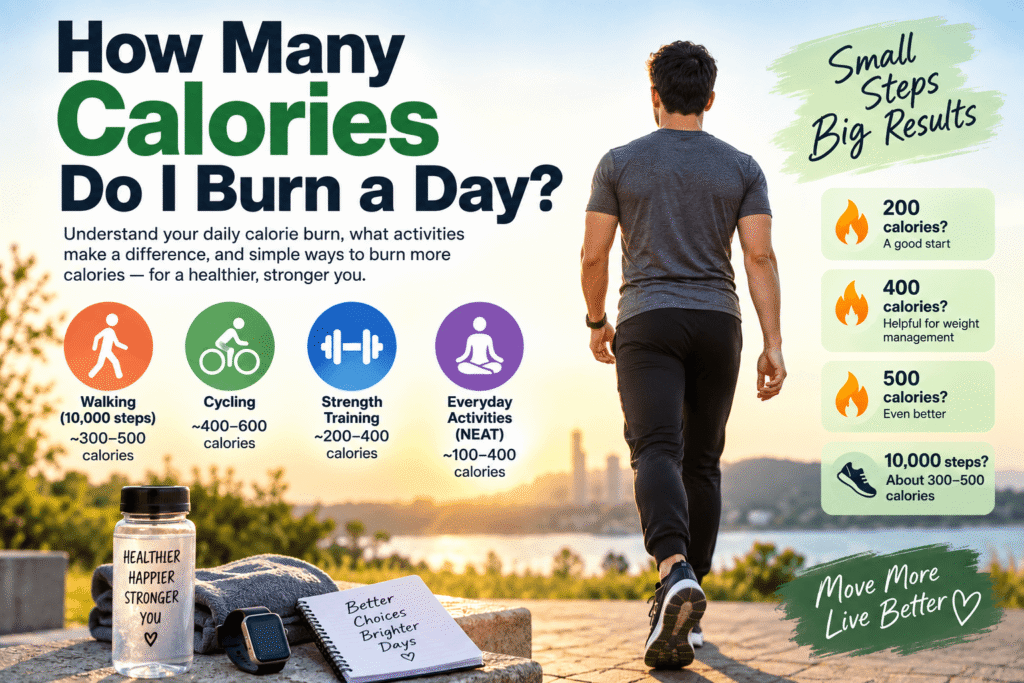
Burning an additional 200 calories through activity can be meaningful, but there is no universal requirement to burn exactly 200 exercise calories every day.
Whether 200 active calories is “enough” depends on what you mean by enough.
For general health, public-health recommendations are based primarily on activity duration and intensity, not a mandatory daily calorie target. U.S. guidelines recommend adults accumulate 150–300 minutes of moderate-intensity aerobic activity per week, plus muscle-strengthening activity on at least two days per week.
For weight management, 200 calories of activity can contribute to energy expenditure, but weight change depends on overall energy balance and other factors rather than one workout number.
Is Burning 400 Calories a Day Enough?
Burning 400 active calories can represent a substantial amount of physical activity for many people, but 400 calories is not a universal daily target.
For example, CDC estimates that a 154-pound person burns roughly 280 calories per hour walking at 3.5 mph and about 590 calories per hour jogging at 5 mph. A heavier person generally expends more during the same listed activity, while a lighter person generally expends less.
Therefore, reaching 400 activity calories might require very different amounts of exercise for different people.
Instead of treating 400 as a pass/fail number, consider:
- total weekly activity
- exercise intensity
- cardiovascular fitness
- strength training
- recovery
- overall energy intake
- your specific goal
Is Burning 500 Calories a Day Enough?
Burning 500 calories through physical activity may be a significant workout or accumulated activity level, but you do not need to burn exactly 500 exercise calories every day to be healthy or manage weight.
The common idea that a fixed number of calories burned each day automatically produces a predictable amount of weekly fat loss oversimplifies human physiology.
Body weight changes dynamically as energy intake, expenditure and body composition change. NIDDK’s Body Weight Planner specifically uses a dynamic mathematical model for this reason.
If weight loss is the goal, both food intake and physical activity matter. CDC notes that physical activity increases energy expenditure and that reducing calorie intake together with increased activity can create an energy deficit.
200 vs 400 vs 500 Active Calories a Day
All three levels can contribute positively to total activity; the appropriate amount depends on the individual rather than the number itself.
| Active calories | Practical interpretation | Main consideration |
|---|
| 200 kcal | Useful additional activity | Can contribute to health and energy expenditure |
| 400 kcal | Greater activity expenditure | Requires different activity amounts depending on body size/intensity |
| 500 kcal | Substantial activity for many people | Not necessary as a universal daily target |
The better question is not simply “How many calories did I burn?”
Ask:
“Am I getting enough physical activity for my health and goals, and is the amount sustainable?”
How Many Calories Do 10,000 Steps Burn?
There is no scientifically correct single calorie value for 10,000 steps because calorie expenditure depends on body weight, walking speed, distance, terrain, incline and individual physiology.
Ten thousand steps is a movement volume, not a fixed unit of energy.
Consider two people walking the same number of steps. One person may be heavier, walk faster, cover a longer distance per step or encounter hills. Their calorie expenditures can therefore differ.
The 2024 Compendium illustrates why pace and terrain matter: different walking speeds, slopes and load-carrying conditions receive different MET values.
Rather than using a universal “10,000 steps = X calories” formula, estimate walking calories using your:
body weight + actual walking duration/distance + speed + terrain.
A fitness tracker can provide a convenient estimate, but it should not be interpreted as an exact metabolic measurement.
Do You Need 10,000 Steps a Day?
No universal health guideline requires every adult to complete exactly 10,000 steps every day.
Current U.S. physical-activity recommendations are primarily expressed in minutes and intensity: adults should generally aim for 150–300 minutes of moderate-intensity aerobic activity each week and muscle-strengthening activity on at least two days.
A step goal can still be a useful behavioral tool because it encourages more daily movement.
The better goal is usually to move more and sit less, then gradually increase activity to an appropriate level. U.S. Physical Activity Guidelines explicitly encourage adults to move more and sit less.
What Is the Laziest Way to Burn More Calories?
There is no passive trick that burns large numbers of calories without effort, but the easiest approach is to increase low-intensity movement throughout your normal day.
You do not need every calorie to come from a formal workout.
Examples include:
- walking while making phone calls
- taking short walking breaks
- standing and moving periodically
- doing household chores
- parking farther away
- taking stairs when practical
- walking after meals
- performing errands on foot when possible
These activities contribute to physical activity and NEAT.
Housework counts too. The 2024 Compendium, for example, lists general sweeping at 3.3 METs, moderate mopping at 3.5 METs and general moderate house cleaning at 3.3 METs.
The advantage of low-intensity movement is not that it burns an extraordinary number of calories per minute. The advantage is that it can be accumulated throughout the day.
Easy Ways to Increase Daily Calorie Expenditure
Increasing daily movement is often more sustainable than trying to maximize workout calories.
A practical progression is:
- Reduce prolonged sitting. Get up and move periodically during sedentary periods.
- Add short walks. A few short walks can accumulate meaningful weekly activity.
- Walk routine journeys when practical. Turn transportation into physical activity.
- Use household activity. Cleaning, gardening and similar tasks contribute to movement.
- Increase walking pace gradually. Faster walking generally requires more energy than slow walking.
- Add structured exercise. Combine aerobic activity with strength training rather than focusing solely on calorie numbers.
For general health, work toward the established activity guidelines rather than chasing the highest possible wearable calorie reading.
Can Burning More Calories Help You Lose Weight?
Increasing physical activity can support weight loss by increasing energy expenditure, but exercise calories are only one side of energy balance.
Weight loss requires energy intake to remain below energy expenditure over time, although the body’s response is dynamic rather than perfectly linear.
CDC explains that using more calories through physical activity while reducing calorie intake creates the calorie deficit associated with weight loss. CDC also notes that much weight loss comes from reducing calorie intake, while regular activity is particularly important for health and weight maintenance.
That means a workout does not automatically create a deficit.
For example:
Total daily expenditure − total calorie intake = approximate daily energy balance.
If expenditure exceeds intake, there is an energy deficit. If intake exceeds expenditure, there is an energy surplus.
However, avoid assuming a fixed daily deficit will produce exactly the same rate of weight loss indefinitely. Metabolism and body weight change during weight loss, which is why NIDDK uses dynamic models for longer-term projections.
Common Calorie-Burning Mistakes
Several misunderstandings can make calorie tracking less useful.
Mistake 1: Counting only exercise calories.
Your body expends energy continuously. Exercise is only one component of TDEE.
Mistake 2: Treating wearable numbers as exact.
Use tracker calories primarily as estimates and trends rather than assuming perfect precision.
Mistake 3: Assuming 10,000 steps burns the same calories for everyone.
Body weight, speed, terrain and distance change walking energy expenditure.
Mistake 4: Believing you must burn 500 active calories daily.
Public-health activity recommendations do not require a universal exercise-calorie target.
Mistake 5: Ignoring strength training because it does not show a huge calorie number.
Health recommendations include muscle-strengthening activity at least two days each week in addition to aerobic exercise.
Mistake 6: Using exercise calories as permission to eat the same number back automatically.
Both food intake and total energy expenditure influence energy balance, and both are estimates outside controlled measurements.
Key Takeaways
- Your body burns calories continuously, including while resting and sleeping.
- Total daily energy expenditure includes resting metabolism, food-related thermogenesis and physical activity.
- There is no universal daily calorie-burn target that applies to everyone.
- Burning 200, 400 or 500 active calories can contribute to activity, but none is a required universal number.
- Ten thousand steps does not equal a fixed number of calories.
- Low-intensity everyday movement can increase daily energy expenditure without formal exercise.
- For health, focus on sustainable physical activity rather than maximizing a wearable’s calorie number.
- For weight management, consider both calorie intake and total energy expenditure.
Frequently Asked Questions
How many calories would I naturally burn a day?
Your natural calorie expenditure varies according to factors such as age, sex, height, weight, body composition and activity. Even without deliberate exercise, your body expends energy on basic physiological functions, digestion and everyday movement.
Is burning 400 calories a day enough?
Burning 400 active calories can contribute substantially to daily activity, but there is no universal requirement to burn 400 calories per day. Overall activity, fitness, diet, health and personal goals matter more than hitting one calorie number.
Is it enough to burn 500 calories a day?
It may be substantial activity for many people, but 500 exercise calories is not a universal health or weight-loss requirement. The appropriate activity amount varies by individual.
Is burning 200 calories a day enough?
Two hundred active calories can make a useful contribution to physical activity. For general health, however, judge activity against evidence-based recommendations for weekly aerobic and muscle-strengthening activity rather than a specific calorie target.
How many calories do 10,000 steps burn?
There is no fixed answer. Calories expended during 10,000 steps depend on body weight, walking speed, stride/distance, terrain, incline and other individual factors.
What is the easiest way to burn more calories?
Increase everyday movement. Walking, taking stairs, standing periodically and performing household activities can raise daily physical activity without requiring an intense workout.
Do you burn calories while sleeping?
Yes. Your body continues using energy while sleeping to support breathing, circulation, brain activity, temperature regulation and other essential physiological processes.
Should I focus on steps or calories burned?
For most people, steps and activity minutes can be useful behavior targets, while estimated calories provide additional context. For health, meeting evidence-based physical-activity recommendations is generally more meaningful than chasing an exact calorie-burn number.














2 Responses