

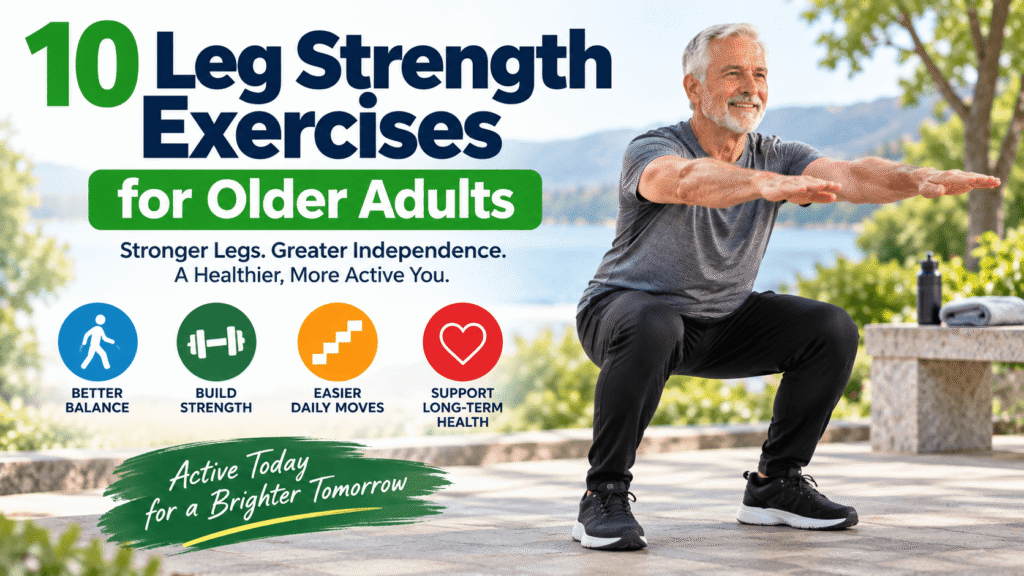
10 Best Leg Strength Exercises for Older Adults
The following exercises collectively target the major muscles around the hips, thighs, lower legs, and ankles.
| Exercise | Main muscles/area | Equipment | Beginner-friendly modification |
|---|---|---|---|
| Sit-to-Stand | Quads, glutes, hips | Chair | Use armrests if necessary |
| Chair Squat | Quads, glutes | Chair | Reduce squat depth |
| Calf Raise | Calves | Chair/counter | Hold support |
| Knee Extension | Quadriceps | Chair | No added resistance |
| Hamstring Curl | Hamstrings | Chair | Small range of motion |
| Side Leg Raise | Hip abductors | Chair | Smaller leg lift |
| Hip Extension | Glutes, posterior hip | Chair | Shorter movement |
| Step-Up | Quads, glutes, calves | Low step | Use a lower step |
| Supported Reverse Lunge | Quads, glutes | Chair/counter | Reduce depth |
| Toe Raise | Anterior lower leg | Chair/counter | Hold support |
1. Sit-to-Stand
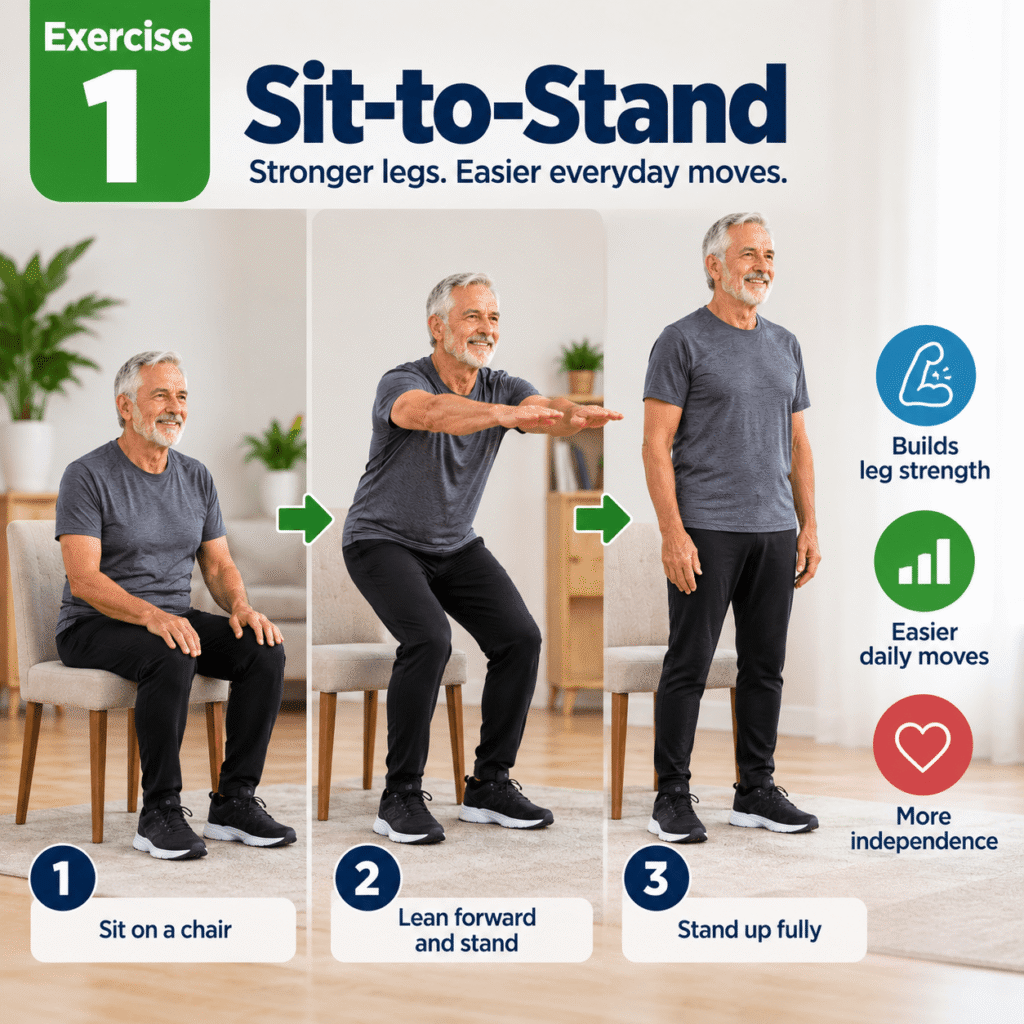
The sit-to-stand strengthens the thighs and hips while directly practicing one of the most common movements in daily life: rising from a chair.
The National Institute on Aging identifies getting up from a chair as an everyday activity supported by muscle-strengthening exercise.
How to do it:
- Sit toward the front of a stable chair.
- Place both feet firmly on the floor.
- Lean the torso slightly forward while keeping control.
- Push through the feet and stand.
- Straighten into a comfortable upright position.
- Slowly lower yourself back to the chair.
Avoid dropping quickly onto the seat.
Beginner modification: Use the chair’s armrests or another secure support if needed.
Progression: Gradually rely less on the arms. Later, increase repetitions or use an appropriate external resistance if technique remains controlled.
Best functional application: Standing from chairs, toilets, beds, and other seated positions.
2. Chair Squats
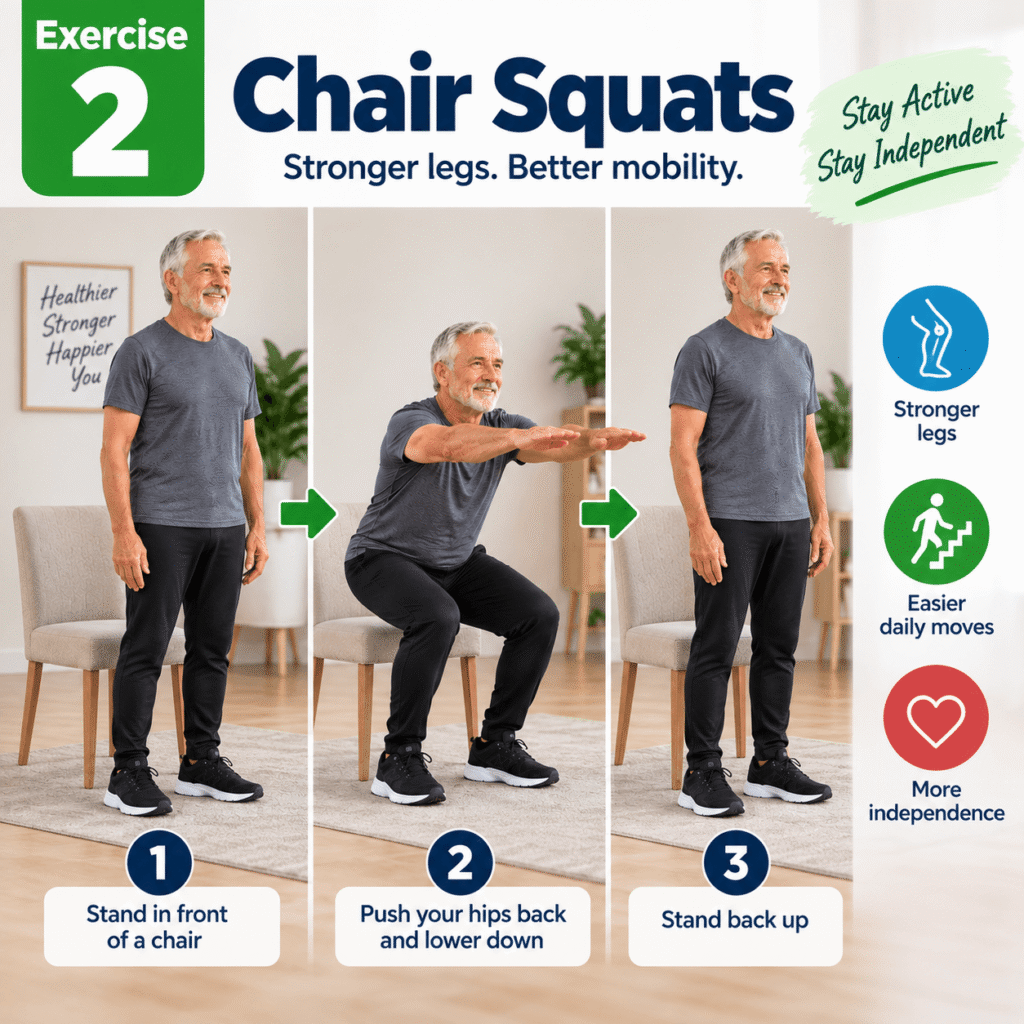
Chair squats strengthen the quadriceps, glutes, and hip muscles while allowing a chair to act as a depth reference and safety aid.
Unlike a sit-to-stand, the goal can be to lightly touch or approach the chair before standing again rather than fully sitting and resting.
How to do it:
- Stand in front of a stable chair.
- Position the feet comfortably apart.
- Push the hips backward.
- Bend the knees while lowering toward the chair.
- Lightly touch the chair or stop at a comfortable depth.
- Push through the feet to stand again.
Keep the movement slow enough to maintain control.
Beginner modification: Perform a partial squat rather than lowering all the way to the chair.
Progression: Increase the comfortable range of motion before adding external resistance.
3. Standing Calf Raises
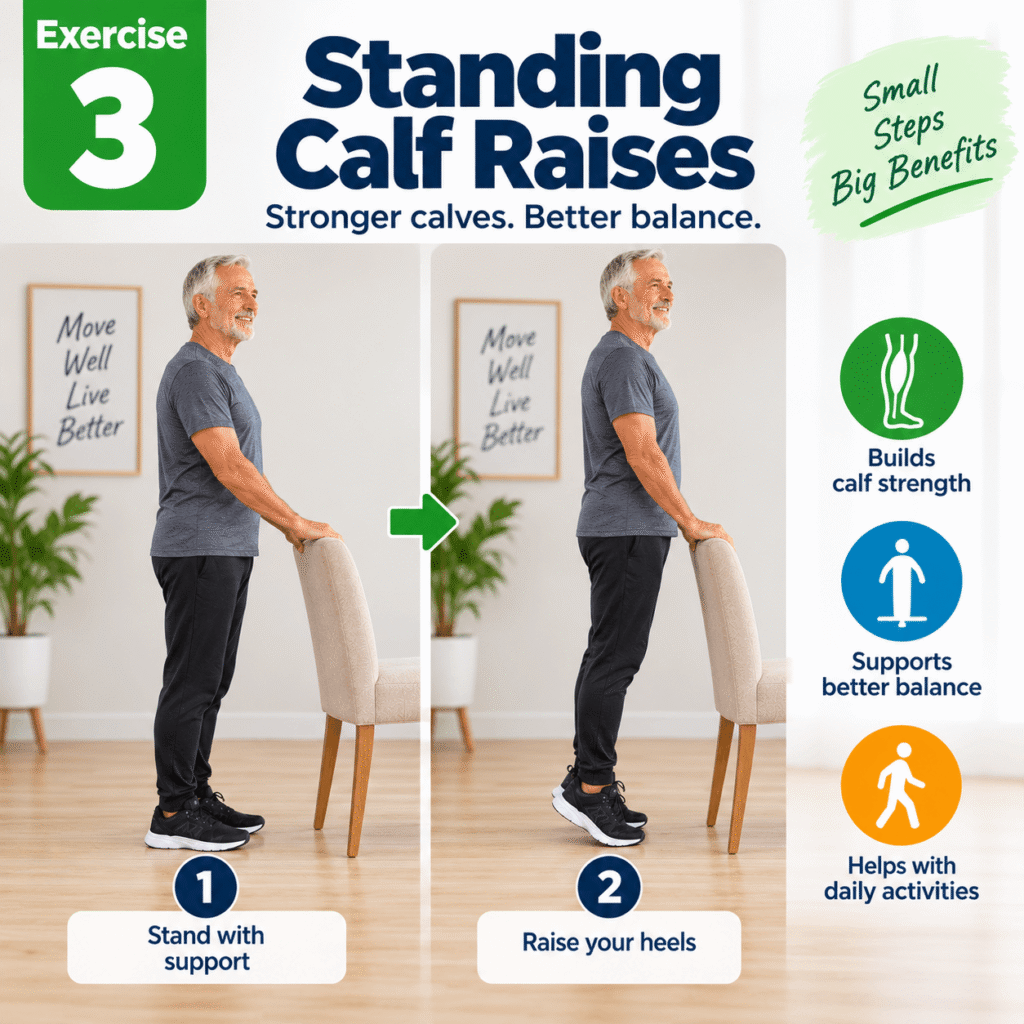
Calf raises strengthen the muscles at the back of the lower leg that help control the ankle and contribute to walking and push-off.
How to do it:
- Stand behind a sturdy chair or counter.
- Hold the support lightly.
- Keep the torso upright.
- Slowly raise the heels from the floor.
- Pause briefly at the top.
- Lower the heels under control.
Avoid bouncing.
Beginner modification: Use both hands for support.
Progression: Move from firm two-hand support toward lighter support only when balance is sufficient.
Ankle and foot training may improve certain measures of ankle strength and balance, although a 2025 systematic review characterized much of this evidence as low or very-low certainty and did not establish a reduction in falls from ankle-foot exercises alone.
That distinction is useful: calf exercises can strengthen the ankle region, but they should not be marketed as a stand-alone fall-prevention solution.
4. Seated Knee Extensions
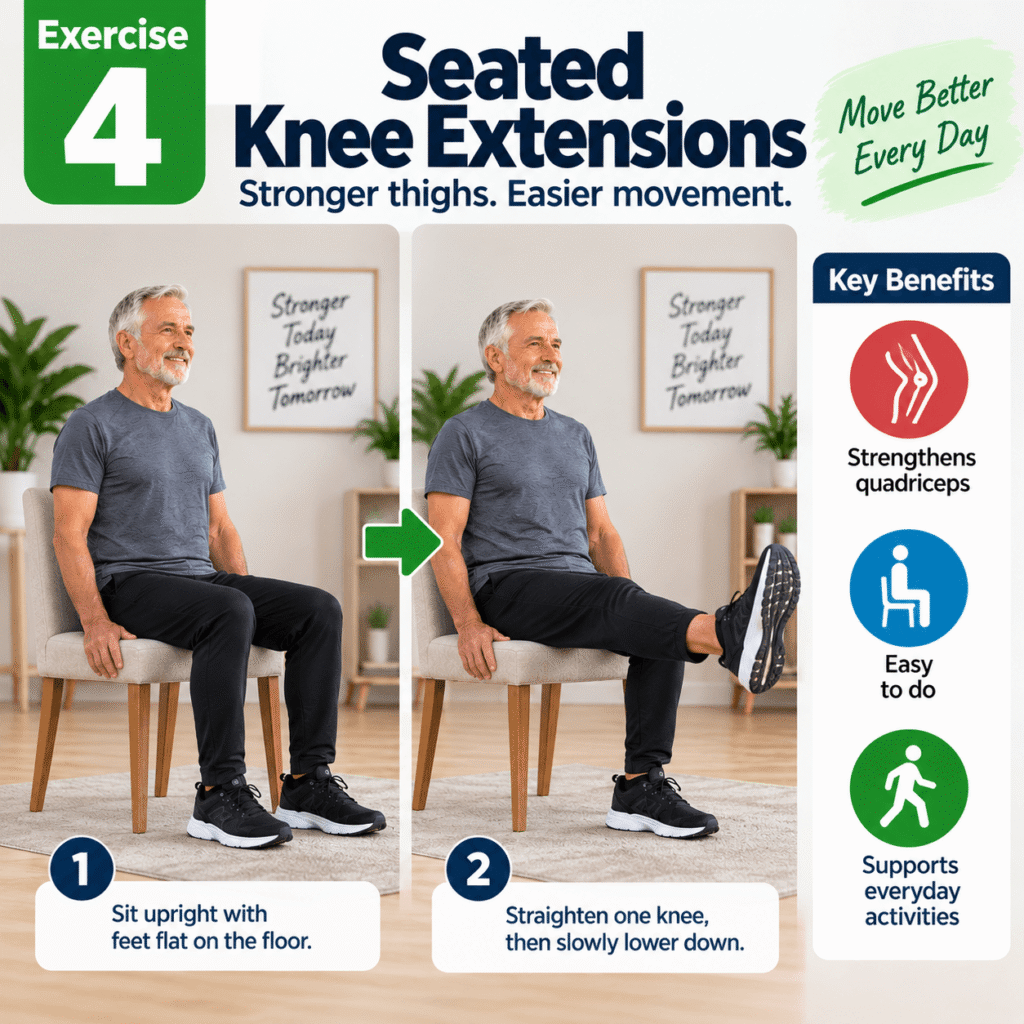
Seated knee extensions primarily target the quadriceps at the front of the thigh.
Because the exercise is performed while seated, it can be a useful starting point for people who are not yet comfortable with repeated standing exercises.
How to do it:
- Sit upright in a stable chair.
- Keep both feet initially on the floor.
- Slowly straighten one knee.
- Stop at a comfortable position without forcing the joint.
- Lower the foot slowly.
- Repeat before switching legs.
Beginner modification: Use only the weight of the leg.
Progression: Appropriate resistance can eventually be added with professional guidance or suitable equipment.
5. Standing Hamstring Curls
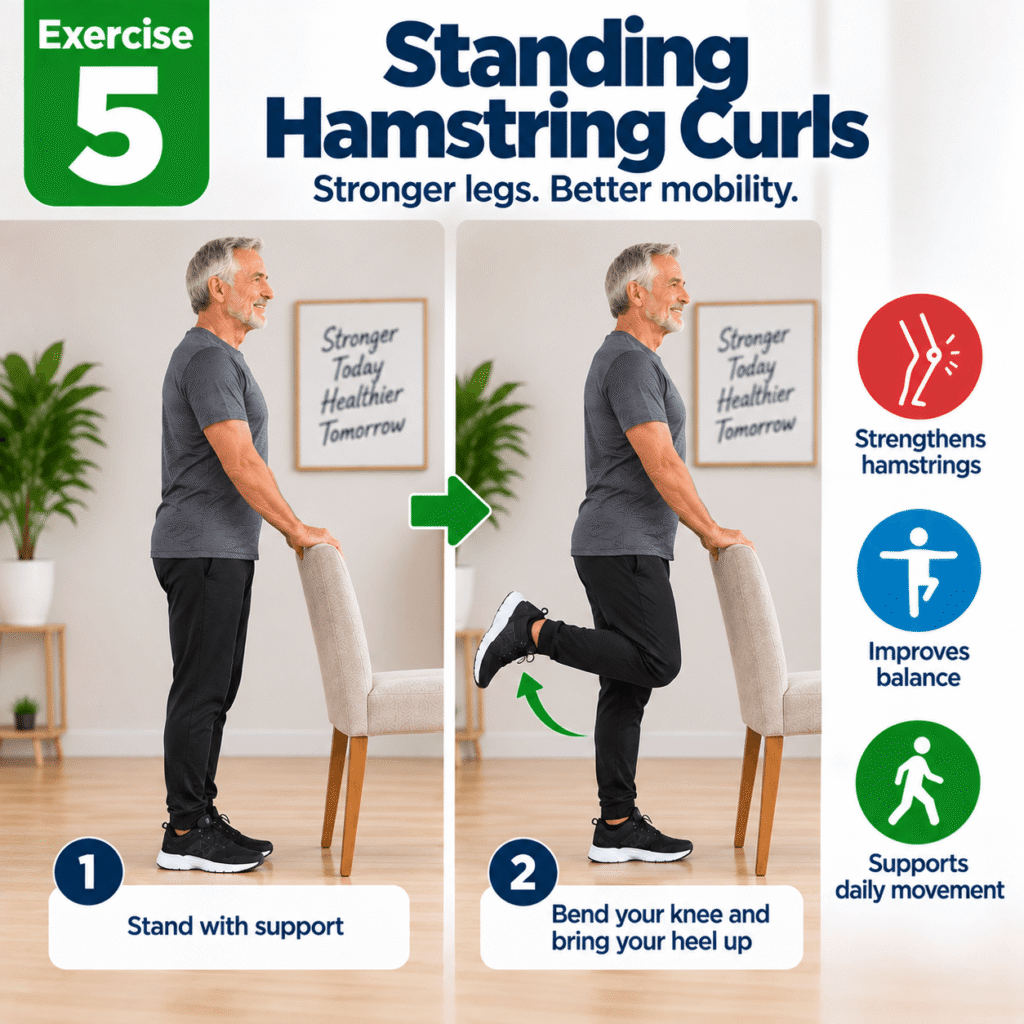
Standing hamstring curls strengthen the muscles along the back of the thigh by bending the knee against gravity or added resistance.
How to do it:
- Stand behind a stable chair.
- Hold the chair for support.
- Keep the thighs relatively aligned.
- Bend one knee and bring the heel toward the buttocks.
- Pause without forcing the movement.
- Slowly lower the foot.
- Repeat on the other side.
Do not swing the leg to create momentum.
Beginner modification: Use a smaller range of motion.
Progression: A suitable resistance band or ankle resistance can make the movement more demanding once body-weight repetitions are easy and controlled.
6. Side Leg Raises
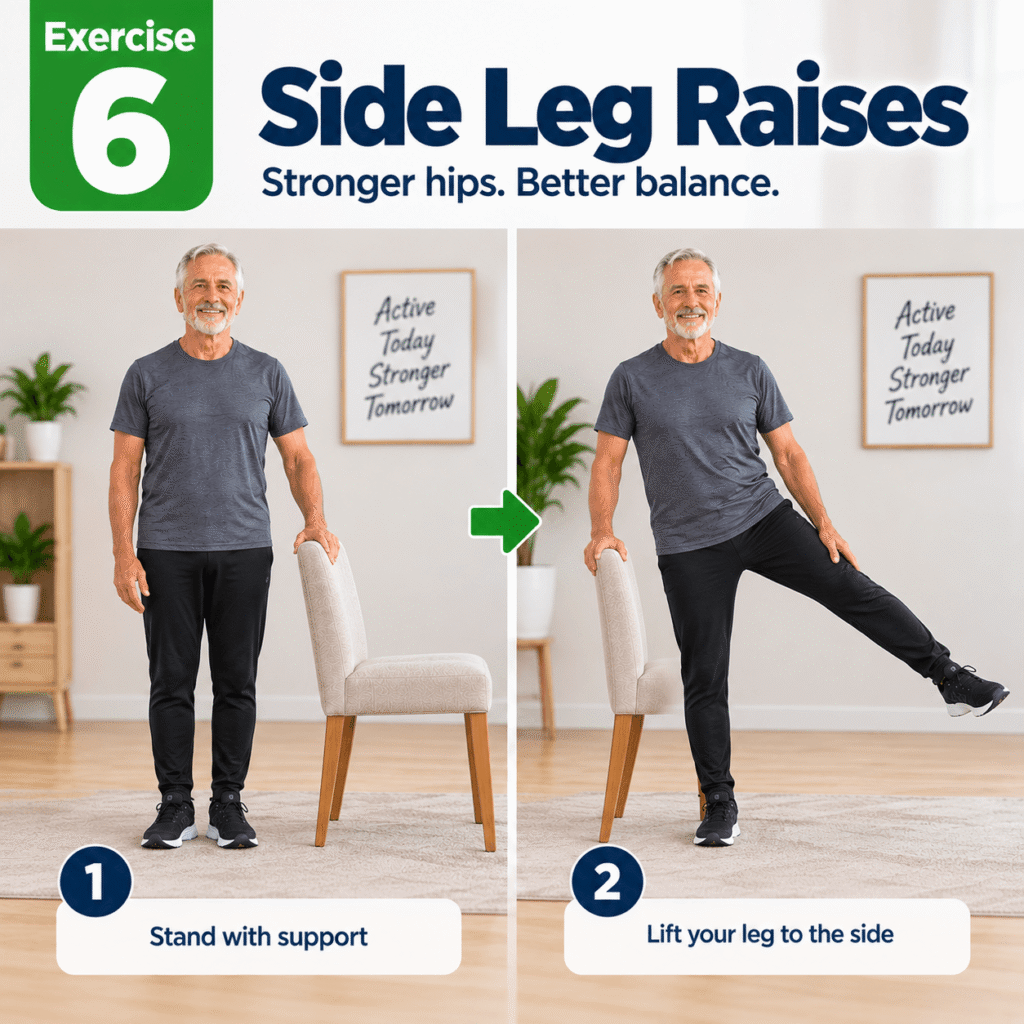
Side leg raises strengthen the hip abductors, which help control side-to-side movement of the pelvis and leg.
How to do it:
- Stand behind a chair or beside a counter.
- Hold the support.
- Keep the torso upright.
- Move one leg slowly out to the side.
- Keep the toes generally pointing forward rather than rotating the entire leg outward.
- Return slowly.
- Repeat on the opposite side.
The movement does not need to be large.
Beginner modification: Lift the leg only a short distance.
Progression: Reduce reliance on hand support only when doing so is safe, or add suitable resistance.
7. Standing Hip Extensions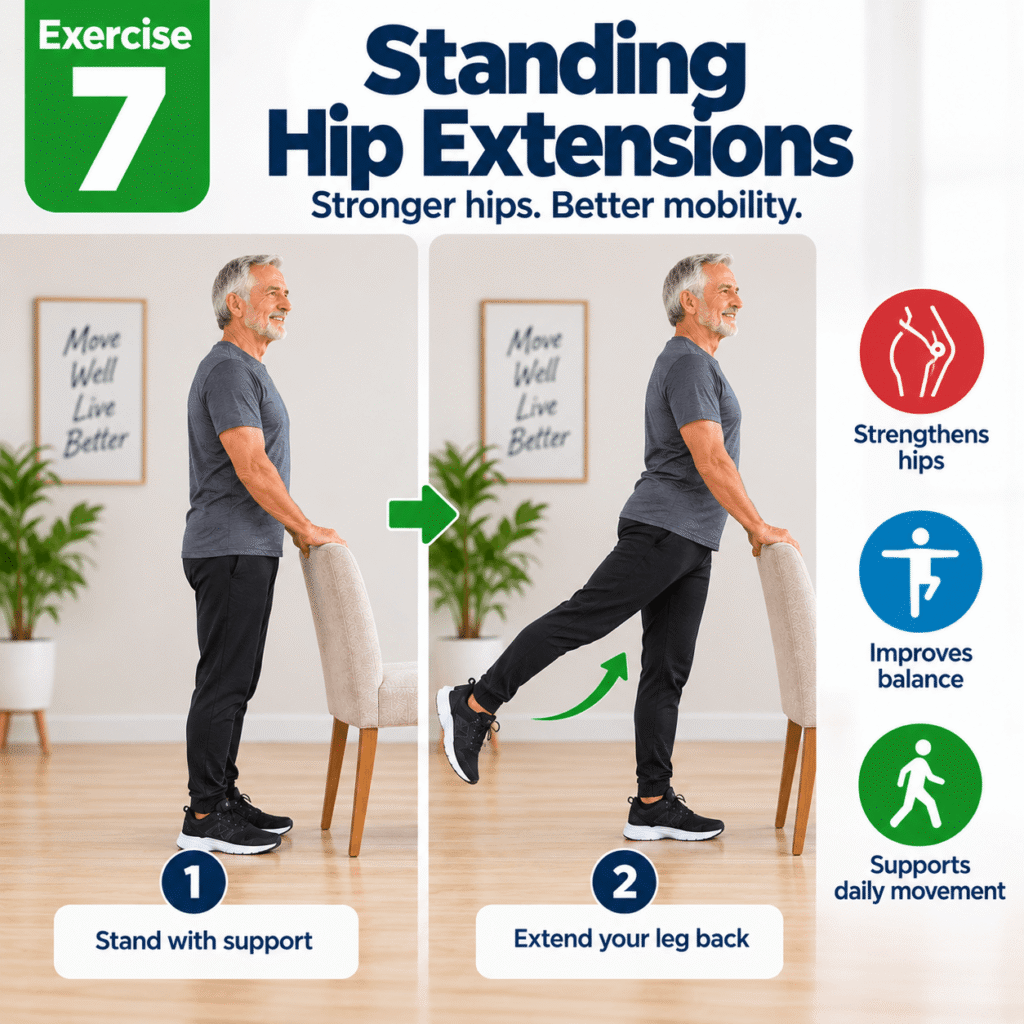
Standing hip extensions primarily train the gluteal and posterior hip muscles involved in extending the hip.
How to do it:
- Stand behind a stable chair.
- Hold the chair.
- Maintain an upright trunk.
- Move one leg backward without aggressively arching the lower back.
- Pause briefly.
- Bring the leg back under control.
- Switch sides.
A common mistake is trying to lift the leg too high and compensating through the lower back.
Beginner modification: Use a very small backward movement.
Progression: Increase resistance gradually rather than exaggerating the range of motion.
8. Step-Ups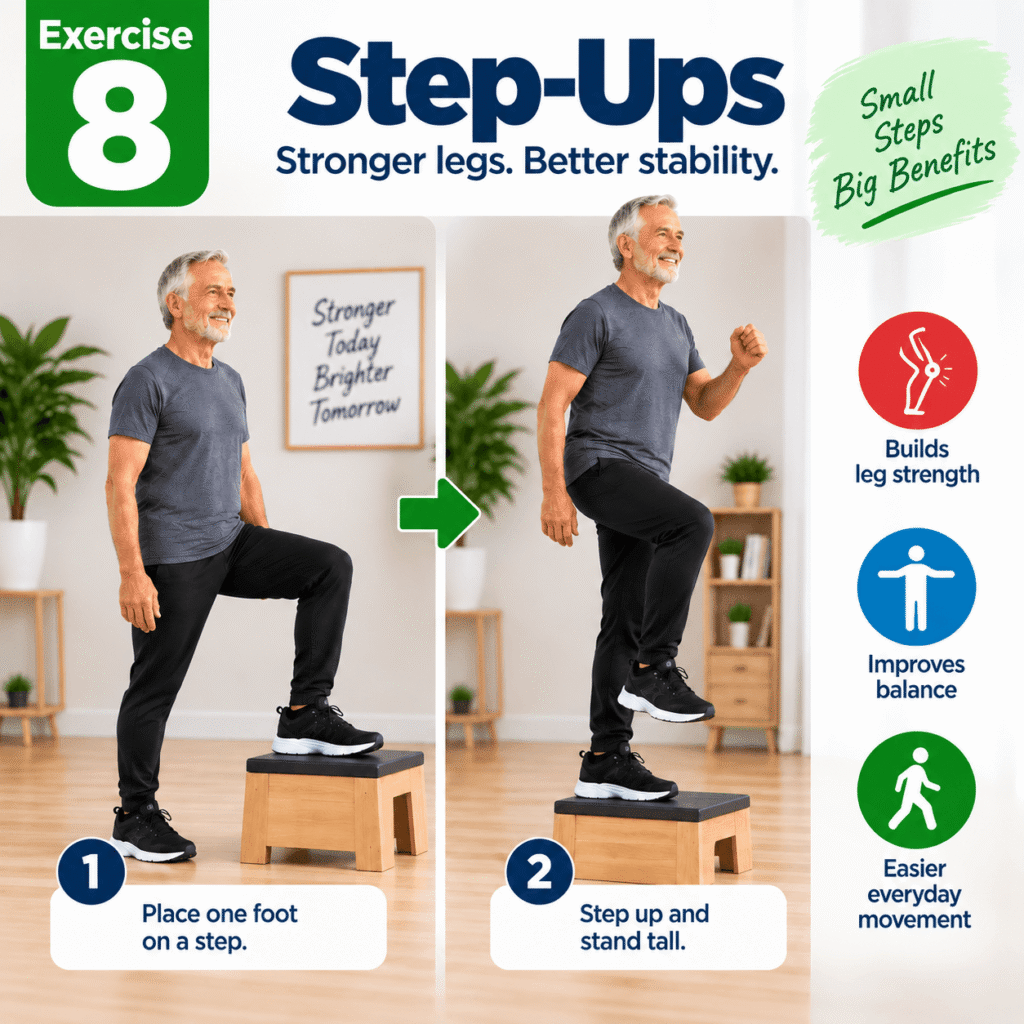
Step-ups train the legs through a movement similar to climbing stairs, making them particularly relevant to everyday function.
Step-ups involve greater balance and coordination demands than seated knee extensions, so they may not be the first exercise for every beginner.
How to do it:
- Stand in front of a low, secure step.
- Keep a handrail or stable support available.
- Place one foot completely on the step.
- Push through that leg and step up.
- Bring the other foot up if appropriate.
- Step down slowly and under control.
Beginner modification: Start with a very low step and secure hand support.
Progression: Increase repetitions before considering a higher step.
Someone who cannot safely control the step-up even with appropriate support may benefit from starting with sit-to-stands and other simpler exercises.
9. Supported Reverse Lunges
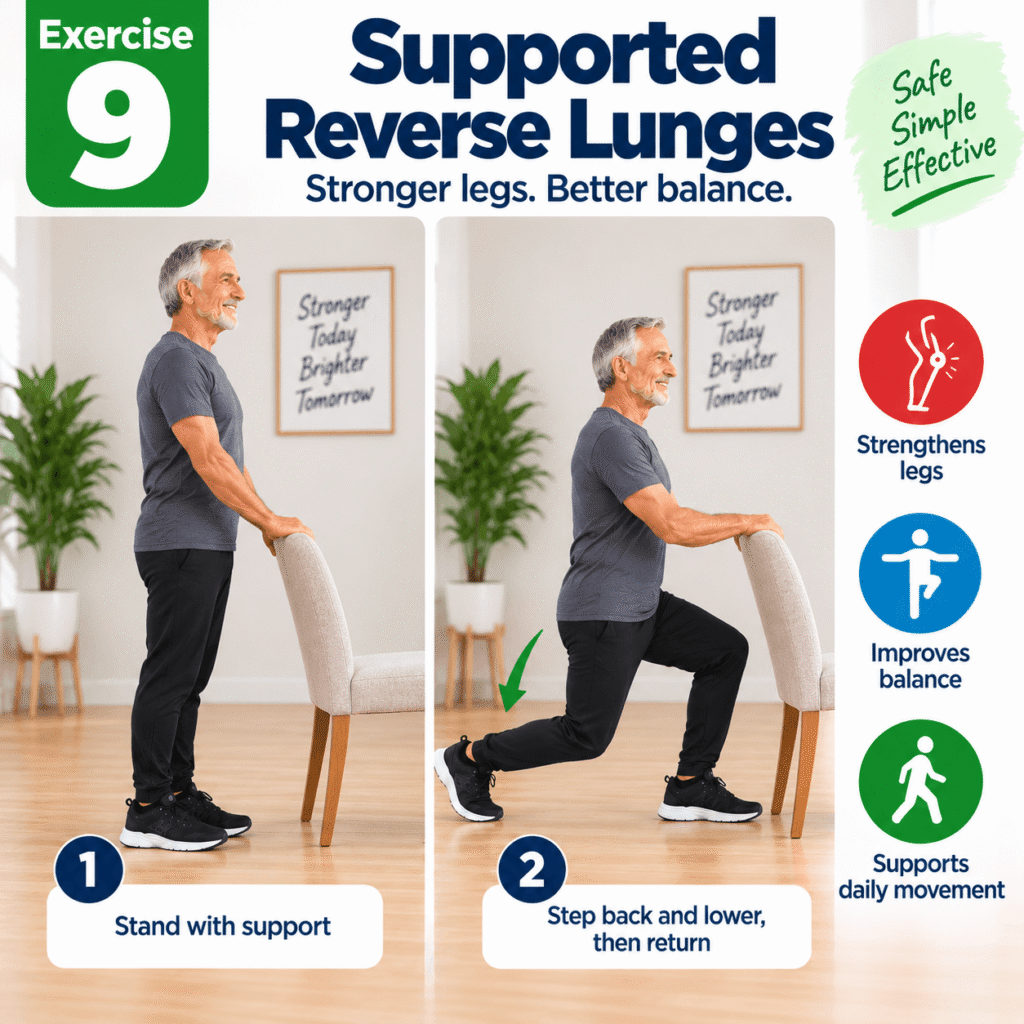
A supported reverse lunge strengthens the thighs and hips while requiring more single-leg control than a chair squat.
For that reason, it belongs later in a beginner progression rather than automatically being the first exercise attempted.
How to do it:
- Stand beside a stable counter or heavy chair.
- Hold the support.
- Step one foot backward.
- Bend both knees slightly while maintaining control.
- Push through the front foot to return.
- Repeat on the opposite side.
A deep lunge is unnecessary.
Beginner modification: Take a short step backward and bend the knees only slightly.
If this movement causes instability, substitute chair squats or sit-to-stands.
10. Toe Raises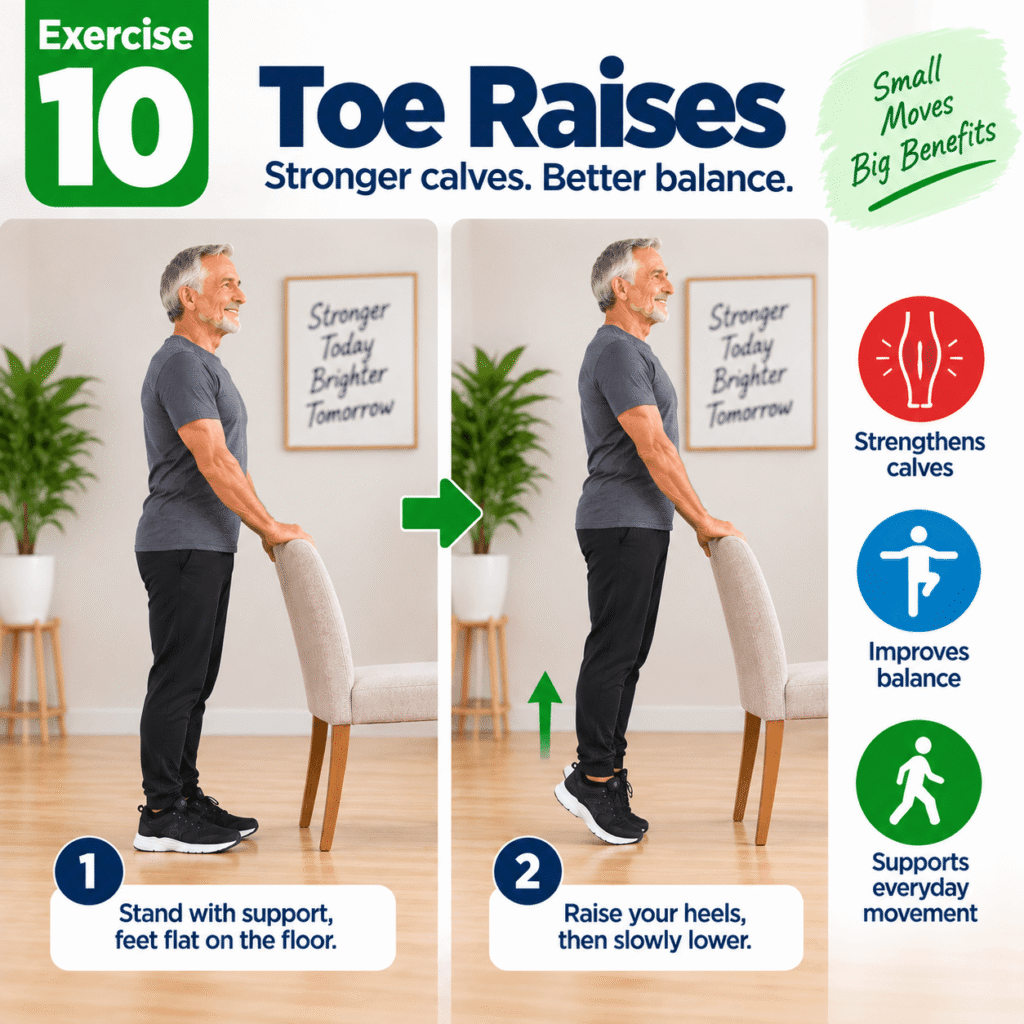
Toe raises strengthen the muscles at the front of the lower leg that lift the forefoot toward the shin.
This movement complements calf raises because the two exercises emphasize different actions around the ankle.
How to do it:
- Stand beside a counter or behind a chair.
- Keep the heels on the floor.
- Lift the toes and front of the feet upward.
- Pause briefly.
- Lower slowly.
Beginner modification: Keep both hands on the support.
Progression: Increase controlled repetitions before reducing support.
Research on ankle-foot exercise suggests possible improvements in plantarflexion strength and some balance measures, but evidence quality varies and direct fall-prevention effects remain uncertain.
10 Leg Strength Exercises for Older Adults: A Safe and Practical Guide
Leg strength exercises for older adults can help maintain the muscular capacity needed for everyday activities such as standing up from a chair, climbing stairs, walking, and carrying groceries. Good options include sit-to-stands, chair squats, calf raises, knee extensions, hamstring curls, side leg raises, hip extensions, step-ups, supported lunges, and toe raises.
Strength training becomes particularly relevant with age because maintaining muscular strength supports physical function and independent living. The National Institute on Aging specifically notes that muscle-strengthening exercise can make activities such as getting out of a chair and climbing stairs easier.
For most healthy adults aged 65 and older, current CDC guidance recommends muscle-strengthening activity on at least two days each week, alongside aerobic and balance activities. Exercise should still be adapted to the person’s current ability and health status.
Why Is Leg Strength Important for Older Adults?
Strong legs help older adults perform everyday movements more easily and support continued independence. The quadriceps, hamstrings, glutes, calves, hip muscles, and muscles around the ankles all contribute to standing, walking, stair climbing and controlling the body during movement.
Strength training is therefore not simply about building larger muscles.
For an older adult, practical improvements may mean:
- getting out of a chair more easily;
- climbing stairs with greater control;
- maintaining walking ability;
- carrying household items;
- getting into and out of a car;
- maintaining functional independence.
The National Institute on Aging reports that muscle-strengthening exercise can improve physical function and help older adults perform everyday activities.
A network meta-analysis examining older adults with sarcopenia also found evidence supporting resistance exercise and combinations of resistance, aerobic, and balance exercise for measures of physical function and quality of life.
One distinction matters, however: stronger legs do not automatically mean that someone has good balance.
Balance depends on multiple systems and skills. Strength training should therefore complement rather than automatically replace balance-specific exercise.
Which Leg Exercises Are Best for Beginners?
Sit-to-stands, supported calf raises, seated knee extensions, standing hamstring curls, and supported side leg raises are practical starting exercises because support and range of motion can be easily adjusted.
A beginner does not need to start with all 10 exercises.
A sensible initial selection might be:
- Sit-to-stand
- Seated knee extension
- Supported calf raise
- Standing hamstring curl
- Supported side leg raise
The National Institute on Aging recommends that beginners can initially perform strengthening exercises without weights or resistance bands until they become comfortable with the movements.
That principle is more useful than trying to make an exercise difficult immediately.
First establish control. Then progressively increase the challenge.
How Many Repetitions Should Older Adults Do?
A practical general target for muscle-strengthening exercises is 8–12 repetitions per exercise, beginning with at least one set when appropriate.
CDC guidance describes 8–12 repetitions as one set and notes that one set is useful, while two or three sets may provide additional benefits.
This is not a requirement that every older adult must immediately perform 12 repetitions.
Someone beginning after a long period of inactivity may need an easier starting point based on ability.
The final repetitions should feel challenging when the exercise is appropriately loaded, but technique should remain controlled.
How Often Should Older Adults Train Their Legs?
Older adults should generally include muscle-strengthening activity on at least two days each week as part of a broader physical-activity program.
The National Institute on Aging also advises avoiding training the same muscle group on consecutive days so muscles have time to recover.
A simple schedule could therefore look like:
Monday: Lower-body strength
Tuesday: Walking or other aerobic activity
Wednesday: Balance/mobility activity
Thursday: Lower-body strength
Friday: Walking or another suitable activity
Weekend: Appropriate recreational, aerobic, balance, or recovery activity
The exact program should reflect the individual’s health, fitness, and recovery capacity.
How to Progress Leg Exercises Safely
Progressive overload means gradually making exercise more challenging as the body adapts rather than repeatedly performing exactly the same easy workload.
For older adults, progression does not necessarily mean lifting heavy weights.
An exercise can progress by:
- improving movement quality;
- increasing comfortable range of motion;
- adding repetitions;
- adding another set;
- gradually increasing resistance;
- moving to a more challenging variation when appropriate.
The National Institute on Aging notes that gradually increasing resistance, sets, repetitions, or training frequency can result in stronger muscles.
For exercises where a chair or counter is being used because of balance concerns, reducing support should not automatically be the first progression.
Safety comes before difficulty.
Strength Training vs. Balance Training for Older Adults
Strength training and balance training overlap, but they are not interchangeable.
| Strength training | Balance training |
|---|---|
| Primarily challenges muscular force production | Primarily challenges postural control |
| Includes squats, resistance exercises and leg raises | Includes appropriately challenging balance activities |
| Helps develop muscular strength | Develops balance-specific ability |
| Can support functional movement | Directly practices balance control |
| Should be part of older-adult exercise | Should also be part of older-adult exercise |
CDC guidance recommends that adults aged 65 and older include aerobic, muscle-strengthening, and balance activities rather than relying on only one type of exercise.
WHO guidance similarly recommends multicomponent physical activity emphasizing functional balance and strength for older adults.
Research supports this distinction.
A systematic review comparing strength training with alternative exercise programs found no significant difference in falls between strength training and other exercise interventions.
By contrast, broader exercise programs that substantially challenge balance have repeatedly been associated with reduced fall rates among community-dwelling older adults.
Therefore, strengthen the legs—but include balance training rather than assuming stronger legs alone provide complete fall protection.
Common Leg-Exercise Mistakes to Avoid
The most useful leg exercise is one that can be performed consistently with appropriate technique and progression. Making an exercise unnecessarily difficult does not automatically make it more effective.
Common problems include:
- progressing resistance too quickly;
- using momentum instead of controlled movement;
- sacrificing technique to complete more repetitions;
- holding the breath during exertion;
- locking the knees aggressively;
- using unstable furniture for support;
- ignoring unusual pain or other concerning symptoms;
- training hard every day without adequate recovery;
- removing hand support before balance is sufficient.
The National Institute on Aging specifically advises against holding the breath during strength exercise and recommends avoiding locking the joints in a straight position.
When Should an Older Adult Stop Exercising?
Exercise should be stopped when concerning symptoms develop rather than pushing through them simply to finish a set.
Ordinary muscular effort is different from sudden or severe pain.
Someone with significant medical conditions, major mobility limitations, a recent injury or operation, unexplained symptoms during activity, or uncertainty about whether an exercise is appropriate should obtain individualized guidance from a qualified healthcare professional.
NIA recommends seeking advice from a doctor or physical therapist when unsure whether a particular movement is appropriate.
For people with substantial balance problems, a physical therapist can also determine whether exercises such as step-ups or lunges are appropriate and what type of support is needed.
Simple Beginner Leg Workout for Older Adults
A beginner leg workout can start with five movements rather than attempting all 10 exercises in one session.
For example:
| Exercise | Starting approach |
|---|---|
| Sit-to-Stand | 1 set of controlled repetitions |
| Seated Knee Extension | 1 set per leg |
| Supported Calf Raise | 1 set |
| Standing Hamstring Curl | 1 set per leg |
| Side Leg Raise | 1 set per leg |
When appropriate, work toward the CDC’s general muscle-strengthening framework of approximately 8–12 repetitions per exercise, and eventually consider additional sets as ability improves.
The objective is not to complete a predetermined number at any cost.
The objective is controlled, appropriately challenging exercise that can gradually progress.
Key Takeaways
- Leg strengthening helps maintain the muscular capacity needed for everyday activities and independent living.
- Sit-to-stands, chair squats, calf raises, knee extensions, hamstring curls, side leg raises, hip extensions, step-ups, supported lunges, and toe raises collectively train major lower-body muscles.
- Beginners can start with body weight and stable support before adding resistance.
- CDC guidance recommends muscle-strengthening exercise on at least two days per week for adults 65 and older.
- CDC describes 8–12 repetitions as a useful general range for a set of muscle-strengthening activity.
- Strength and balance are related but distinct. Older-adult exercise programs should include both.
- Progress gradually rather than making exercises substantially harder all at once.
Frequently Asked Questions
What is the best leg exercise for older adults?
There is no single best exercise for everyone. Sit-to-stands are particularly practical because they train the legs while practicing a movement used repeatedly in everyday life.
How can older adults strengthen weak legs at home?
Older adults can use body-weight and chair-supported exercises such as sit-to-stands, calf raises, knee extensions, hamstring curls, and side leg raises. Resistance can be added gradually as strength improves.
How often should seniors do leg-strengthening exercises?
Adults aged 65 and older should generally perform muscle-strengthening activities on at least two days each week, according to CDC guidance.
How many leg exercises should an older adult do?
There is no universal number. Beginners can start with a small selection covering the major lower-body muscles rather than attempting every possible exercise in one session.
Are squats safe for older adults?
Squats can be appropriate for many older adults when the movement matches their strength, mobility, balance, and health status. A chair squat or sit-to-stand provides an easier starting variation.
Can a 70- or 80-year-old build stronger legs?
Older age does not eliminate the ability to respond to resistance exercise. Progressive resistance training is used to improve strength and physical function in older populations, although the appropriate program depends on individual health and ability.
Do strong legs prevent falls?
Leg strength can contribute to physical function, but strength alone should not be equated with fall prevention. Exercise programs that include appropriately challenging balance training have stronger evidence for reducing falls.
Is walking enough to strengthen an older adult’s legs?
Walking is valuable aerobic physical activity, but guidelines separately recommend muscle-strengthening exercise. Older adults should generally combine aerobic activity, strength training, and balance activity rather than treating walking as a substitute for all three.
References & Sources
CDC — Physical Activity Guidelines for Older Adults
National Institute on Aging — Exercise and Physical Ability
WHO — Physical Activity Recommendations
PubMed — Exercise and Falls Meta-Analysis
PubMed — Strength Training and Falls Systematic Review

ARTICLE REVIEWED BY
Alex John
Nutritionist
Alex John is a nutritionist who provides practical guidance on balanced eating, walking, exercise, simple workouts, weight management, and natural ways to develop healthier daily habits.









3 Responses