How Many Miles Does the Average Person Walk in a Year and in a Lifetime?
The average person walks far more than most people realize. Over a lifetime, the total distance adds up to something surprisingly massive—enough to circle the Earth multiple times.
In simple terms:
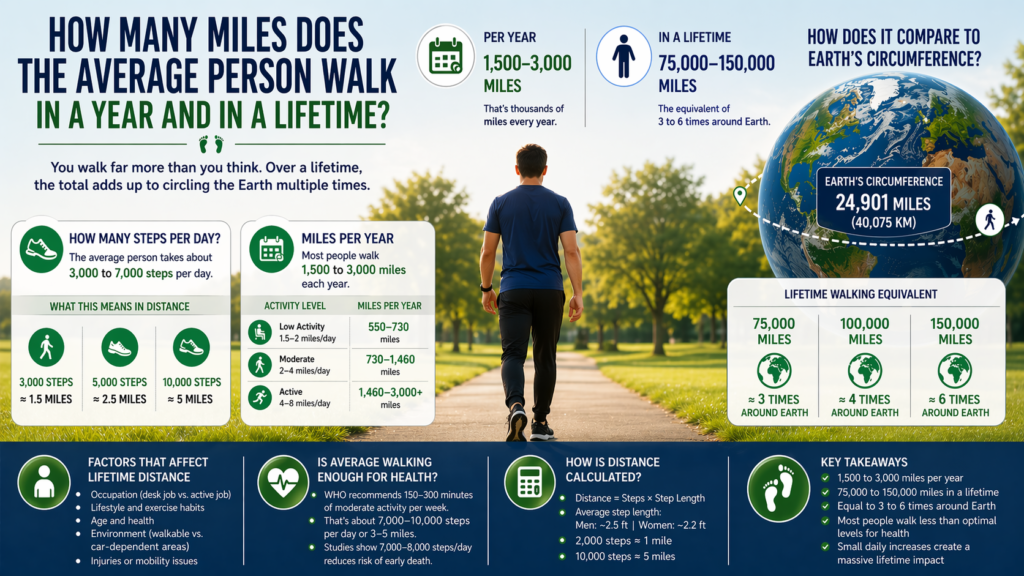
- Per year: ~1,500 to 3,000 miles
- Over a lifetime: ~75,000 to 150,000 miles
That means an average human can walk the equivalent of 3 to 6 times around the Earth.
Let’s break it down clearly.
How many steps does the average person take per day?
The average person takes about 3,000 to 7,000 steps per day globally.
According to research published in The Lancet Public Health (2019), daily step counts vary widely by country, but most adults fall within this range.
What this means in distance:
- Average step length: ~2.1 to 2.5 feet
- 2,000 steps = 1 mile
Typical daily distance:
- 3,000 steps ≈ 1.5 miles
- 5,000 steps ≈ 2.5 miles
- 10,000 steps ≈ 5 miles
Key insight:
Most people walk between 1.5 and 3 miles per day without structured exercise.
How many miles does the average person walk per year?
The average person walks about 1,500 to 3,000 miles per year.
This estimate comes from combining daily averages with yearly totals.
Calculation:
- 2–3 miles/day × 365 days =
~730 to 1,095 miles/year (low activity)
- 4–8 miles/day (active lifestyle) =
~1,500 to 3,000+ miles/year
Simple breakdown:
| Activity Level |
Miles per Day |
Miles per Year |
| Low activity |
1.5–2 miles |
550–730 miles |
| Moderate |
2–4 miles |
730–1,460 miles |
| Active |
4–8 miles |
1,460–3,000+ miles |
Key insight:
Even modest daily movement adds up to hundreds or thousands of miles per year.
How many miles does a person walk in a lifetime?
The average person walks between 75,000 and 150,000 miles in a lifetime.
This estimate assumes:
- Lifespan: ~75–80 years
- Consistent daily walking habits
Example calculation:
- 2.5 miles/day × 365 days × 80 years =
~73,000 miles
- 5 miles/day × 365 days × 80 years =
~146,000 miles
Real-world interpretation:
- Sedentary individuals: ~60,000–80,000 miles
- Moderately active: ~80,000–120,000 miles
- Highly active: 120,000+ miles
Key insight:
A human lifetime of walking equals tens of thousands of miles—even without intentional exercise.
How does lifetime walking distance compare to Earth’s circumference?
Earth’s circumference is about 24,901 miles (40,075 km).
Comparison:
| Walking Distance |
Equivalent Around Earth |
| 75,000 miles |
~3 times |
| 100,000 miles |
~4 times |
| 150,000 miles |
~6 times |
What this means:
- The average person walks enough to circle the planet multiple times
- Even low activity levels are equal to at least 2–3 global laps
Key insight:
Walking is one of the most underestimated forms of long-term physical movement.
What factors affect how many miles a person walks in life?
Lifetime walking distance varies widely depending on lifestyle and environment.
Key factors:
1. Occupation
- Desk jobs: fewer daily steps
- Manual labor: significantly more walking
2. Lifestyle habits
- Exercise routines
- Walking as transportation
3. Age
- Peak walking years: adulthood
- Lower activity in childhood and old age
4. Environment
- Walkable cities vs car-dependent areas
5. Health conditions
- Injuries or mobility issues reduce the total distance
Key insight:
Two people can differ by tens of thousands of miles over a lifetime.
Is the average walking distance enough for good health?
For many people, average walking is below recommended health levels.
According to the World Health Organization (WHO):
- Adults should get 150–300 minutes of moderate activity per week
What does that mean in walking:
- ~7,000 to 10,000 steps per day
- ~3 to 5 miles daily
Research insight:
A study in JAMA Network Open (2021) found:
- 7,000–8,000 steps/day significantly reduces mortality risk
Key takeaway:
- Average walking (~3,000–5,000 steps) is often not enough
- Increasing steps can dramatically improve health outcomes
How is walking distance calculated from steps?
Walking distance is estimated using step count and average stride length.
Basic formula:
- Distance = Steps × Step Length
Typical values:
- Average step length:
- Men: ~2.5 feet
- Women: ~2.2 feet
Quick conversions:
- 2,000 steps ≈ 1 mile
- 10,000 steps ≈ 5 miles
Tools used:
- Fitness trackers (Fitbit, Apple Watch)
- Smartphone pedometers
Key insight:
Step-based tracking provides a reliable estimate of real-world movement.
Key Takeaways
- The average person walks 1,500 to 3,000 miles per year
- Over a lifetime, that becomes 75,000 to 150,000 miles
- That equals 3 to 6 times around the Earth
- Most people walk at less than optimal levels for health
- Small daily increases in steps can significantly impact lifetime totals
FAQ Section
How many miles does the average person walk per day?
Most people walk 1.5 to 3 miles per day, depending on activity level.
How many steps equal a mile?
Roughly 2,000 steps equal 1 mile, depending on stride length.
How many miles do humans walk in a lifetime on average?
Typically, 75,000 to 150,000 miles over a lifetime.
Can a person walk around the Earth in their lifetime?
Yes. Most people walk the equivalent of 3 to 6 times around the Earth.
Is 10,000 steps a day necessary?
Not strictly, but 7,000–10,000 steps/day is linked to strong health benefits.
Do active people walk significantly more in life?
Yes. Highly active individuals may walk tens of thousands more miles than sedentary people.
How accurate are step counters?
Modern fitness trackers are generally accurate within 5–10% for step counting.
Conclusion
Walking may seem like a simple daily activity, but over time, it adds up to an extraordinary distance. Whether you’re walking for health, commuting, or doing daily tasks, every step contributes to a lifetime journey that can span the equivalent of circling the planet multiple times.