What Are Macronutrients? 3 Types and Why You Need Them
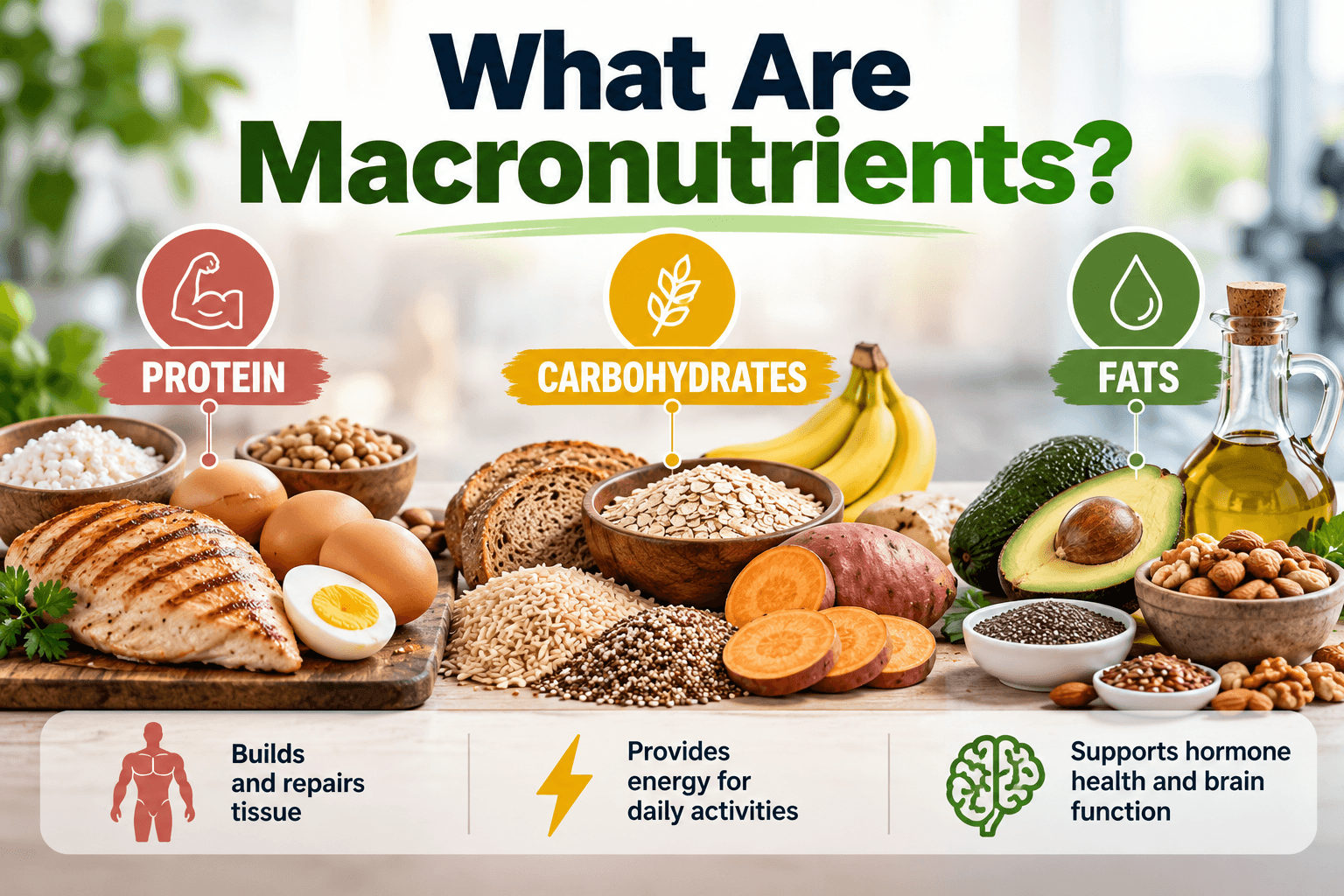
Macronutrients are nutrients your body needs in large amounts to provide energy and support essential functions. The three main energy-producing macronutrients are carbohydrates, proteins, and fats. Together, they help fuel daily activities, build and repair tissues, maintain healthy cells, and support normal metabolism.
Each macronutrient performs a different role. Carbohydrates are a major source of energy, protein provides the amino acids needed for growth and repair, and fats supply concentrated energy and essential fatty acids.
Here are the three macronutrients and what they do.
What Are the 3 Types of Macronutrients?
The three primary macronutrients are:
Carbohydrates: Provide approximately 4 calories per gram and help fuel the brain, muscles, and other tissues.
Protein: Provides approximately 4 calories per gram and supplies amino acids needed for muscle maintenance, tissue repair, enzymes, and immune function.
Fat: Provides approximately 9 calories per gram and supports energy storage, cell membranes, essential fatty acid intake, and the absorption of certain vitamins.
| Macronutrient | Calories per gram | Main functions | Common food sources |
|---|---|---|---|
| Carbohydrates | 4 | Energy production, glycogen storage | Oats, rice, potatoes, fruit, beans |
| Protein | 4 | Tissue maintenance, enzymes, immune function | Eggs, fish, chicken, lentils, tofu |
| Fat | 9 | Energy storage, cell structure, vitamin absorption | Olive oil, nuts, avocado, seeds, fatty fish |
Source: FDA Food Labeling Guide. Calorie values are standard approximations used in nutrition calculations.
Most foods contain a combination of macronutrients rather than just one. For example, lentils contain carbohydrates and protein, while almonds supply fat, protein, and carbohydrates.
Understanding these differences makes it easier to build meals that provide energy and a variety of essential nutrients.
1. Carbohydrates: The Body’s Major Dietary Energy Source
Carbohydrates are nutrients found in foods such as grains, fruits, vegetables, milk, and legumes. Many carbohydrates are broken down during digestion into glucose, which the body uses to produce energy.
Glucose is particularly important for the brain and working muscles. The body can use it immediately or store some as glycogen in the liver and muscles.
What Are the Main Types of Carbohydrates?
Carbohydrates are commonly divided into sugars, starches, and dietary fiber.
Sugars
Sugars are relatively simple carbohydrate molecules that occur naturally in foods or are added during processing.
Examples include fructose in fruit, lactose in milk, and sucrose in table sugar.
Naturally occurring sugars in whole foods are often accompanied by water, fiber, vitamins, or minerals. This makes the overall nutritional profile of an apple different from that of a sugar-sweetened drink.
Starches
Starches consist of chains of glucose molecules.
Common sources include rice, potatoes, oats, bread, pasta, and beans.
Digestible starches are broken down into glucose, although the rate of digestion varies depending on food structure, cooking, fiber, and other components of the meal.
Dietary Fiber
Fiber is a type of carbohydrate that human digestive enzymes cannot fully break down.
It supports bowel function, and certain fibers can influence fullness, blood glucose responses, and cholesterol levels.
Some fibers are fermented by intestinal microorganisms, producing short-chain fatty acids.
The World Health Organization recommends at least 25 grams of naturally occurring dietary fiber per day for adults, preferably from varied whole foods.
Learn more in our guide to dietary fiber, its benefits, and food sources.
Which Foods Are Good Sources of Carbohydrates?
Nutrient-rich carbohydrate sources include:
Oats, barley, and other whole grains
Brown rice and whole-wheat bread
Beans, chickpeas, and lentils
Potatoes and sweet potatoes
Apples, bananas, berries, and other fruits
Vegetables
The WHO’s healthy-diet guidance recommends choosing carbohydrates primarily from whole grains, vegetables, fruits, and pulses.
Are Carbohydrates Bad for You?
No. Carbohydrates are not inherently unhealthy.
The source and quality of carbohydrates often matter more than simply labeling a food as high-carb or low-carb.
For example, oats provide carbohydrates alongside fiber and other nutrients, while sugary drinks can provide substantial energy with little fiber.
People with diabetes or other metabolic conditions may need individualized carbohydrate guidance, but carbohydrates do not need to be universally avoided.
2. Protein: The Nutrient for Growth, Maintenance, and Repair
Protein is a macronutrient made from amino acids. The body uses these amino acids to build and maintain muscles, skin, organs, enzymes, hormones, and many other structures.
During digestion, dietary proteins are broken into smaller peptides and amino acids. After absorption, the body uses these building blocks to create the proteins required for normal function.
What Does Protein Do in the Body?
Maintains and repairs muscles
Protein provides amino acids required for muscle protein synthesis, the process through which the body builds and renews muscle proteins.
This process is important throughout life, particularly during growth, physical training, recovery, and aging.
Supports enzymes and hormones
Many enzymes are proteins that help control chemical reactions in the body.
Some hormones, including insulin, are also proteins or peptides.
Supports immune function
Antibodies are proteins that help the immune system recognize and respond to potentially harmful substances.
Maintains tissues and body structures
Structural proteins contribute to skin, connective tissues, organs, and many other parts of the body.
For a detailed explanation, read our guide to what protein is, how it works, and daily protein needs.
What Are Essential Amino Acids?
Human proteins are built from 20 commonly used amino acids.
Nine are considered essential because the body cannot produce them in sufficient amounts. They must come from food.
These include leucine, lysine, histidine, isoleucine, methionine, phenylalanine, threonine, tryptophan, and valine.
Both animal and plant-based foods can contribute to daily amino acid needs. A varied plant-based diet can supply all nine essential amino acids without requiring every meal to contain all of them.
Which Foods Are High in Protein?
Good protein sources include:
| Animal-based foods | Plant-based foods |
|---|---|
| Eggs | Lentils |
| Chicken | Chickpeas |
| Fish | Tofu |
| Yogurt | Tempeh |
| Milk | Soybeans |
| Lean meat | Beans |
| Cottage cheese | Nuts and seeds |
Protein content varies with portion size, brand, food type, and preparation.
How Much Protein Do You Need Every Day?
Protein needs depend on body weight, age, activity, pregnancy, and health status.
The long-established adult Recommended Dietary Allowance (RDA) is 0.8 grams per kilogram of body weight per day.
For example, using that reference:
| Body weight | Calculation | Protein per day |
|---|---|---|
| 50 kg | 50 × 0.8 | 40 g |
| 60 kg | 60 × 0.8 | 48 g |
| 70 kg | 70 × 0.8 | 56 g |
| 80 kg | 80 × 0.8 | 64 g |
These are baseline RDA calculations, not individualized optimal targets.
The newer Dietary Guidelines for Americans, 2025–2030, released in January 2026, recommend a higher protein target of approximately 1.2–1.6 g/kg/day, adjusted to individual circumstances.
For a 70-kilogram adult, that would equal 84–112 grams daily.
These different figures reflect distinct nutritional frameworks. The higher target should not be interpreted as a universal medical requirement or automatically applied to everyone.
Research also suggests that additional protein can modestly support lean-mass gains when combined with resistance exercise. A 2022 systematic review of 74 randomized trials found benefits from increased protein intake, particularly in participants performing resistance training.
However, more protein does not automatically produce greater muscle growth without appropriate training and overall nutrition.
People with kidney disease or other conditions affecting protein metabolism should seek individualized dietary advice.
Research: Systematic review of protein intake and muscle mass, 2022.
3. Dietary Fat: Essential for Energy, Cells, and Vitamin Absorption
Dietary fat provides approximately nine calories per gram, more than twice the energy supplied by protein or carbohydrates.
However, fat does more than provide calories.
The body uses fats to maintain cell membranes, store energy, and support several biological processes.
Dietary fat also helps the body absorb vitamins A, D, E, and K.
What Are the Main Types of Dietary Fat?
Monounsaturated fats
These occur in foods such as olive oil, avocados, and certain nuts.
Replacing saturated fats with unsaturated fats can support healthier blood cholesterol levels.
Polyunsaturated fats
These include omega-3 and omega-6 fatty acids.
Sources include walnuts, seeds, vegetable oils, and fatty fish.
Two fatty acids—linoleic acid and alpha-linolenic acid—are essential because the body cannot make them in sufficient amounts.
Saturated fats
Saturated fats occur in foods such as butter, fatty meats, cheese, coconut oil, and palm oil.
A high intake of saturated fat can increase LDL cholesterol in many people, particularly compared with diets emphasizing unsaturated fats.
Trans fats
Industrially produced trans fats are associated with harmful cardiovascular effects and should be avoided.
Which Foods Provide Healthier Fats?
Examples include:
Olive oil
Avocados
Almonds and walnuts
Chia seeds and flaxseeds
Salmon and sardines
Other nuts and seeds
The WHO recommends obtaining dietary fat primarily from unsaturated sources, limiting saturated fat to no more than 10% of daily energy, and trans fat to no more than 1%.
Does Research Support Replacing Saturated Fat?
A 2020 Cochrane review of long-term randomized trials found that reducing saturated fat intake may lower the risk of combined cardiovascular events.
The review found less clear evidence for an effect on overall mortality.
More recent research has emphasized that benefits may vary with baseline cardiovascular risk and which nutrients replace saturated fat.
These findings support paying attention to fat quality rather than avoiding all dietary fat.
Research: Cochrane Review: Reduction in Saturated Fat Intake for Cardiovascular Disease.
How Do Macronutrients Work Together in the Body?
The body processes carbohydrates, proteins, and fats through interconnected metabolic pathways.
Although each has particular functions, all three can contribute to energy metabolism.
| Macronutrient | What happens during digestion? | How the body uses it |
|---|---|---|
| Carbohydrates | Many are broken into simple sugars | Immediate energy and glycogen storage |
| Protein | Broken into peptides and amino acids | Tissue repair, protein synthesis, and other functions |
| Fat | Broken down and absorbed through specialized pathways | Energy, storage, cell structures, and signaling |
For example, after eating rice, fish, vegetables, and olive oil, your digestive system processes carbohydrate, protein, and fat together.
Glucose can supply energy, amino acids can help maintain tissues, and fatty acids can support energy metabolism and cell functions.
The presence of fat in the meal may also help with the absorption of fat-soluble compounds.
This explains why viewing foods only as “carbs,” “protein,” or “fat” misses part of their nutritional value.
Macronutrients vs. Micronutrients: What’s the Difference?
Macronutrients are needed in relatively large amounts, while micronutrients are needed in much smaller quantities.
| Feature | Macronutrients | Micronutrients |
|---|---|---|
| Main categories | Carbohydrates, protein, fat | Vitamins and minerals |
| Required quantities | Generally larger | Generally smaller |
| Energy contribution | Three main macros provide calories | No calories |
| Main roles | Energy, structures, metabolism | Supporting essential body processes |
| Examples | Starch, amino acids, fatty acids | Vitamin C, calcium, iron, zinc |
For example, almonds contain fat, protein, and carbohydrates, but they also supply micronutrients such as magnesium and vitamin E.
A food’s nutritional quality therefore cannot be judged by its macronutrient content alone.
For more information, explore our guide to the 13 types of vitamins and their functions.
Is Water a Macronutrient?
Water is an essential nutrient required in large amounts.
Some nutrition classifications include water among macronutrients for this reason.
However, conventional macronutrient tracking focuses on the three energy-yielding categories: carbohydrates, proteins, and fats.
Water supplies no calories, but it is essential for circulation, temperature control, nutrient transport, and normal body function.
How Much of Each Macronutrient Do You Need?
The amount of each macronutrient varies according to energy needs, health, age, and activity level.
The National Academies established the following Acceptable Macronutrient Distribution Ranges (AMDRs) for adults:
| Macronutrient | Percentage of daily calories |
|---|---|
| Carbohydrates | 45–65% |
| Protein | 10–35% |
| Fat | 20–35% |
These are broad adult reference ranges, not fixed requirements for every individual.
They also differ from certain newer dietary recommendations that emphasize specific gram-per-kilogram protein targets.
For most people, the important goal is obtaining sufficient nutrients through a balanced diet rather than meeting an exact percentage every day.
Source: National Academies Dietary Reference Intake Tables.
Example: Macronutrients in a 2,000-Calorie Diet
Suppose someone follows an illustrative 2,000-calorie eating pattern containing:
50% carbohydrates
20% protein
30% fat
The corresponding amounts would be:
| Macronutrient | Calories | Approximate grams |
|---|---|---|
| Carbohydrates | 1,000 | 250 g |
| Protein | 400 | 100 g |
| Fat | 600 | 67 g |
| Total | 2,000 |
These figures are an example of how macro percentages are converted into grams, not a personalized meal prescription.
Actual calorie needs vary. The percentage of calories from each macronutrient is only one part of assessing nutritional adequacy.
How Do You Calculate Macronutrients?
You can estimate the calories supplied by a food’s macronutrients using three simple equations:
Carbohydrate calories = grams of carbohydrate × 4
Protein calories = grams of protein × 4
Fat calories = grams of fat × 9
For example, consider the FDA’s sample Nutrition Facts label for a serving of lasagna.
The label lists a serving size of 1 cup (227 grams), with:
34 g total carbohydrate
15 g protein
9 g total fat
280 labeled calories
Using the simplified formulas:
| Macronutrient | Calculation | Estimated calories |
|---|---|---|
| Carbohydrates | 34 × 4 | 136 |
| Protein | 15 × 4 | 60 |
| Fat | 9 × 9 | 81 |
| Estimated total | 277 |
The label reports 280 calories.
Why the difference?
Food labels use rounding rules and can incorporate more detailed energy factors. Fiber and other carbohydrate components may also contribute different amounts of usable energy.
Consequently, macro-based calculations should be treated as estimates rather than exact laboratory measurements.
Source: FDA: How to Understand and Use the Nutrition Facts Label.
Which Foods Contain All Three Macronutrients?
Many everyday foods contain carbohydrates, protein, and fat in different proportions.
| Food | Main macronutrient contribution | Other nutritional contributions |
|---|---|---|
| Oats | Mostly carbohydrate | Protein, fat, fiber |
| Almonds | Mostly fat | Protein, carbohydrate, fiber |
| Lentils | Carbohydrate and protein | Fiber, minerals |
| Whole milk | Carbohydrate, protein, and fat | Calcium, vitamin B12 |
| Eggs | Protein and fat | Vitamins and minerals |
| Avocado | Mostly fat | Fiber, potassium |
| Salmon | Protein and fat | Omega-3 fatty acids |
These are broad nutritional descriptions. Exact values depend on serving size, variety, preparation, and processing.
One useful distinction is that the foods richest in a particular macronutrient are not necessarily the foods with the most balanced overall nutrient profile.
For example, olive oil is primarily fat, but it can still be a useful ingredient in a meal containing vegetables, whole grains, and protein foods.
How Can You Build a Balanced Meal With Macronutrients?
A balanced meal does not have to contain a precisely calculated ratio of carbs, protein, and fat.
Instead, focus on food quality, variety, and appropriate portions.
A practical meal could include:
Protein: Grilled fish, eggs, chicken, beans, or tofu.
Carbohydrates: Brown rice, oats, potatoes, or another whole grain.
Vegetables: Broccoli, spinach, carrots, or a colorful salad.
Healthy fats: Olive oil, nuts, seeds, or avocado.
Example 1: Balanced Breakfast
A bowl of oatmeal prepared with milk or fortified soy milk, topped with berries and a small serving of walnuts.
Oats provide carbohydrates and fiber.
Milk or soy milk adds protein.
Walnuts contribute unsaturated fat.
Berries supply fiber and micronutrients.
Example 2: Balanced Lunch
A serving of grilled chicken or tofu with brown rice, vegetables, and olive oil.
Chicken or tofu supplies protein.
Rice contributes carbohydrates.
Vegetables supply fiber and micronutrients.
Olive oil provides fat.
Example 3: Plant-Based Dinner
Lentils served with quinoa, roasted vegetables, and a small amount of olive oil.
This combination contributes carbohydrates, plant protein, fiber, essential fatty acids, vitamins, and minerals.
Meal portions should reflect individual energy and dietary requirements.
For a broader food-based framework, read our Complete Guide to Healthy Foods and Balanced Nutrition.
Do Macronutrients Matter for Weight Loss?
Yes. Macronutrients influence total energy intake, hunger, fullness, and body composition.
However, the amount of energy consumed relative to energy expenditure remains a major factor in weight change.
Protein can support muscle maintenance during weight loss, especially when combined with resistance exercise.
Fiber-rich carbohydrate foods may improve fullness and support dietary consistency.
Fat supplies essential nutrients and contributes to satisfaction from meals, but its higher energy density makes portion awareness useful.
For example, an eating pattern centered on vegetables, whole grains, legumes, suitable protein sources, and unsaturated fats may be easier to sustain than a highly restrictive plan that eliminates entire food groups.
A diet can meet its numerical macronutrient targets while still providing too little fiber or insufficient vitamins and minerals.
Macro balance and overall food quality must be considered together.
For a detailed comparison, read Protein vs. Calories: What Matters More for Weight Loss?.
Do Macronutrient Needs Change With Age?
Yes. Macronutrient needs can change with growth, aging, physical activity, and health status.
Children and Teenagers
Children need adequate energy, protein, essential fats, and other nutrients to support growth.
Their macronutrient reference ranges differ from adult values, particularly during early childhood.
Adult calorie targets and macro percentages should not automatically be applied to children.
Healthy Adults
Healthy adults generally benefit from a varied diet that provides sufficient energy, protein, essential fatty acids, fiber, vitamins, and minerals.
Individual needs differ according to body size, activity, and other factors. There is no universally optimal macro split determined by sex alone.
Adults Over 50 and 60
Maintaining muscle mass and physical function becomes increasingly important with age.
Adequate protein, sufficient energy, and regular resistance exercise can help support muscle health.
Older adults may require individualized protein targets, especially when managing illness, reduced appetite, or changes in physical activity.
Read our detailed guide to how much protein you need after 60.
Athletes and Physically Active People
Physically active people may require additional carbohydrates to support training and additional protein to support recovery and adaptation.
Requirements depend on training type, duration, intensity, and individual goals.
Sports nutrition advice should be tailored rather than based on a single universal ratio.
What Happens If You Don’t Get Enough Macronutrients?
Inadequate overall energy or macronutrient intake can interfere with normal body functions.
Insufficient protein can contribute to loss of muscle mass and impaired tissue maintenance, particularly when total energy intake is also inadequate.
Insufficient essential fatty acids can affect normal physiological functions, although deficiency is uncommon in people eating a varied diet.
Very restrictive eating patterns can also make it difficult to obtain enough fiber, vitamins, and minerals.
On the other hand, consuming more of any macronutrient than your body requires can contribute to excessive overall energy intake.
This does not mean one macronutrient should be completely avoided.
A balanced approach considers both nutrient adequacy and appropriate energy intake.
People who have kidney disease, diabetes, digestive disorders, food allergies, or other conditions requiring special diets may need professional guidance before making major macronutrient changes.
Common Macronutrient Myths
Myth 1: Carbohydrates automatically cause weight gain
Carbohydrates do not independently determine weight gain.
Total energy intake, food choices, activity, and other factors influence body weight. Whole grains, fruit, and legumes can be part of a healthy eating pattern.
Myth 2: Eating fat automatically makes you gain body fat
Dietary fat supplies concentrated energy, but it does not automatically cause body-fat gain.
Unsaturated fats are important components of a balanced diet.
Myth 3: More protein always means more muscle
Protein provides amino acids for muscle maintenance and growth, but muscle-building responses also depend on resistance exercise, total energy, recovery, and other factors.
Myth 4: Healthy eating requires tracking every macro
Many people can meet their nutritional needs without counting individual grams of carbohydrate, protein, or fat.
Food variety, reasonable portions, and overall dietary quality are often more practical starting points.
Frequently Asked Questions About Macronutrients
What are macronutrients in simple terms?
Macronutrients are nutrients needed in relatively large amounts. The three main energy-providing macronutrients are carbohydrates, proteins, and fats.
What are the three main macronutrients?
Carbohydrates, protein, and fat are the three main macronutrients used to provide dietary energy.
Which macronutrient gives the most energy?
Fat supplies approximately nine calories per gram, compared with four calories per gram for carbohydrates and protein.
Is fiber a macronutrient?
Fiber is classified as a type of carbohydrate. It has different digestive properties from most sugars and starches and is important for healthy digestion.
Is water considered a macronutrient?
Water is sometimes classified as a macronutrient because it is required in large quantities. Unlike carbohydrates, protein, and fat, it supplies no calories.
What is the difference between calories and macronutrients?
Calories are units of energy. Macronutrients are nutrients that supply energy and perform other biological functions.
What is the best macronutrient ratio?
There is no single ideal macronutrient ratio for everyone. Reference ranges can be useful, but individual needs depend on health, age, activity, and dietary goals.
Should you count macros to lose weight?
Counting macros can help some people monitor food intake, but it is not essential for weight loss or healthy eating. Total energy balance, dietary quality, and long-term consistency remain important.
The Bottom Line
Macronutrients are essential parts of everyday nutrition.
Carbohydrates provide a major source of dietary energy, protein supplies amino acids needed for maintenance and repair, and fat supports energy storage, cell structures, and other vital functions.
Each has a different purpose, and most nutritious foods contain a combination of them.
Understanding macronutrients can help you read food labels, compare food choices, and plan meals more confidently.
But a healthy diet is not determined by hitting exact macro percentages alone.
The most useful approach is to eat a variety of nutrient-dense foods, obtain enough energy and essential nutrients, and adjust your eating pattern to your individual needs.
References
U.S. Food and Drug Administration (FDA). How to Understand and Use the Nutrition Facts Label. Serving sizes, nutrient values, and label interpretation.
National Academies of Sciences, Engineering, and Medicine. Dietary Reference Intake Tables. Established adult macronutrient distribution ranges.
World Health Organization (WHO). Healthy Diet. Updated January 2026. Dietary quality, carbohydrates, fats, fiber, and healthy-eating recommendations.
U.S. Department of Agriculture and Department of Health and Human Services. Dietary Guidelines for Americans, 2025–2030. Current U.S. dietary recommendations, including protein guidance.
U.S. Food and Drug Administration (FDA). Calories on the Nutrition Facts Label. Energy information and calorie interpretation.
National Institutes of Health — Office of Dietary Supplements. Nutrient Recommendations and Databases. Dietary Reference Intakes and nutrition database resources.
Systematic Review and Meta-Analysis (2022). Protein Intake to Support Muscle Mass and Function in Healthy Adults. Evidence on protein consumption and lean body mass.
Cochrane Database of Systematic Reviews (2020). Reduction in Saturated Fat Intake for Cardiovascular Disease. Randomized-trial evidence concerning saturated fat and cardiovascular outcomes.
USDA FoodData Central. Food Composition Database. Reference database for verifying nutritional composition and serving-based values.
Medical disclaimer: This article is for educational purposes. Nutritional requirements vary by individual, and medical conditions may require personalized dietary advice.