
What Are the 20 Best Exercises for Belly Fat Loss?
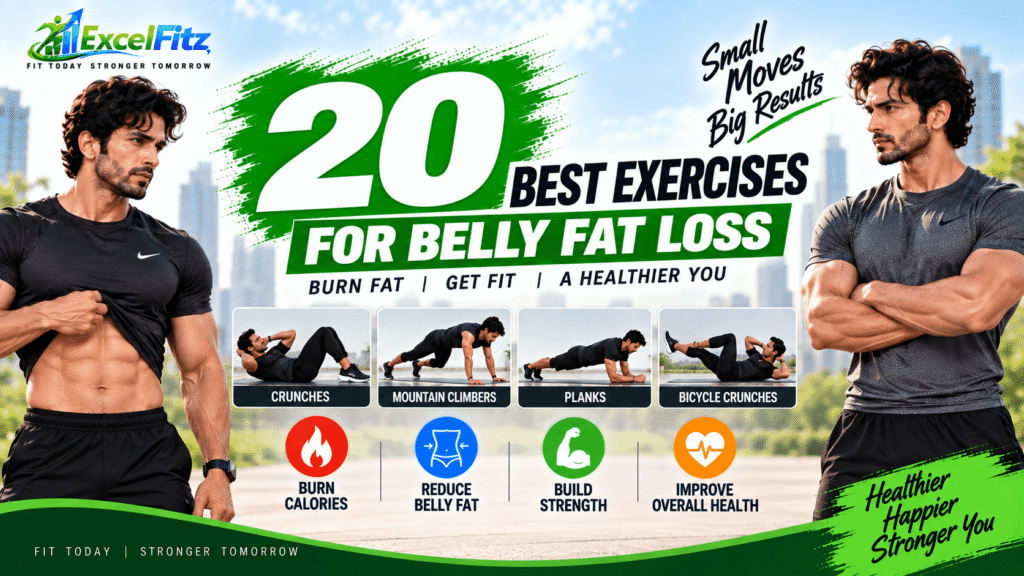
The following 20 exercises can form part of a well-rounded program for reducing overall and abdominal fat while improving cardiovascular fitness, strength, and core stability:
- Brisk Walking
- Running
- Cycling
- Swimming
- Rowing
- Stair Climbing
- Jump Rope
- Jumping Jacks
- Mountain Climbers
- Burpees
- High Knees
- Bodyweight Squats
- Reverse Lunges
- Push-Ups
- Planks
- Side Planks
- Dead Bugs
- Bird Dogs
- Bicycle Crunches
- Russian Twists
These exercises fall into four useful categories: aerobic exercise, cardiovascular conditioning, resistance training, and core training. Combining categories generally produces a more complete fitness program than relying only on abdominal exercises.
How Do You Perform These 20 Belly-Fat-Loss Exercises?
Each exercise contributes differently to a fat-loss and fitness program. Aerobic and conditioning exercises generally increase cardiovascular demand, resistance movements train major muscles, and direct core exercises develop trunk strength and control.
1. Brisk Walking

Brisk walking is one of the most accessible aerobic exercises for increasing physical activity and supporting fat loss. It requires little equipment, can be performed almost anywhere, and is easier to recover from than high-impact exercise.
Brisk walking counts as moderate-intensity aerobic activity when the pace raises breathing and heart rate noticeably.
How to do it:
- Stand tall with relaxed shoulders.
- Walk at a purposeful pace.
- Swing the arms naturally.
- Maintain a pace that makes you breathe faster while still allowing conversation.
- Begin with 20–30 minutes if appropriate.
Primary purpose: Aerobic activity
Difficulty: Beginner
Impact: Low
Equipment: Supportive footwear
Good for: Beginners and increasing weekly activity
Increase duration, pace, incline, or weekly walking volume gradually.
2. Running

Running is a vigorous aerobic exercise that can increase cardiovascular demand and energy expenditure in less time than lower-intensity walking.
Running involves repeated lower-body movement and primarily challenges the cardiovascular system, legs, and supporting musculature.
How to do it:
- Begin with a comfortable walking warm-up.
- Keep the torso upright.
- Use a natural stride rather than deliberately overstriding.
- Maintain a sustainable pace.
- Slow down or alternate running with walking as needed.
Primary purpose: Vigorous aerobic exercise
Difficulty: Intermediate
Impact: High
Equipment: Appropriate shoes
Beginners can use a run-walk approach such as one minute of jogging followed by one or two minutes of walking.
3. Cycling

Cycling provides aerobic exercise with less impact than running and can be adjusted from easy recovery work to vigorous intervals.
The quadriceps, glutes, hamstrings, and calves contribute to pedaling while the cardiovascular system supports sustained activity.
How to do it:
- Adjust the seat to a comfortable height.
- Keep the knees tracking naturally.
- Pedal at a sustainable cadence.
- Increase resistance gradually.
- Use either continuous riding or intervals.
Primary purpose: Aerobic conditioning
Difficulty: Beginner to advanced
Impact: Low
Equipment: Bicycle or stationary bike
Cycling can be particularly useful for people who want higher cardiovascular activity without repetitive running impact.
4. Swimming

Swimming is a low-impact, whole-body aerobic activity that can contribute to weekly exercise volume while training multiple muscle groups.
Water supports body weight while creating resistance against the arms and legs.
How to do it:
- Choose a stroke you can perform safely.
- Swim at an easy-to-moderate pace initially.
- Rest between lengths when needed.
- Gradually increase continuous swimming time.
Primary purpose: Aerobic exercise
Impact: Low
Difficulty: Depends on swimming ability
Equipment: Access to a pool
Swimming is a useful alternative when land-based high-impact cardio is uncomfortable.
5. Rowing

Rowing combines cardiovascular exercise with repeated muscular work from the legs, hips, back, arms, and core.
A rowing machine can be used for steady aerobic training or interval-based conditioning.
How to do it:
- Start with the knees bent and arms extended.
- Push through the legs.
- Extend the hips.
- Pull the handle toward the lower ribs.
- Reverse the movement under control.
Primary purpose: Full-body conditioning
Difficulty: Intermediate
Equipment: Rowing machine
Correct technique is more important than immediately increasing speed or resistance.
6. Stair Climbing

Stair climbing raises heart rate while strongly engaging the lower body, particularly the quadriceps, glutes, and calves.
It can provide vigorous cardiovascular work without requiring running.
How to do it:
- Maintain an upright posture.
- Place the whole foot securely on each step.
- Push through the working leg.
- Avoid relying heavily on railings.
- Begin with short intervals if necessary.
Primary purpose: Aerobic conditioning
Difficulty: Intermediate
Equipment: Stairs or stair machine
Increase duration before attempting very high speeds.
7. Jump Rope

Jumping rope is a vigorous conditioning exercise that combines cardiovascular demand with coordination and lower-leg endurance.
Because it involves repeated jumping, it is higher impact than walking or cycling.
How to do it:
- Keep the elbows near the sides.
- Turn the rope primarily with the wrists.
- Make small jumps.
- Land softly.
- Maintain a steady rhythm.
Primary purpose: Cardiovascular conditioning
Difficulty: Intermediate
Impact: High
Beginners can alternate 20–30 seconds of jumping with longer recovery periods.
8. Jumping Jacks

Jumping jacks are a simple whole-body conditioning exercise that can quickly increase heart rate.
They work well inside circuits and require no equipment.
How to do it:
- Start with feet together and arms by the sides.
- Jump the feet outward.
- Raise the arms overhead.
- Jump back to the starting position.
- Repeat at a controlled rhythm.
Primary purpose: Conditioning
Equipment: None
Difficulty: Beginner to intermediate
For a low-impact variation, step one foot outward at a time instead of jumping.
9. Mountain Climbers

Mountain climbers combine cardiovascular conditioning with a plank position, requiring the core and shoulders to stabilize the body while the legs move rapidly.
They provide both cardiovascular and trunk-stability demands.
How to do it:
- Start in a high plank.
- Keep the hands under the shoulders.
- Bring one knee toward the chest.
- Switch legs.
- Maintain a stable torso.
Primary purpose: Conditioning plus core stability
Difficulty: Intermediate
Equipment: None
Beginners can slow the movement and step each knee forward rather than switching quickly.
10. Burpees

Burpees are vigorous full-body conditioning exercises that combine several movements into one sequence.
A typical burpee incorporates a squat, plank transition, return to standing, and jump.
How to do it:
- Begin standing.
- Squat and place the hands on the floor.
- Step or jump the feet backward.
- Hold a plank briefly.
- Return the feet forward.
- Stand or jump upward.
Primary purpose: Full-body conditioning
Difficulty: Intermediate to advanced
Impact: Moderate to high
Burpees are optional. They are not required to lose abdominal fat.
11. High Knees

High knees are a running-in-place drill that rapidly increases cardiovascular demand while involving the hips, legs, and trunk.
How to do it:
- Stand upright.
- Drive one knee upward.
- Alternate legs rapidly.
- Pump the arms naturally.
- Maintain control rather than leaning backward.
Primary purpose: Cardiovascular conditioning
Difficulty: Intermediate
Impact: Moderate to high
Fast marching provides a lower-impact alternative.
12. Bodyweight Squats

Bodyweight squats are resistance exercises that primarily strengthen the quadriceps, glutes, and other lower-body muscles.
Resistance training can complement aerobic activity when the goal is improved body composition.
How to do it:
- Stand with feet at a comfortable width.
- Brace the trunk.
- Bend at the hips and knees.
- Lower under control.
- Push through the feet to return to standing.
Primary purpose: Resistance training
Difficulty: Beginner
Equipment: None
A meta-analysis of randomized trials found that resistance training can reduce body-fat percentage, fat mass, and visceral-fat measures compared with no-exercise controls.
13. Reverse Lunges
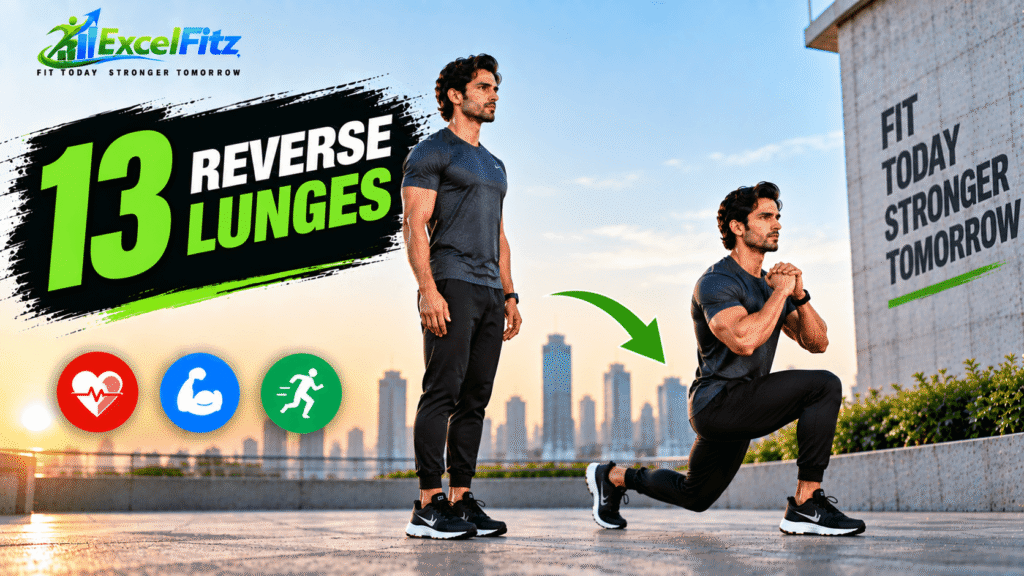
Reverse lunges train the legs and glutes one side at a time while also challenging balance and trunk control.
How to do it:
- Stand upright.
- Step one leg backward.
- Bend both knees under control.
- Keep the front foot planted.
- Push through the front leg to return.
- Alternate sides.
Primary purpose: Resistance training
Difficulty: Beginner to intermediate
Equipment: None or optional weights
Holding onto a stable support can make the exercise easier for beginners.
14. Push-Ups
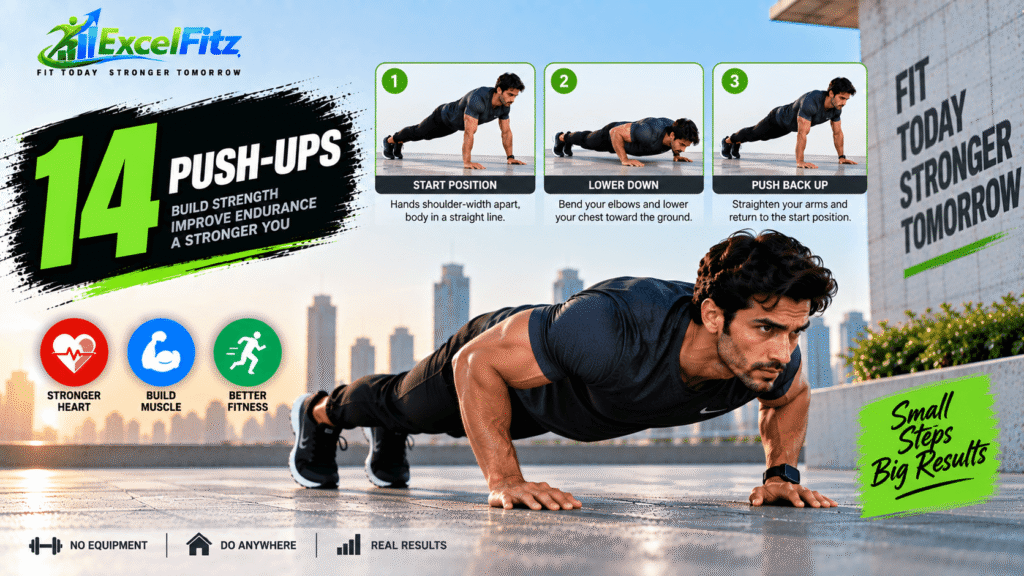
Push-ups are bodyweight resistance exercises that primarily train the chest, shoulders, and triceps while requiring the core to stabilize the torso.
How to do it:
- Place the hands slightly wider than shoulder-width.
- Keep the body in a straight line.
- Lower the chest toward the floor.
- Keep the elbows under control.
- Press back to the starting position.
Primary purpose: Upper-body resistance training
Difficulty: Scalable
Equipment: None
Beginners can perform push-ups against a wall, countertop, or bench.
15. Planks
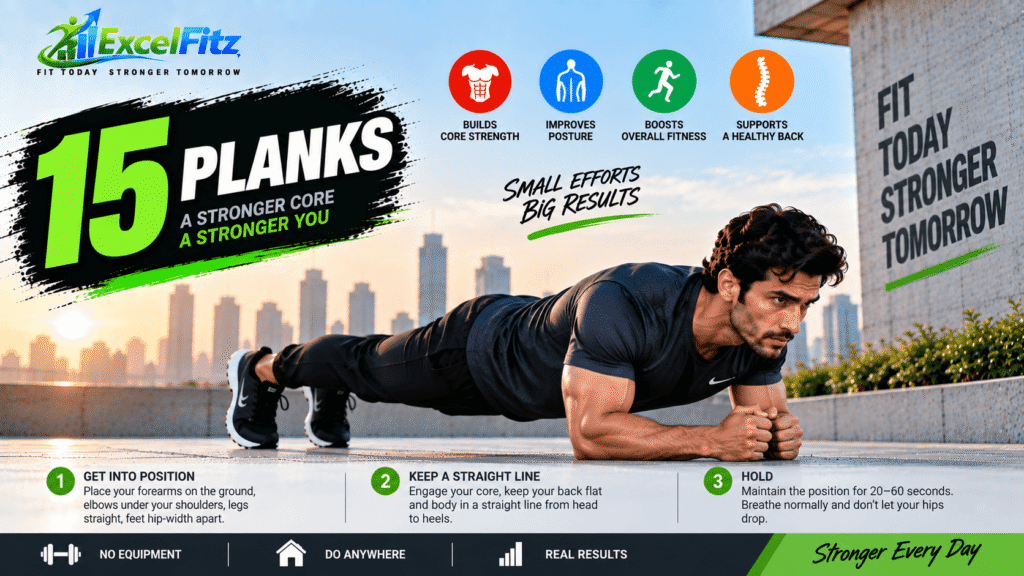
Planks are isometric core exercises that train the trunk to resist unwanted spinal movement.
Planks strengthen the abdominal and surrounding trunk muscles, but they should not be described as exercises that directly melt fat from the stomach.
How to do it:
- Place the forearms or hands on the floor.
- Extend the legs behind you.
- Maintain a straight line from head to heels.
- Brace the abdominal muscles.
- Hold while breathing normally.
Primary purpose: Core stability
Difficulty: Beginner to intermediate
Start with 15–30 seconds of controlled positioning rather than sacrificing form for longer holds.
16. Side Planks
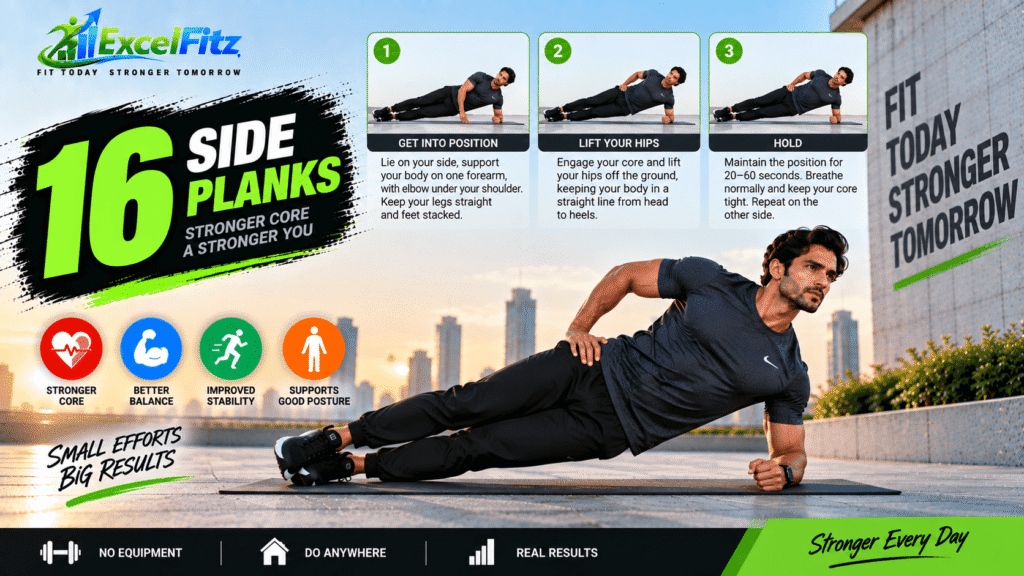
Side planks emphasize lateral trunk stability and train the oblique abdominal muscles along with other stabilizers.
How to do it:
- Lie on one side.
- Place the elbow beneath the shoulder.
- Stack or stagger the feet.
- Lift the hips.
- Maintain a straight body line.
- Repeat on both sides.
Primary purpose: Lateral core stability
Difficulty: Intermediate
Keeping the lower knee on the floor provides an easier modification.
17. Dead Bugs
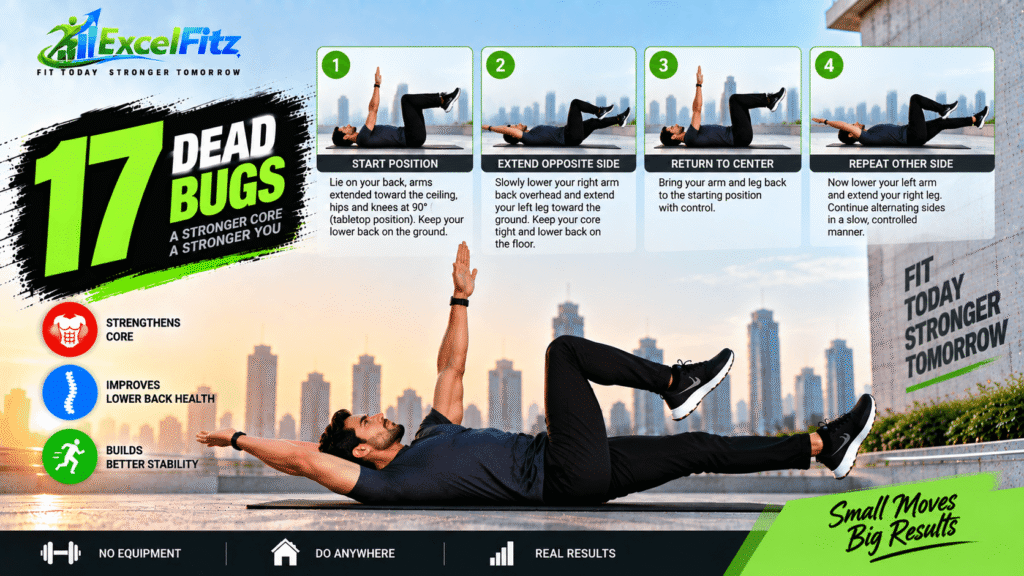
Dead bugs are low-impact core exercises that train trunk control while the arms and legs move independently.
How to do it:
- Lie on your back.
- Raise the arms.
- Bend the hips and knees.
- Brace the abdomen.
- Extend the opposite arm and leg.
- Return and switch sides.
Primary purpose: Core control and coordination
Difficulty: Beginner
Impact: Low
Only extend as far as you can while maintaining good trunk control.
18. Bird Dogs
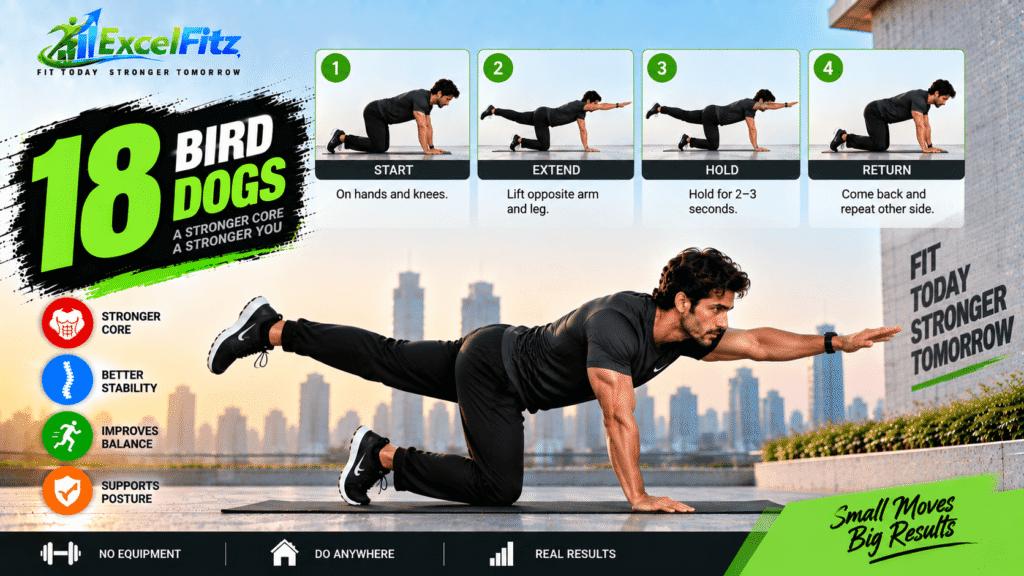
Bird dogs train core stability, balance, and coordination from a hands-and-knees position.
How to do it:
- Start on hands and knees.
- Brace the torso.
- Extend one arm forward.
- Extend the opposite leg backward.
- Avoid rotating the hips.
- Return and change sides.
Primary purpose: Core stability
Difficulty: Beginner
Impact: Low
Move slowly and prioritize stability rather than reaching as far as possible.
19. Bicycle Crunches
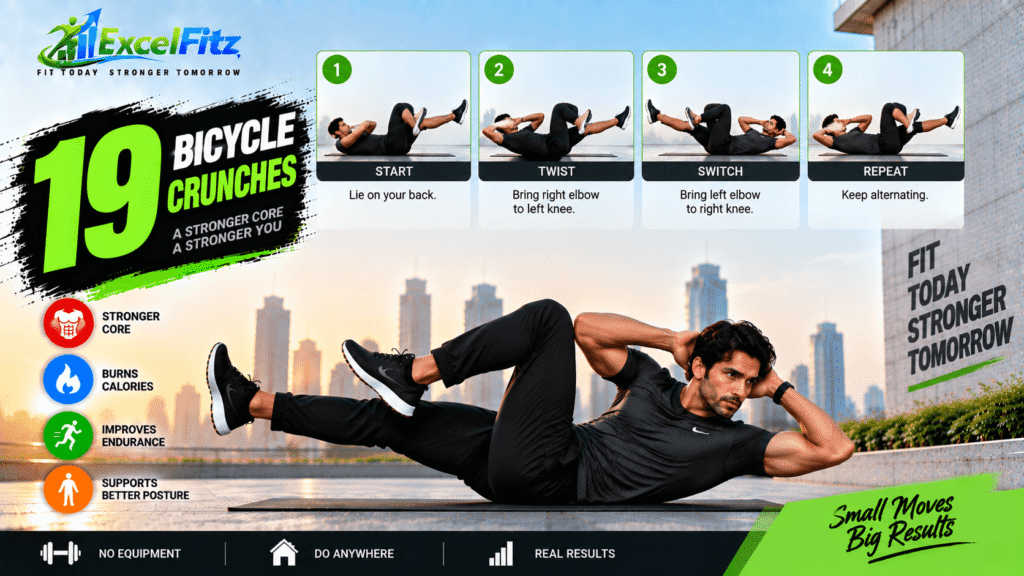
Bicycle crunches are dynamic abdominal exercises that combine trunk flexion with rotation.
They primarily train the abdominal musculature rather than serving as high-calorie-expenditure cardio.
How to do it:
- Lie on your back.
- Place the hands lightly behind the head.
- Bring one knee toward the torso.
- Rotate the opposite shoulder toward that knee.
- Alternate sides slowly.
Primary purpose: Dynamic core training
Difficulty: Intermediate
Avoid pulling the head forward with the hands.
20. Russian Twists
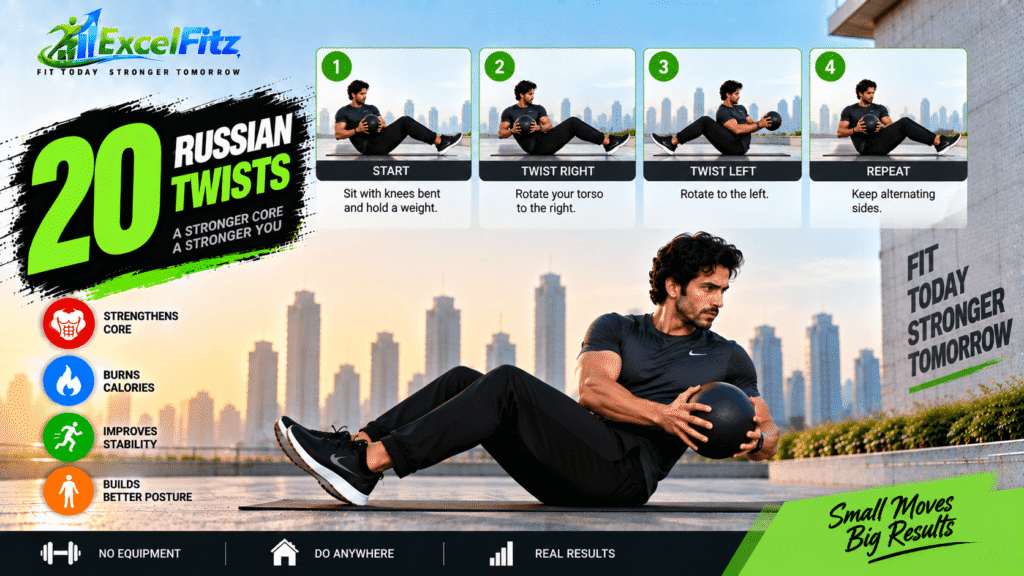
Russian twists are rotational core exercises performed from a seated position.
The exercise trains rotational control, but aggressive twisting is unnecessary and may be uncomfortable for some people.
How to do it:
- Sit with the knees bent.
- Lean backward slightly while maintaining trunk control.
- Bring the hands together.
- Rotate gently from side to side.
- Use a controlled range of motion.
Primary purpose: Rotational core training
Difficulty: Intermediate
Equipment: Optional weight
People with back discomfort may prefer bird dogs, dead bugs, or side planks.
Can Exercise Actually Reduce Belly Fat?
Yes. Regular exercise can help reduce abdominal fat, including visceral adipose tissue, although the amount of change varies between people and programs.
A 2024 network meta-analysis covering 84 randomized controlled trials and 4,836 participants with overweight or obesity found that aerobic exercise, resistance training, combined exercise, and high-intensity interval training could all reduce visceral adipose tissue.
This means belly-fat management does not depend on one special exercise. Different forms of physical training can contribute through different mechanisms.
Exercise also increases energy expenditure. When total energy expenditure exceeds energy intake over time, stored body energy—including body fat—can decrease.
Can Ab Exercises Specifically Burn Belly Fat?
Abdominal exercises strengthen the abdominal muscles, but they should not be relied upon as a guaranteed way to selectively remove fat covering those muscles.
In one randomized study, six weeks of abdominal exercises improved muscular endurance but did not significantly reduce abdominal fat.
Research into localized fat loss continues, and small studies have produced findings worth further investigation. However, the evidence is not strong enough to promise that repeatedly exercising one body part will reliably remove fat from that exact location.
A useful distinction is:
Core training → stronger abdominal and trunk muscles
Whole-body activity + appropriate energy balance → greater potential for body-fat reduction
Which Exercises Are Better for Fat Loss and Which Strengthen the Core?
Aerobic and whole-body exercises contribute more directly to cardiovascular activity and energy expenditure, while planks, dead bugs, bird dogs, and crunch variations mainly develop core strength.
| Exercise category | Main function | Examples | Role in belly-fat goal |
|---|---|---|---|
| Aerobic | Cardiovascular activity and energy expenditure | Walking, running, cycling, swimming | Supports overall and abdominal-fat reduction |
| Conditioning | Higher-intensity cardiovascular work | Jump rope, mountain climbers, burpees | Adds vigorous activity and fitness |
| Resistance | Strength and muscle development | Squats, lunges, push-ups | Supports strength and body composition |
| Core | Trunk strength and stability | Planks, dead bugs, bird dogs | Strengthens abdominal and supporting muscles |
A strong program does not need to choose only one category.
Is Cardio or Strength Training Better for Belly Fat?
Both cardio and resistance training can support abdominal-fat reduction, and combining them provides complementary benefits.
Aerobic exercise makes it easier to accumulate cardiovascular activity and increase weekly energy expenditure.
Resistance training helps build or preserve strength and lean tissue while also contributing to total physical activity.
A meta-analysis of controlled trials found reductions in subcutaneous abdominal fat following aerobic, resistance, and combined exercise programs.
For most people, a balanced week is more useful than framing cardio and strength as competing choices.
Is HIIT Better Than Steady Cardio for Abdominal Fat?
HIIT can reduce abdominal and visceral fat, but current evidence does not consistently show that it is superior to continuous aerobic exercise.
Research has found reductions in abdominal and visceral fat following HIIT programs. However, direct comparisons with continuous aerobic exercise have not consistently demonstrated a meaningful fat-loss advantage.
Choose based on:
- fitness level
- joint tolerance
- available time
- personal preference
- recovery capacity
- consistency
Someone who enjoys brisk walking five days per week may achieve better long-term adherence than someone forcing themselves through HIIT they dislike.
How Can Beginners Combine These Exercises Into a Workout?
Beginners can combine a few resistance and core exercises with moderate cardio instead of attempting all 20 exercises in one session.
A simple example:
Warm-up
- 5 minutes easy walking
Strength and core circuit — 2 rounds
- 10 bodyweight squats
- 8 reverse lunges per leg
- 8–12 incline push-ups
- 20-second plank
- 8 dead bugs per side
- 8 bird dogs per side
Cardio
- 15–20 minutes brisk walking or cycling
Progress gradually by increasing duration, repetitions, sets, or resistance.
Do not increase every training variable at the same time.
How Often Should You Exercise for Fat Loss?
Adults should generally work toward at least 150 minutes of moderate-intensity aerobic activity per week or an equivalent amount of vigorous activity, plus muscle-strengthening work on at least two days.
U.S. guidelines recommend 150–300 minutes of moderate-intensity aerobic activity weekly, while WHO similarly recommends 150–300 minutes of moderate aerobic activity or 75–150 minutes of vigorous activity.
A practical beginner schedule could be:
| Day | Exercise |
|---|---|
| Monday | 30-minute brisk walk |
| Tuesday | Strength + core |
| Wednesday | 30-minute cycling or walking |
| Thursday | Rest or light walking |
| Friday | Strength + core |
| Saturday | 30–45 minutes aerobic exercise |
| Sunday | Recovery or easy walking |
The best schedule is one that is safe enough and realistic enough to repeat consistently.
What Common Belly-Fat Workout Mistakes Should You Avoid?
The biggest mistake is treating belly-fat loss as an abdominal-exercise problem instead of a whole-body fitness and energy-balance goal.
Common mistakes include:
- Doing hundreds of crunches while ignoring full-body exercise
- Believing sweating equals fat loss
- Skipping resistance training
- Attempting advanced HIIT too soon
- Training intensely every day without adequate recovery
- Ignoring daily walking and general physical activity
- Expecting visible changes within a few days
- Using poor technique to complete more repetitions
- Assuming exercise automatically compensates for excessive calorie intake
Consistency is more valuable than repeatedly switching to whichever exercise is marketed as the newest “fat burner.”
Who Should Modify These Exercises?
People who cannot comfortably tolerate running, jumping, vigorous intervals, or certain floor exercises should choose lower-impact alternatives rather than forcing painful movements.
Useful substitutions include:
- Running → brisk walking
- Jump rope → cycling
- Jumping jacks → step jacks
- High knees → fast marching
- Burpees → step-back burpees
- Floor push-ups → incline push-ups
- Russian twists → bird dogs
- Long planks → shorter plank intervals
Moderate physical activity is safe for most adults, but people with chronic medical conditions or those planning to start vigorous activity after long periods of inactivity may benefit from discussing suitable exercise with a healthcare professional.
Stop exercising and seek appropriate medical guidance if activity causes symptoms such as chest pain, fainting, or unusual severe shortness of breath.
What Are the Key Takeaways?
- Walking, running, cycling, swimming, resistance exercises, conditioning movements, and core training can all contribute to a complete fitness program.
- No single exercise reliably targets belly fat alone.
- Aerobic exercise helps increase cardiovascular activity and energy expenditure.
- Resistance training supports strength and body composition.
- Core exercises strengthen the abdominal and trunk muscles.
- HIIT can work, but it is not mandatory and is not consistently superior to continuous cardio for fat loss.
- Beginners should prioritize consistency and progressive training rather than maximal intensity.
- Aim to combine regular aerobic activity with at least two weekly strength-training sessions.
Frequently Asked Questions
What Are the 20 Best Exercises and Workouts for Belly Fat Loss?
The best exercises for belly-fat loss include walking, running, cycling, swimming, resistance training, higher-intensity conditioning, and core exercises. These activities do not all work in the same way: cardio increases aerobic activity and energy expenditure, resistance exercises train major muscle groups, and core exercises strengthen the muscles of the trunk.
No exercise can be guaranteed to selectively remove fat only from your stomach. A better strategy is to combine whole-body activity that supports overall fat loss with core exercises that strengthen the abdominal muscles underneath the fat.
For most adults, a balanced program can include moderate or vigorous aerobic exercise plus strength training at least twice per week. U.S. physical-activity guidelines recommend 150–300 minutes of moderate-intensity aerobic activity per week, along with muscle-strengthening exercise on at least two days.
What exercise burns the most belly fat?
No single exercise selectively burns the most belly fat. Regular aerobic exercise, resistance training, and appropriate high-intensity training can all contribute to reductions in overall and abdominal fat.
Can walking help reduce belly fat?
Yes. Brisk walking increases physical activity and energy expenditure and can contribute to an overall fat-loss program when performed consistently.
Do planks burn belly fat?
Planks primarily strengthen the core. They can be part of a comprehensive fat-loss program but should not be expected to selectively remove abdominal fat.
Do crunches get rid of belly fat?
Crunches train the abdominal muscles but do not reliably remove the fat covering those muscles when performed alone.
Is running better than walking for belly fat?
Running is more vigorous and generally increases energy expenditure more quickly, while walking is lower impact and easier for many people to sustain. Both can be useful.
Is HIIT good for reducing belly fat?
Yes. HIIT can contribute to reductions in abdominal and visceral fat, but evidence does not consistently show it is superior to continuous aerobic exercise.
Should I do cardio or abs first?
The order depends on your training goal. If cardiovascular fitness is the priority, cardio can come first; if core strength or resistance performance is the priority, strength work may come first.
How many days per week should I exercise?
Aim to accumulate at least 150 minutes of moderate aerobic activity each week and perform muscle-strengthening activities on at least two days, adjusting the schedule to your ability and recovery.

ARTICLE REVIEWED BY
Alex John
Nutritionist
Alex John is a nutritionist who provides practical guidance on balanced eating, walking, exercise, simple workouts, weight management, and natural ways to develop healthier daily habits.







2 Responses