
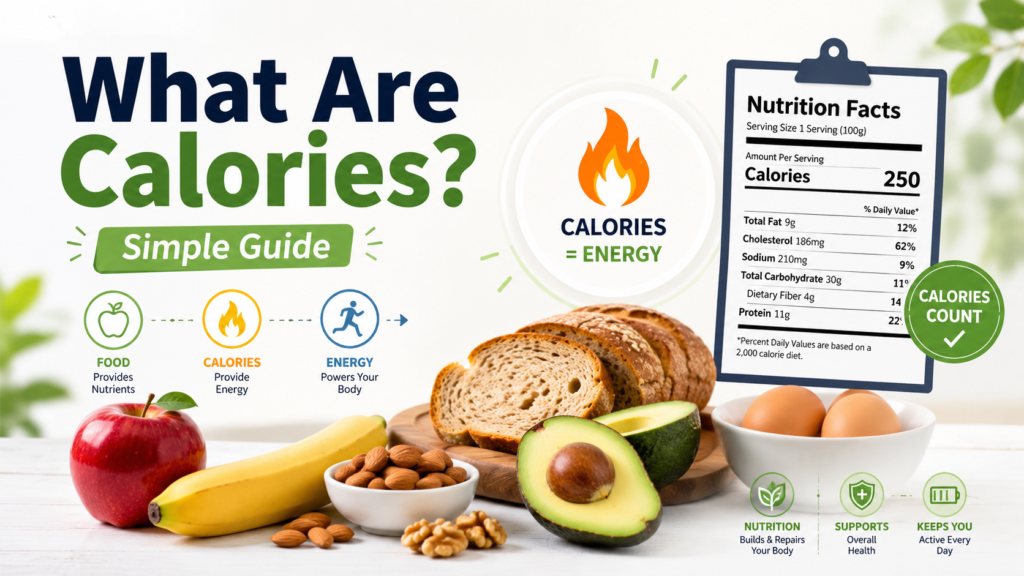
What Are Calories? A Simple Guide to Food Energy
Calories are units of energy. In nutrition, calories tell you how much energy your body can get from a food or drink.
Your body uses calories for basic survival, movement, digestion, thinking, breathing, and repairing tissues. MedlinePlus defines calories as food energy supplied by carbohydrates, fats, protein, and alcohol.
The simple truth is this: calories matter, but calories are not the whole story. A 300-calorie meal with protein, fiber, vitamins, and minerals affects your body differently from 300 calories of candy or soda.
What Are Calories in Simple Terms?
Calories are a measure of energy from food and drinks. When a food label says a serving has 150 calories, it means that serving provides 150 units of usable food energy.
In everyday nutrition, the word “calorie” usually means “kilocalorie,” or kcal. This is the larger energy unit used on food labels and diet plans. The technical “small calorie” is different, but most people do not need to use it in daily eating decisions. NIH’s StatPearls explains that food Calories are “big” calories, equal to 1,000 small calories.
A simple way to understand calories:
- Food gives your body energy.
- Calories measure that energy.
- Your body spends calories to stay alive and move.
- Eating more or fewer calories than your body uses can affect body weight over time.
Why Does the Body Need Calories?
The body needs calories because calories fuel essential life functions. Even when you are resting, your body uses energy for breathing, blood circulation, brain activity, digestion, temperature regulation, and cell repair.
Calories are not “bad.” The problem is not calories themselves. The problem is regularly eating far more or far fewer calories than your body needs, or getting too many calories from foods that provide little nutritional value.
Your body uses calories for:
- Basal metabolism: energy used at rest for survival.
- Physical activity: walking, exercising, working, cleaning, and movement.
- Digestion: breaking down and processing food.
- Growth and repair: building tissue, healing, and maintaining muscle.
- Brain function: thinking, focusing, and regulating body systems.
This is why very low-calorie diets can be risky without medical supervision. Your body needs enough energy and nutrients to function well.
What Is the Difference Between Calories, Kilocalories, and kcal?
A kilocalorie, or kcal, is the same unit most food labels call a Calorie. In nutrition writing, “calorie,” “Calorie,” and “kcal” are often used to mean the same practical thing: food energy.
Technically:
| Term | Meaning | Every day nutrition use |
|---|---|---|
| Small calorie, or cal | Energy needed to raise 1 gram of water by 1°C | Rarely used in food discussions |
| Kilocalorie, or kcal | 1,000 small calories | Used in nutrition science |
| Calorie, with capital C | Same as 1 kilocalorie | Common on food labels |
| calorie, casual use | Usually means kcal | Common in diets and apps |
For a beginner, the key point is simple: when a food label says “200 calories,” it means 200 kilocalories of food energy.
Where Do Calories in Food Come From?
Calories in food come mainly from macronutrients: carbohydrates, protein, and fat. Alcohol also provides calories, although alcohol is not an essential nutrient.
Food does not contain calories randomly. Calories come from the chemical energy stored in nutrients. The FDA says calories on Nutrition Facts labels refer to total energy from all sources in a serving, including carbohydrate, fat, protein, and alcohol.
Which Nutrients Provide Calories?
Carbohydrates and protein provide 4 calories per gram, while fat provides 9 calories per gram. This is why high-fat foods are often more calorie-dense than high-carbohydrate or high-protein foods. The USDA Food and Nutrition Information Center lists carbohydrates at 4 calories per gram, protein at 4 calories per gram, and fat at 9 calories per gram.
| Nutrient | Calories per gram | Common sources |
|---|---|---|
| Carbohydrate | 4 calories | Grains, fruit, beans, milk, starchy vegetables, sweets |
| Protein | 4 calories | Meat, fish, eggs, dairy, beans, tofu, lentils |
| Fat | 9 calories | Oils, butter, nuts, seeds, avocado, fatty meats |
| Alcohol | Provides calories | Beer, wine, spirits, cocktails |
Fat has more than twice the calories per gram of carbohydrate or protein. That does not make fat unhealthy by default. It means portions of high-fat foods can add calories quickly.
Which Foods Are Usually Higher or Lower in Calories?
High-calorie foods usually contain more fat, added sugar, refined starch, or large portion sizes. Lower-calorie foods often contain more water, fiber, and volume.
Common higher-calorie foods include:
- Fried foods
- Pastries and desserts
- Sugary drinks
- Fast food meals
- Butter, oils, cream, and cheese
- Nuts and nut butters
- Processed snack foods
Common lower-calorie foods include:
- Leafy greens
- Non-starchy vegetables
- Berries and many fruits
- Broth-based soups
- Lean protein foods
- Plain low-fat yogurt
- Beans and lentils in moderate portions
Do not confuse “lower calorie” with “better” in every case. Nuts, olive oil, salmon, and avocado can be calorie-dense and still nutritious. Diet quality matters.
How Many Calories Do You Need Each Day?
The number of calories you need each day depends on your age, sex, height, weight, physical activity level, body composition, and health goals. There is no single correct calorie target for everyone.
The CDC notes that calorie needs for maintaining weight can be estimated using age, sex, height, weight, and physical activity level. NIDDK’s Body Weight Planner also uses personalized calorie and physical activity planning for weight goals.
Why Do Calorie Needs Change From Person to Person?
Calorie needs change because bodies use energy differently. A taller, heavier, more active person usually needs more calories than a smaller, less active person.
Key factors include:
- Age: calorie needs often change as growth, muscle mass, and activity patterns change.
- Sex: average energy needs often differ because of body size and body composition.
- Height and weight: larger bodies generally use more energy.
- Physical activity: Active people burn more calories through movement.
- Muscle mass: muscle tissue uses energy even at rest.
- Pregnancy, breastfeeding, illness, or recovery: energy needs may increase.
- Health conditions and medications: some can affect appetite, metabolism, or weight.
This is why copying someone else’s calorie target is a bad strategy. Their body is not your body.
Is 2,000 Calories a Day Right for Everyone?
No, 2,000 calories a day is a general nutrition-label reference, not a personal prescription. The FDA uses 2,000 calories a day as a general guide for nutrition advice, but individual calorie needs may be higher or lower.
The 2,000-calorie reference is useful for comparing food labels. It helps calculate percent Daily Values for nutrients. It does not mean every adult should eat exactly 2,000 calories per day.
Use 2,000 calories as:
- A label-reading benchmark
- A general comparison tool
- A starting reference for nutrient percentages
Do not use it as:
- A personalized diet plan
- A weight-loss guarantee
- A universal maintenance target
- A rule for children, athletes, pregnant people, or people with medical needs
How Do Calories Affect Weight?
Calories affect weight through energy balance. Over time, body weight tends to change when energy intake and energy expenditure are consistently out of balance.
If you regularly eat more energy than your body uses, your body can store the extra energy. If you regularly eat less energy than your body uses, your body may use stored energy. Research on energy balance consistently links long-term body weight change with imbalance between energy intake and energy expenditure.
What Is a Calorie Deficit?
A calorie deficit means you consume fewer calories than your body uses. A calorie deficit can lead to weight loss over time because the body must make up the energy gap.
A calorie deficit can come from:
- Eating smaller portions
- Choosing lower-calorie foods
- Reducing sugary drinks or snacks
- Increasing physical activity
- Combining food changes with movement
A healthy deficit should still provide enough protein, fiber, vitamins, minerals, and essential fats. The goal is not just to eat less. The goal is to eat enough of the right foods while reducing excess energy intake.
What Is a Calorie Surplus?
A calorie surplus means you consume more calories than your body uses. A calorie surplus can lead to weight gain over time because extra energy may be stored.
A surplus is not always bad. Some people intentionally use a calorie surplus to support muscle gain, athletic training, recovery, or healthy weight gain.
A better surplus comes from nutrient-dense foods such as:
- Rice, oats, potatoes, or whole grains
- Eggs, fish, lean meat, tofu, beans, or dairy
- Nuts, seeds, olive oil, and avocado
- Smoothies with protein and fruit
- Balanced meals eaten consistently
A poor surplus comes mostly from ultra-processed snacks, sugary drinks, and low-nutrient convenience foods.
What Are Maintenance Calories?
Maintenance calories are the calories needed to keep your body weight roughly stable. If your calorie intake and calorie use are about equal over time, your weight tends to stay in the same general range.
Maintenance calories are not a fixed number. They can shift with:
- Body weight changes
- Activity changes
- Muscle gain or loss
- Sleep and stress patterns
- Age
- Hormonal changes
- Dieting history
This is why calorie calculators are estimates, not exact measurements.
Are All Calories the Same for Health?
All calories measure energy, but all calorie sources are not equal for health. Food quality affects fullness, blood sugar response, nutrient intake, digestion, and long-term health.
For example, 250 calories from eggs, whole-grain toast, and fruit provide protein, fiber, vitamins, minerals, and satiety. A 250-calorie sugary drink mainly provides fast-digesting sugar and little fullness.
A useful comparison:
| Same calorie amount | What differs? | Why it matters |
|---|---|---|
| 300 calories of grilled chicken, beans, and vegetables | More protein, fiber, micronutrients | More filling and nutrient-dense |
| 300 calories of soda and candy | More added sugar, less fiber, and protein | Less filling and easier to overconsume |
| 300 calories of nuts | More healthy fats and minerals | Nutritious but portion-sensitive |
| 300 calories of fried snacks | More fat, salt, and refined starch | Easy to overeat, lower nutrient density |
WHO’s healthy diet guidance emphasizes diet quality, including limiting saturated fat and trans fat as percentages of total energy intake. That is the point many calorie-only diets miss: the source of calories matters.
How Do You Read Calories on a Nutrition Label?
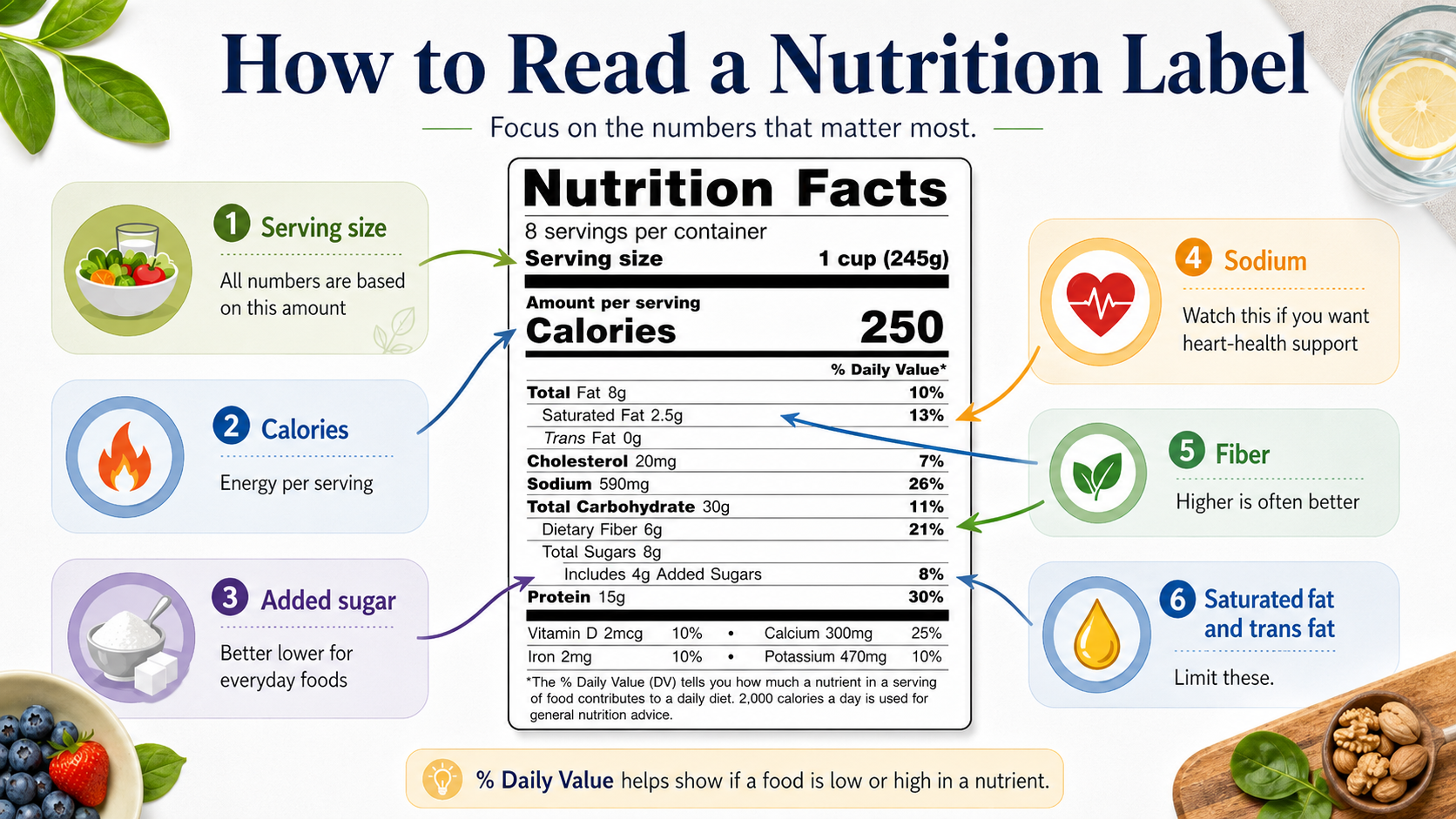
Read calories on a Nutrition Facts label by checking the serving size first, then the calories per serving. The calorie number only makes sense when you know how many servings you are actually eating.
The FDA places calories prominently on Nutrition Facts labels to make the information easier to find and use. But the most common label-reading mistake is ignoring serving size.
Use this simple process:
- Check the serving size.
Is the serving 1 cup, 2 cookies, 1 bottle, or half the package? - Check servings per container.
A small package may contain more than one serving. - Read calories per serving.
This number applies only to the listed serving size. - Multiply if needed.
If one serving has 180 calories and you eat two servings, you have eaten 360 calories. - Look beyond calories.
Check protein, fiber, added sugars, saturated fat, sodium, and key vitamins or minerals.
Example:
If a snack bag lists 160 calories per serving and contains 3 servings, eating the whole bag provides 480 calories.
What Common Mistakes Do People Make About Calories?
The most common mistake is treating calories as the only thing that matters. Calories matter, but nutrition, hunger, habits, and food quality also matter.
Common calorie mistakes include:
- Ignoring serving size.
The label may show calories for one serving, not the whole package. - Thinking low-calorie always means healthy.
Some low-calorie foods are low in protein, fiber, and nutrients. - Thinking high-calorie always means unhealthy.
Nuts, olive oil, salmon, and avocado are calorie-dense but nutritious. - Drinking calories without noticing.
Sugary drinks, coffee drinks, alcohol, and smoothies can add energy quickly. - Overestimating calories burned by exercise.
Exercise is excellent for health, but it may not “erase” large portions of high-calorie foods. - Copying another person’s calorie goal.
Your calorie needs depend on your body and lifestyle. - Using calorie counting as punishment.
Calories are information, not morality.
How Can Beginners Use Calories in a Healthy Way?
Beginners should use calories as a guide, not an obsession. Calorie awareness works best when paired with balanced meals, portion awareness, and nutrient-dense foods.
A simple beginner approach:
- Learn your usual intake.
Track for a few days if it feels safe and useful. - Check portions first.
Portion size often matters more than complicated diet rules. - Prioritize protein and fiber.
These help meals feel more satisfying. - Reduce obvious excesses.
Start with sugary drinks, large desserts, frequent fried foods, and oversized snacks. - Build meals around real foods.
Use protein, vegetables, fruits, whole grains, beans, dairy or alternatives, and healthy fats. - Use labels when eating packaged foods.
Calories are most useful when combined with serving size and nutrient information. - Avoid extreme restriction.
Very low calorie intake can backfire and may be unsafe for many people.
Calorie counting is not appropriate for everyone, especially people with a history of eating disorders or obsessive tracking. In those cases, a registered dietitian or healthcare professional is a better guide.
What Should You Remember About Calories?
Calories are a useful measure of food energy, but they are not a complete measure of food quality. The smartest approach is to understand calories while also paying attention to nutrients, fullness, portions, and long-term habits.
Key takeaways:
- A calorie measures energy.
- Food calories usually mean kilocalories, or kcal.
- Carbohydrates and protein provide 4 calories per gram.
- Fat provides 9 calories per gram.
- Your calorie needs depend on your body and activity level.
- The 2,000-calorie label reference is not right for everyone.
- Weight change is influenced by long-term energy balance.
- Food quality still matters, even when calories are equal.
Calories are not the enemy. Confusion, poor portions, low-nutrient foods, and unrealistic diet rules are the bigger problems.
What Questions Do People Ask About Calories?
What is a calorie in nutrition?
A calorie is a unit of energy from food or drinks. In nutrition, calories show how much energy your body can get from a serving of food.
Are calories bad for you?
No, calories are not bad. Your body needs calories to survive, move, think, digest food, and repair tissues.
Is kcal the same as calories?
Yes, in food and nutrition, kcal usually means the same thing people call calories. One food Calorie equals one kilocalorie.
How many calories should I eat per day?
Your daily calorie needs depend on age, sex, height, weight, activity level, and health goals. A calculator or healthcare professional can give a better estimate than a generic number.
Does eating fewer calories always cause weight loss?
Eating fewer calories than your body uses can lead to weight loss over time. But sleep, activity, hormones, medications, adherence, food quality, and tracking accuracy can affect results.
Are low-calorie foods always healthy?
No. Some low-calorie foods provide few nutrients. A healthy food pattern should include protein, fiber, vitamins, minerals, and enough total energy.
Do drinks have calories?
Yes. Sugary drinks, milk, juice, smoothies, alcohol, and many coffee drinks can contain calories. Water, plain tea, and black coffee usually have little or no calories.
Should I count calories?
Counting calories can help some people understand portions and energy intake. It is not necessary for everyone and may be unhelpful for people who become anxious or obsessive about food.