
What Are Calories and Why Do They Matter for Your Health and Weight?
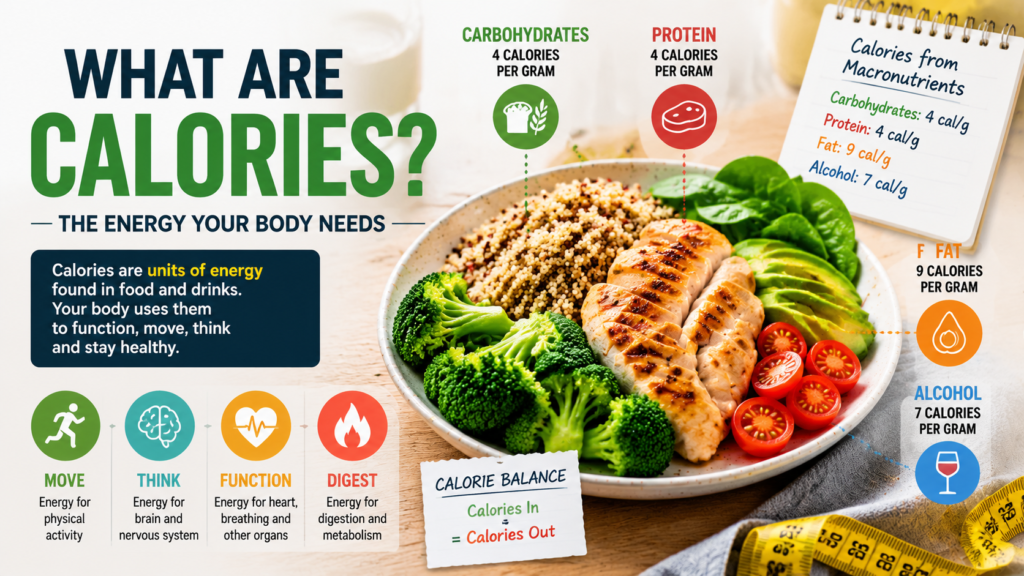
Calories are units of energy that measure how much energy food and drinks provide to the human body. The body uses calories every day to perform essential functions such as breathing, moving, thinking, digestion, and maintaining body temperature.
In simple terms, calories are the fuel your body needs to function. The calories you consume from food are either used immediately for energy, stored for later use, or converted depending on your body’s needs.
Understanding calories helps people make better decisions about nutrition, weight management, exercise, and overall health. Whether someone wants to lose weight, gain muscle, or maintain their current weight, calories play an important role.
Table of Contents
ToggleWhat Are Calories and What Do They Measure?
Calories are measurements of energy found in food and beverages. One calorie represents the amount of energy needed to raise the temperature of water by a specific amount.
In nutrition, the term “calorie” usually refers to a kilocalorie (kcal), which equals 1,000 small calories.
Food labels typically use the term “Calories” with a capital “C,” meaning kilocalories.
For example:
- An apple may contain around 80–100 Calories
- A meal may contain 500–700 Calories
- A snack may contain 150 Calories
These numbers tell you how much energy your body receives from that food.
Why Does the Human Body Need Calories?
The human body needs calories because every biological process requires energy.
Calories support:
- Breathing
- Heart function
- Brain activity
- Digestion
- Muscle movement
- Cell repair
- Hormone production
- Body temperature regulation
Even when a person is sleeping, the body continues using calories to keep organs working.
Are Calories a Nutrient or a Source of Energy?
Calories are not nutrients themselves. Calories measure the amount of energy provided by nutrients.
The main calorie-providing nutrients are:
| Nutrient | Calories per gram |
|---|---|
| Fat | 9 calories |
| Protein | 4 calories |
| Carbohydrates | 4 calories |
| Alcohol | 7 calories |
Nutrients such as vitamins, minerals, and water are essential for health but do not provide calories.
Where Do Calories Come From in Food?
Calories mainly come from macronutrients: carbohydrates, proteins, fats, and alcohol.
The amount of calories in a food depends on the combination and quantity of these nutrients.
For example:
- A high-fat food usually contains more calories because fat provides more energy per gram.
- Protein-rich foods provide fewer calories per gram but help with muscle maintenance and fullness.
- Fiber-rich foods often contain fewer available calories because some fiber is not fully digested.
How Many Calories Do Carbohydrates Provide?
Carbohydrates provide approximately 4 calories per gram.
Carbohydrates are the body’s primary source of quick energy.
Common carbohydrate sources include:
- Rice
- Bread
- Pasta
- Potatoes
- Fruits
- Vegetables
- Beans
- Oats
Carbohydrates are important because they provide energy for:
- Exercise
- Brain function
- Daily activities
Choosing high-quality carbohydrates with fiber can support better health.
Examples:
Better choices:
- Whole grains
- Fruits
- Vegetables
- Legumes
Less nutritious choices:
- Sugary drinks
- Candy
- Highly processed snacks
How Many Calories Does Protein Provide?
Protein provides approximately 4 calories per gram.
Protein is important because it helps:
- Build and repair tissues
- Maintain muscle
- Support immune function
- Increase fullness after meals
Protein sources include:
- Eggs
- Chicken
- Fish
- Meat
- Greek yogurt
- Beans
- Lentils
- Tofu
During weight loss, adequate protein intake can help preserve lean muscle while reducing body fat.
How Many Calories Does Fat Provide?
Fat provides approximately 9 calories per gram, making it the most calorie-dense macronutrient.
Healthy fat sources include:
- Olive oil
- Nuts
- Seeds
- Avocado
- Fatty fish
The body needs dietary fat for:
- Hormone production
- Brain function
- Absorption of fat-soluble vitamins
- Cell health
However, because fat contains more calories per gram, portion size is important.
How Many Calories Does Alcohol Provide?
Alcohol provides approximately 7 calories per gram.
Alcohol contains energy but provides limited nutritional value compared with protein, carbohydrates, and healthy fats.
Alcoholic drinks can contribute significant calories, especially when combined with:
- Sugary mixers
- Large serving sizes
- Frequent consumption
How Does the Body Use Calories Every Day?
The body uses calories through three main processes:
- Resting energy needs
- Physical activity
- Digestion
Together, these determine total daily energy expenditure.
What Is Basal Metabolic Rate (BMR)?
Basal metabolic rate is the amount of energy your body needs to maintain basic functions while at rest.
BMR supports:
- Heartbeat
- Breathing
- Brain activity
- Organ function
- Temperature control
BMR depends on factors such as:
- Age
- Body size
- Muscle mass
- Genetics
- Sex
A person with more muscle mass generally burns more calories at rest compared with someone with less muscle mass.
What Is Total Daily Energy Expenditure (TDEE)?
Total daily energy expenditure is the total number of calories your body burns in one day.
TDEE includes:
| Component | Meaning |
|---|---|
| BMR | Energy used at rest |
| Physical activity | Exercise and movement |
| Thermic effect of food | Energy used for digestion |
TDEE helps estimate how many calories a person needs to maintain their weight.
How Does Physical Activity Affect Calories Burned?
Physical activity increases calorie expenditure.
Examples of activities that burn calories:
- Walking
- Running
- Cycling
- Swimming
- Weight training
- Household activities
The number of calories burned depends on:
- Activity type
- Duration
- Body weight
- Exercise intensity
A person who moves more throughout the day generally uses more energy.
How Do Calories Affect Body Weight?
Calories affect body weight through the relationship between calories consumed and calories burned. When the body receives more energy than it uses, the extra energy can be stored. When the body uses more energy than it receives, stored energy can be used.
This relationship is called energy balance.
The three possible outcomes are:
| Energy Balance | Meaning | Possible Result |
|---|---|---|
| Calories consumed = calories burned | Balanced energy | Weight maintenance |
| Calories consumed < calories burned | Calorie deficit | Weight loss |
| Calories consumed > calories burned | Calorie surplus | Weight gain |
Calories are not the only factor affecting health, but they play an important role in changes in body weight.
What Is a Calorie Deficit?
A calorie deficit occurs when a person consumes fewer calories than the body uses for energy.
When this happens, the body may use stored energy, including stored body fat, to meet its energy requirements.
A calorie deficit can be created by:
- Eating slightly smaller portions
- Choosing lower-calorie nutrient-rich foods
- Increasing physical activity
- Reducing high-calorie processed foods
A sustainable calorie deficit is generally more effective than extreme calorie restriction because it is easier to maintain long-term.
Read More: What Is a Calorie Deficit? How It Works for Weight Loss
What Is a Calorie Surplus?
A calorie surplus occurs when a person consumes more calories than the body needs.
The extra energy may be stored as body fat over time.
A calorie surplus can happen through:
- Large portion sizes
- Frequent high-calorie foods
- Sugary beverages
- Low physical activity
However, a controlled calorie surplus can also be useful for people trying to gain muscle when combined with resistance training.
What Are Maintenance Calories?
Maintenance calories are the number of calories needed to maintain current body weight.
If someone consistently eats around their maintenance calorie level, their weight usually remains relatively stable.
Maintenance calories depend on:
- Age
- Height
- Weight
- Muscle mass
- Activity level
- Metabolism
For example:
- A physically active person usually needs more calories.
- A person with a sedentary lifestyle usually needs fewer calories.
Are All Calories the Same?
Technically, all calories provide energy, but the foods providing those calories can affect the body differently.
A 200-calorie portion of vegetables and a 200-calorie sugary snack provide the same amount of energy, but they differ in:
- Nutrient content
- Fiber amount
- Protein content
- Effect on hunger
- Impact on overall health
Food quality matters because the body needs more than just energy.
Why Do Nutrient Quality and Food Choices Matter?
Calories determine energy intake, but nutrients determine the quality of that energy.
A healthy diet focuses on calories from nutrient-rich foods.
Nutrient-dense foods provide more vitamins, minerals, fiber, and beneficial compounds per calorie.
Examples:
| Nutrient-Dense Foods | Less Nutrient-Dense Foods |
|---|---|
| Vegetables | Candy |
| Fruits | Sugary drinks |
| Beans | Processed snacks |
| Eggs | Highly refined foods |
| Fish | Deep-fried foods |
Choosing nutrient-rich foods can make managing calories easier because these foods often improve fullness and provide better nutrition.
What Is Calorie Density?
Calorie density refers to the number of calories contained in a specific amount of food.
Foods with low calorie density provide fewer calories in larger portions.
Examples of lower calorie-density foods:
- Vegetables
- Fruits
- Soups
- Leafy greens
Examples of higher calorie-density foods:
- Oils
- Butter
- Nuts
- Fried foods
- Desserts
Understanding calorie density can help people feel satisfied while managing calorie intake.
How Many Calories Does a Person Need Each Day?
Daily calorie needs vary from person to person. There is no single calorie number that works for everyone.
Calorie requirements depend on:
- Age
- Sex
- Height
- Weight
- Activity level
- Health goals
General examples:
| Goal | Calorie Approach |
|---|---|
| Maintain weight | Eat around maintenance calories |
| Lose weight | Create a calorie deficit |
| Gain weight | Create a calorie surplus |
| Build muscle | Slight surplus with strength training |
What Factors Change Daily Calorie Needs?
Several factors influence how many calories a person needs.
Body Size
Larger bodies generally require more energy.
Muscle Mass
Muscle tissue requires more energy compared with fat tissue.
Activity Level
People who exercise or move frequently burn more calories.
Age
Calorie needs may change as people get older due to changes in body composition and activity levels.
Goals
A person trying to lose weight will usually need a different calorie intake than someone trying to gain muscle.
How Are Calorie Needs Estimated?
Calorie needs are usually estimated using formulas that consider:
- Basal metabolic rate
- Activity level
- Personal goals
Common methods include:
- BMR calculations
- TDEE estimates
- Nutrition tracking tools
These estimates provide a starting point, but individual results can vary.
How Do You Read Calories on a Food Label?
Food labels show how much energy a food provides.
A nutrition label usually includes:
- Serving size
- Calories per serving
- Macronutrients
- Vitamins and minerals
Understanding labels helps people make informed food choices.
What Does Calories Per Serving Mean?
Calories per serving show how much energy is contained in the listed serving size.
For example:
A food label may say:
Serving size: 1 cup
Calories: 250
If someone eats two cups, they consume:
500 calories
The serving size is important because eating more than the listed portion increases calorie intake.
Why Does Portion Size Matter?
Portion size directly affects total calories consumed.
Common portion mistakes include:
- Eating directly from large packages
- Underestimating serving sizes
- Drinking high-calorie beverages without noticing
Helpful strategies:
- Use smaller plates
- Check serving sizes
- Measure calorie-dense foods like oils and nuts
What Foods Are High and Low in Calories?
Calories vary greatly between foods.
Understanding calorie differences helps with meal planning.
Which Foods Have More Calories?
High-calorie foods often contain more fat or added sugars.
Examples:
- Oils
- Butter
- Nuts
- Cheese
- Fried foods
- Desserts
- Fast food meals
These foods can fit into a balanced diet, but portion control matters.
Which Foods Are Lower in Calories?
Lower-calorie foods often contain more water and fiber.
Examples:
- Leafy vegetables
- Cucumbers
- Tomatoes
- Berries
- Melons
- Vegetable soups
These foods can help people feel full while consuming fewer calories.
What Are Common Myths About Calories?
Myth 1: All Calories Are Bad
Calories are not harmful. The body needs calories to survive.
The issue is consuming more energy than the body needs over time.
Myth 2: Cutting Calories as Much as Possible Is Best
Extremely low-calorie diets can lead to:
- Low energy
- Hunger
- Difficulty maintaining results
A balanced approach is usually more sustainable.
Myth 3: You Must Count Every Calorie
Calorie tracking can help some people, but it is not required for everyone.
Other helpful strategies include:
- Eating balanced meals
- Controlling portions
- Choosing whole foods
Myth 4: Exercise Removes the Need to Manage Food Intake
Exercise is important, but nutrition also plays a major role in energy balance.
A combination of:
- Healthy eating
- Physical activity
- Good habits
usually provides the best results.
Key Takeaways About Calories
Calories are units of energy that fuel the human body.
Important points:
✅ Calories come mainly from carbohydrates, protein, fat, and alcohol.
✅ The body uses calories for basic functions and daily activities.
✅ Energy balance affects weight changes.
✅ A calorie deficit can support weight loss.
✅ Food quality matters, not just calorie numbers.
✅ Nutrient-rich foods support better health.
✅ Individual calorie needs vary based on personal factors.
Understanding calories gives people the knowledge to make smarter nutrition decisions.
Frequently Asked Questions (FAQ)
What are calories in simple words?
Calories are units that measure the amount of energy food and drinks provide to the body.
Are calories good or bad?
Calories are neither good nor bad. The body needs calories for energy, but consuming more calories than needed can contribute to weight gain.
How many calories should I eat per day?
Daily calorie needs depend on age, body size, activity level, and health goals. There is no single number for everyone.
Do calories cause weight gain?
Consuming more calories than the body uses over time can lead to weight gain because the extra energy may be stored as fat.
What is a calorie deficit?
A calorie deficit happens when you consume fewer calories than your body burns, which can support weight loss.
Are all calories equal?
All calories provide energy, but foods differ in nutrients, fullness, and health effects.
Should I count calories to lose weight?
Counting calories can help some people understand their intake, but many people can manage weight through balanced eating and portion control.
How many calories are in one gram of fat?
One gram of fat provides approximately 9 calories, making it the most calorie-dense macronutrient.
Conclusion
Calories are the foundation of how the body receives and uses energy. Understanding calories helps people make informed choices about eating, exercise, and weight management.
A healthy approach is not simply reducing calories but choosing quality foods, maintaining balance, and matching calorie intake with personal goals.
When combined with a nutritious diet and active lifestyle, understanding calories becomes a powerful tool for improving overall health.