
What Is Brisk Walking, and How Do You Do It Properly?
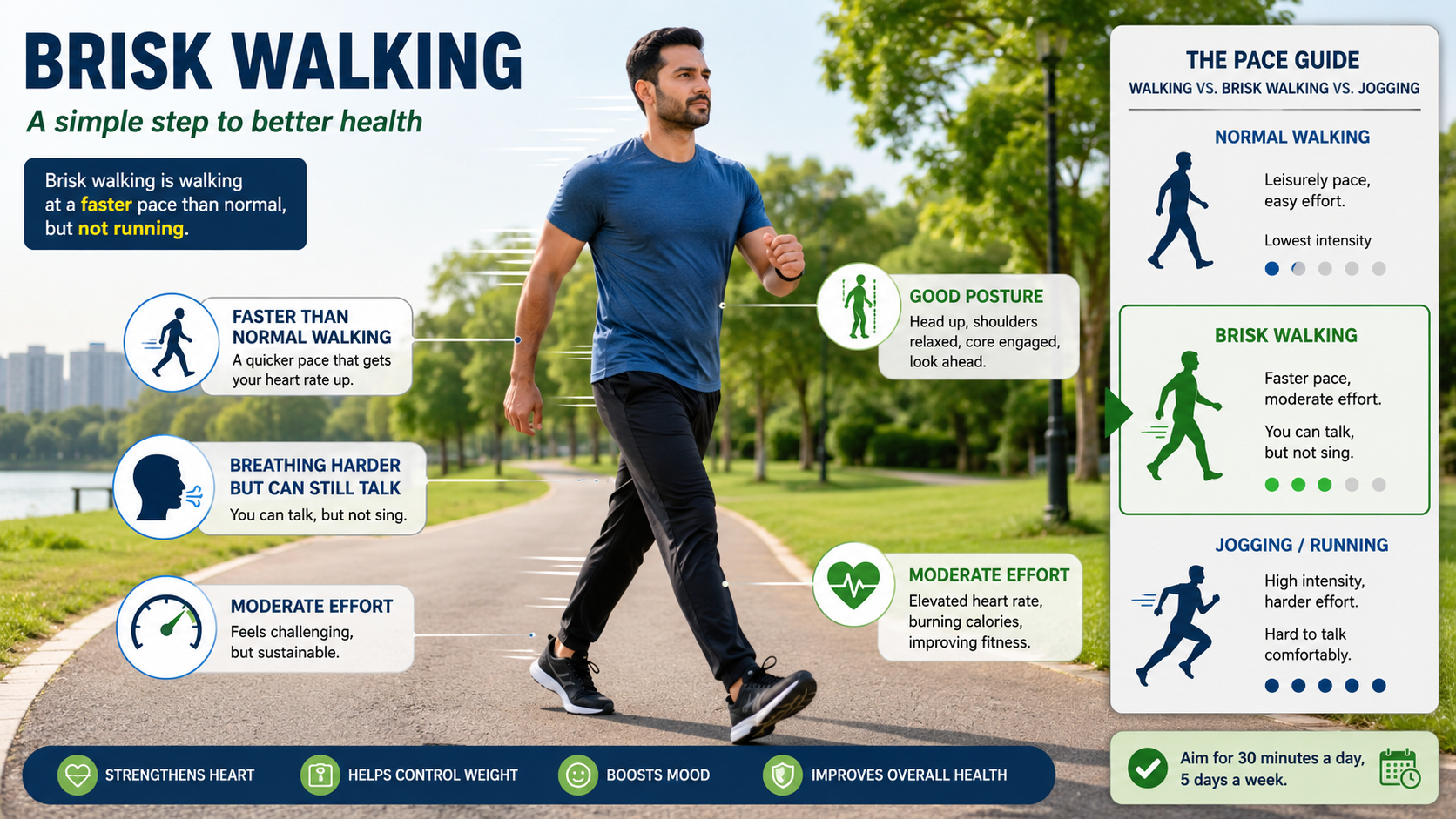
Brisk walking is a purposeful, faster form of walking that raises your heart rate, increases your breathing, and still allows you to hold a conversation. It is one of the easiest ways to add moderate-intensity aerobic exercise into daily life.
A brisk walk is especially useful for beginners, office workers, older adults, and people who want low-impact exercise without needing a gym. Health organisations such as the CDC and American Heart Association include brisk walking as a practical example of moderate-intensity aerobic activity.
Brisk walking matters because physical inactivity remains a major global health issue. WHO reported that nearly one-third of adults worldwide, around 1.8 billion people, did not meet recommended physical activity levels in 2022.
What Is Brisk Walking?
Brisk walking is walking at a pace that feels faster than a casual stroll and requires noticeable effort. It should make you breathe harder than normal, but not so hard that you cannot speak.
In simple terms, brisk walking sits between normal walking and jogging. You are not running, but you are moving with enough pace and purpose to challenge your heart, lungs, muscles, and posture.
Brisk walking is commonly used for:
- Cardiovascular fitness
- Weight management
- Better daily movement habits
- Improved stamina
- Joint-friendly exercise
- Mental wellbeing
- Posture and gait improvement
The NHS describes walking as simple, free, and one of the easiest ways to become more active, while noting that brisk walking can help build stamina, burn excess calories, and support heart health.
How Fast Should a Brisk Walk Be?
A brisk walk is often around 3 miles per hour, but the right speed depends on your age, fitness level, stride length, and health status. The NHS defines a brisk walk as about 3 miles per hour and says it should feel faster than a stroll.
Another useful marker is cadence. Research in the British Journal of Sports Medicine found that about 100 steps per minute is a reasonable rule of thumb for moderate-intensity walking in adults, although it may not suit every person.
How Can You Tell If You Are Walking Briskly Enough?
You are likely walking briskly enough if you can talk but cannot comfortably sing. This is often called the “talk test,” and the NHS uses this as a simple way to recognise brisk walking intensity.
Use these practical checks:
- Too easy: You can sing easily or barely notice your breathing.
- Brisk pace: You can talk, but your breathing is deeper.
- Too hard for beginners: You cannot speak in short sentences.
For most people, brisk walking should feel like a 5 or 6 out of 10 effort. Seniors, beginners, and people returning after illness or injury may reach moderate effort at a slower pace.
What Is the Proper Technique for Brisk Walking?
Proper brisk walking technique means walking with upright posture, controlled steps, natural arm movement, and smooth heel-to-toe foot motion. Good technique helps you walk faster without unnecessary strain.
Brisk walking is not just “walking quickly.” It works best when your body alignment, stride, breathing, and rhythm support efficient movement.
What Is the Correct Brisk Walking Posture?
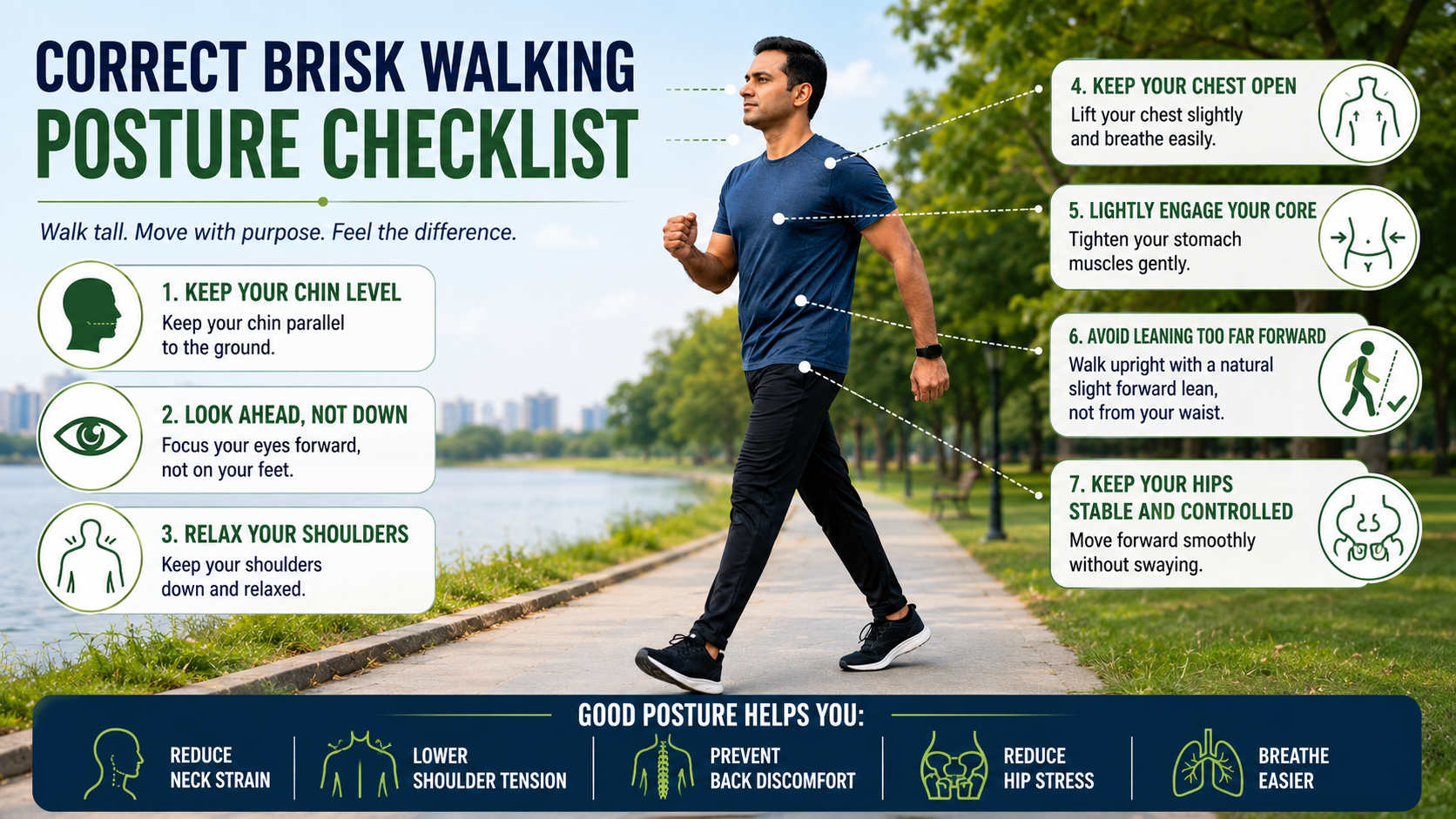
Correct brisk walking posture means keeping your head up, shoulders relaxed, back straight, and eyes looking forward. Mayo Clinic recommends walking with the head up, neck and shoulders relaxed, stomach muscles slightly tightened, and back straight rather than arched.
Use this posture checklist:
- Keep your chin level.
- Look ahead, not down at your feet.
- Relax your shoulders.
- Keep your chest open.
- Lightly engage your core.
- Avoid leaning too far forward.
- Keep your hips stable and controlled.
Good posture helps reduce neck, shoulder, back, and hip strain. It also makes breathing easier during a brisk walk.
How Should Your Feet and Arms Move During a Brisk Walk?
Your feet should roll smoothly from heel to toe, while your arms swing naturally with a slight bend at the elbows. Mayo Clinic describes proper walking as smooth heel-to-toe movement with free arm swing and purposeful motion.
For better walking form:
- Land gently on your heel.
- Roll through the middle of the foot.
- Push off through the toes.
- Keep your steps quick, not overly long.
- Swing your arms forward and back, not across your body.
- Keep your hands relaxed.
A common mistake is overstriding. Longer steps can increase impact and reduce efficiency. A slightly shorter, quicker stride is often better for brisk walking.
What Are the Main Health Benefits of Brisk Walking?
Brisk walking can improve cardiovascular fitness, support healthy weight management, strengthen daily mobility, reduce sedentary time, and improve mental well-being. It is a low-impact exercise that can be adapted to most fitness levels.
The CDC states that regular physical activity can lower the risk of heart disease, stroke, type 2 diabetes, depression, dementia, falls, and unhealthy weight gain.
How Does Brisk Walking Support Heart Health?
Brisk walking supports heart health by increasing heart rate, improving circulation, and contributing to weekly aerobic activity targets. The American Heart Association recommends at least 150 minutes of moderate-intensity aerobic activity per week and lists brisk walking as a moderate-intensity activity.
Recent research also suggests that walking pace may matter. A 2025 BMJ Group summary of research in Heart reported that average and brisk walking pace were associated with lower risks of heart rhythm abnormalities compared with slow walking, although the study was observational and cannot prove cause and effect.
This means brisk walking should be viewed as a strong heart-health habit, not a guaranteed medical treatment.
Can Brisk Walking Help With Weight Management?
Brisk walking can support weight management because it increases energy use, helps reduce sedentary time, and is easier to repeat consistently than many high-impact workouts. Mayo Clinic notes that walking can help maintain a healthy weight and lose body fat, especially when done faster, farther, and more frequently.
For weight management, brisk walking works best when combined with:
- A balanced diet
- Consistent weekly movement
- Strength training
- Good sleep
- Reduced sitting time
- Gradual increases in pace or distance
Brisk walking does not need to be extreme to be useful. A sustainable daily routine usually works better than occasional intense exercise.
How Does Brisk Walking Improve Mental Well-being?
Brisk walking can improve mental well-being by reducing anxiety, supporting sleep, improving mood, and giving the brain a movement break. The CDC states that even a single session of moderate-to-vigorous physical activity can improve sleep, reduce anxiety, and lower blood pressure.
The NHS also explains that physical activity can help people switch off from worries and stress, and that even a quick walk around work can be a useful mental break.
For office workers, a brisk walk can be especially valuable because it interrupts long sitting periods and gives the body a chance to move, breathe, and reset.
How Long Should You Brisk Walk Each Day?
A practical target is 30 minutes of brisk walking on 5 days per week, which equals 150 minutes of moderate-intensity activity. The CDC recommends at least 150 minutes of moderate-intensity physical activity per week for adults, plus muscle-strengthening activity on 2 days each week.
Beginners do not have to start with 30 minutes. The NHS says a brisk 10-minute daily walk has health benefits and counts toward weekly physical activity goals.
A beginner-friendly progression:
| Fitness Level | Starting Routine | Progress Goal |
|---|---|---|
| Sedentary beginner | 10 minutes, 3–5 days weekly | Build to 20–30 minutes |
| Office worker | 10 minutes at lunch + 10 minutes after work | Build to 150 minutes weekly |
| Senior beginner | 5–10 minutes at a comfortable brisk effort | Add time gradually |
| Active adult | 30 minutes, 5 days weekly | Add hills or intervals |
A 2025 systematic review in The Lancet Public Health also found that about 7,000 daily steps were associated with lower risks of several health outcomes compared with very low step counts, although step count does not replace intensity-based exercise guidance.
How Can Beginners Start a Brisk Walking Routine Safely?
Beginners should start slowly, increase gradually, and focus on consistency before speed. Brisk walking should challenge you, but it should not cause sharp pain, dizziness, chest discomfort, or severe breathlessness.
Follow this simple plan:
- Warm up for 5 minutes with easy walking.
- Walk briskly for 5–10 minutes using the talk test.
- Slow down for 2–3 minutes if breathing becomes uncomfortable.
- Repeat short brisk intervals if continuous brisk walking feels too hard.
- Cool down for 5 minutes with relaxed walking.
Mayo Clinic recommends warming up slowly for 5 to 10 minutes and cooling down at the end of a walk.
People with heart disease, balance problems, severe joint pain, recent surgery, or chronic health conditions should ask a healthcare professional what level of walking is suitable.
What Common Brisk Walking Mistakes Should You Avoid?
The most common brisk walking mistakes are walking too fast too soon, overstriding, looking down, tensing the shoulders, and skipping warm-up or recovery time. These mistakes can make brisk walking less comfortable and harder to maintain.
Avoid these errors:
- Taking steps that are too long
- Leaning forward from the waist
- Swinging arms across the chest
- Wearing unsupportive shoes
- Starting with long walks too quickly
- Ignoring pain or dizziness
- Walking with tight shoulders
- Treating every walk as a maximum-effort workout
Good brisk walking should feel purposeful, controlled, and repeatable.
How Is Brisk Walking Different From Normal Walking, Power Walking, and Jogging?
Brisk walking is faster than normal walking, less intense than jogging, and usually less exaggerated than power walking. It is a middle-ground exercise that balances health benefits, joint comfort, and daily practicality.
| Activity | Intensity | Main Feature | Best For |
|---|---|---|---|
| Normal walking | Light | Comfortable daily movement | Beginners, recovery, casual activity |
| Brisk walking | Moderate | Faster pace with deeper breathing | Heart health, weight management, fitness |
| Power walking | Moderate to vigorous | Strong arm drive and faster cadence | Advanced walkers |
| Jogging | Vigorous | Running movement with higher impact | Higher fitness and calorie burn |
For many people, brisk walking is the most sustainable option because it is low-impact, easy to fit into daily life, and adaptable.
Key Takeaway: What Should You Remember About Brisk Walking?
Brisk walking is a moderate-intensity walking exercise that improves fitness, heart health, mood, mobility, and daily activity levels. The best brisk walking routine is one you can repeat consistently.
Remember:
- Walk fast enough to breathe harder but still talk.
- Aim toward 150 minutes per week over time.
- Start with 10 minutes if you are inactive.
- Use upright posture and heel-to-toe movement.
- Increase duration, distance, or pace gradually.
- Combine brisk walking with strength training for better overall fitness.
FAQs About Brisk Walking
What is considered a brisk walk?
A brisk walk is a faster-than-normal walk that raises your heart rate and breathing while still allowing you to talk. The NHS describes it as about 3 miles per hour.
Is brisk walking good for weight loss?
Yes, brisk walking can support weight loss when combined with a calorie-conscious diet and consistent activity. It helps increase energy use and reduce sedentary time.
How many minutes of brisk walking should I do daily?
A common goal is 30 minutes a day, 5 days per week. Beginners can start with 10 minutes daily and build gradually.
Is brisk walking better than normal walking?
Brisk walking usually provides greater cardiovascular benefit than slow walking because it raises heart rate and breathing more. Normal walking is still beneficial, especially for beginners or recovery days.
Can seniors do brisk walking?
Yes, many seniors can do brisk walking safely if they start at a comfortable pace and progress gradually. Seniors with balance issues, chest symptoms, or chronic illness should seek medical guidance first.
What is the best time for brisk walking?
The best time is the time you can follow consistently. Morning, lunch break, and evening walks can all work if they fit your routine.
Should I briskly walk every day?
Daily brisk walking can be healthy for many people, but beginners may need rest or easier walking days. The weekly goal matters more than doing the same intensity every day.
Does brisk walking count as cardio?
Yes, brisk walking counts as cardiovascular exercise when it raises your heart rate and breathing to moderate intensity.
Conclusion
Brisk walking is one of the most practical ways to improve health without expensive equipment or high-impact training. When done with good posture, controlled pace, and regular frequency, it can support cardiovascular fitness, weight management, mental well-being, and long-term mobility.








One Response