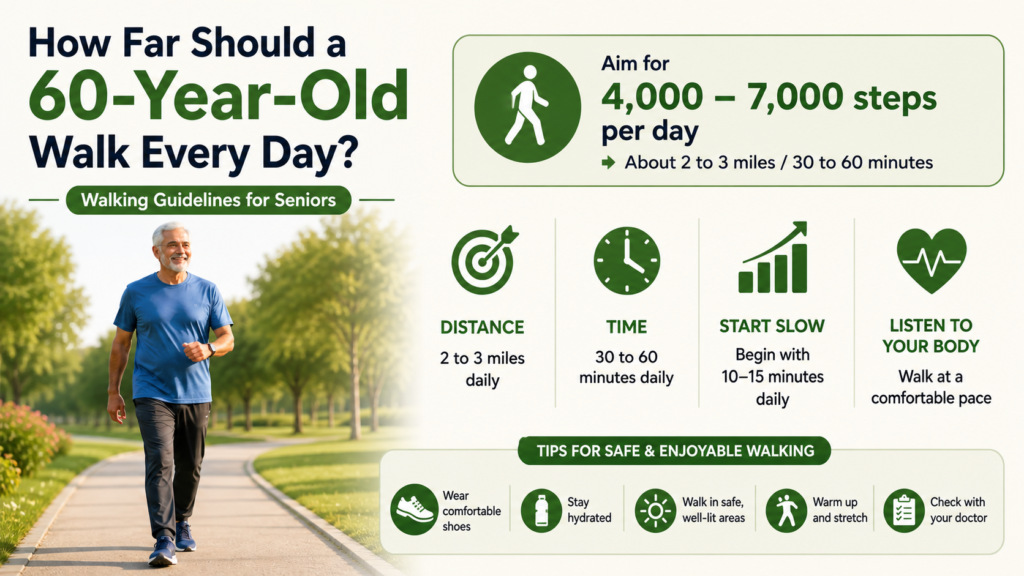
How Far Should a 60-Year-Old Walk Every Day?
Walking is one of the simplest and most practical ways to remain active after age 60. It requires little equipment, can be adapted to different fitness levels, and is generally easier on the joints than many high-impact exercises.
But how far should a 60-year-old walk every day?
For many healthy adults around age 60, a practical goal is to work toward 30 minutes of moderate-intensity walking on five days of the week. Depending on walking speed, 30 minutes may cover approximately 1.25 to 1.75 miles, or about 2 to 2.8 kilometres.
That is a useful general target—not a compulsory distance. A suitable walking routine depends on your current fitness, health conditions, mobility, balance, terrain, and recovery.
Quick Answer
A generally healthy 60-year-old can work toward:
| Walking measure | Practical target |
|---|
| Walking time | About 30 minutes |
| Frequency | Five days per week |
| Weekly activity | At least 150 minutes |
| Typical distance | About 1.25–1.75 miles in 30 minutes |
| Intensity | Purposeful but sustainable |
| Simple pace test | You can talk, but singing is difficult |
| Strength training | At least two days per week |
| Balance activity | Regularly, especially after age 65 |
Current guidance for older adults recommends at least 150 minutes of moderate-intensity aerobic activity per week. Older adults should also include muscle-strengthening and balance activities in their routines. The aerobic activity can be divided into shorter sessions across the week.
How Far Should a 60-Year-Old Walk Every Day?
A healthy 60-year-old may be able to walk approximately 1.25 to 1.75 miles in 30 minutes, depending on pace.
However, distance is not the only—or necessarily the best—way to measure a successful walk. Someone walking on hills, recovering from inactivity, or managing arthritis may cover less distance while still receiving a meaningful workout.
A better starting point is to ask:
- How long can I walk comfortably?
- Does the pace raise my breathing slightly?
- Can I recover normally afterward?
- Can I repeat the routine consistently?
Someone who has not exercised recently may begin with five to ten minutes at a comfortable pace. A regular walker may comfortably walk for 30 to 45 minutes or longer.
The long-term goal is consistent movement, not reaching an exact number of miles every day. Some physical activity is better than none, and activity can be accumulated in shorter sessions.
Is It Better to Measure Walking by Time or Distance?
For most older adults, time and effort are more useful than distance.
Walking distance can change considerably because of:
- Walking speed
- Hills or uneven ground
- Weather
- Joint stiffness
- Balance
- Fatigue
- Rest breaks
- Fitness level
For example, a 30-minute walk on a hilly trail may require more effort than a longer walk on a flat indoor track.
This is why public-health guidance is generally expressed in minutes and intensity rather than mandatory daily mileage.
A person could reach 150 weekly minutes by walking:
- 30 minutes on five days
- About 22 minutes every day
- Three 10-minute sessions on five days
- A mixture of longer and shorter walks
Choose a schedule that is realistic enough to maintain.
How Far Is a 30-Minute Walk?
The distance covered in 30 minutes depends on walking speed.
| Walking speed | Distance in 30 minutes | Distance in 60 minutes |
|---|
| 2 mph | 1 mile | 2 miles |
| 2.5 mph | 1.25 miles | 2.5 miles |
| 3 mph | 1.5 miles | 3 miles |
| 3.5 mph | 1.75 miles | 3.5 miles |
| 4 mph | 2 miles | 4 miles |
These numbers are mathematical estimates, not required targets.
Walking at 2 mph may provide moderate exercise for one person, while another may need a faster pace to reach the same relative intensity. Your individual effort matters more than matching someone else’s speed.
Walking Guide for Ages 60, 65, 70, and 80
There is no separate official mileage requirement for every age. The general weekly activity target applies broadly, but the routine should be adjusted according to health, fitness, and physical ability.
| Age | Practical walking goal | How to adapt it |
|---|
| 60–64 | Work toward 150 weekly minutes | Increase duration gradually if inactive |
| 65–69 | Work toward the same weekly goal if able | Add strength and balance activities |
| 70–79 | Continue regular moderate activity according to ability | Use shorter sessions and recovery days when needed |
| 80 and older | Walk as regularly as health and mobility allow | Prioritize safety, stability, and independence |
When health conditions prevent someone from reaching 150 minutes, official guidance recommends being as physically active as their abilities and conditions allow.
How Far Should a 65-Year-Old Walk Every Day?
A healthy 65-year-old can generally work toward approximately 30 minutes of moderate walking on five days per week.
Depending on pace, that may equal around 1.25 to 1.75 miles per walk. However, someone new to exercise may need to begin with shorter sessions.
After age 65, the routine should include more than walking. Strength and balance activities are also recommended to support physical function and reduce fall risk.
How Far Should a 70-Year-Old Walk Every Day?
Many healthy 70-year-olds can also work toward 30 minutes of moderate-intensity walking on most days.
There is no rule requiring a 70-year-old to walk fewer miles simply because of age. Health, mobility, and fitness are more important than the number 70.
A person who finds 30 continuous minutes difficult can divide the walk into:
- Three 10-minute walks
- Two 15-minute walks
- One longer walk and one short walk
The total weekly activity matters more than completing every session at once.
How Far Should an 80-Year-Old Walk Every Day?
There is no universal daily distance for an 80-year-old.
A healthy, active 80-year-old may comfortably walk for 30 minutes or longer. Someone with limited mobility, balance concerns, or chronic health conditions may benefit from several shorter walks.
For adults in this age group, the priorities should be:
- Walking safely
- Maintaining mobility
- Remaining independent
- Preserving leg strength
- Avoiding prolonged inactivity
- Choosing stable, familiar routes
An 80-year-old should not feel pressured to maintain the same distance or pace as a younger or more active walker.
What Is a Good Walking Speed for Seniors?
A good walking speed for seniors is a pace that feels purposeful but sustainable.
You should notice an increase in breathing and heart rate, but you should not feel out of control. At moderate intensity, you can generally talk in complete sentences, but you cannot comfortably sing.
This is known as the talk test. It is often more useful than prescribing a fixed speed because exercise intensity depends on personal fitness and ability.
A Simple Walking-Intensity Guide
| Intensity | How it feels |
|---|
| Light | You can talk and sing comfortably |
| Moderate | You can talk, but singing is difficult |
| Vigorous | You can say only a few words before pausing for breath |
For many people, a walking speed of 2.5 to 3.5 mph feels brisk. However, that range should not be treated as a requirement.
A slower pace may still be moderate intensity for someone who:
- Has recently become active
- Uses a walking aid
- Has arthritis
- Is walking uphill
- Has reduced aerobic fitness
- Is recovering from an illness
Start with a speed you can control and increase it gradually.
How Many Steps Are in 60 Minutes of Walking?
The number of steps completed in 60 minutes depends primarily on cadence, meaning the number of steps taken per minute.
Use this simple formula:
Steps per minute × 60 = approximate steps in one hour
| Walking cadence | Steps in 30 minutes | Steps in 60 minutes |
|---|
| 70 steps per minute | 2,100 | 4,200 |
| 80 steps per minute | 2,400 | 4,800 |
| 90 steps per minute | 2,700 | 5,400 |
| 100 steps per minute | 3,000 | 6,000 |
| 110 steps per minute | 3,300 | 6,600 |
| 120 steps per minute | 3,600 | 7,200 |
Therefore, many people may complete approximately 4,800 to 7,200 steps during 60 minutes of continuous walking.
A cadence near 100 steps per minute is commonly used as a rough indicator of moderate-intensity walking. Research involving adults aged 61 to 85 supports it as a practical population-level estimate, but it is not an individual requirement.
Stride length, height, terrain, fitness and walking technique affect both pace and step count. A shorter person may take more steps than a taller person while covering the same distance.
How Many Steps Are in a 30-Minute Walk?
Based on cadence, a 30-minute walk may include approximately:
- 2,400 steps at 80 steps per minute
- 2,700 steps at 90 steps per minute
- 3,000 steps at 100 steps per minute
- 3,300 steps at 110 steps per minute
- 3,600 steps at 120 steps per minute
These figures count steps taken during the walk, not the person’s total steps for the entire day.
Does a 60-Year-Old Need 10,000 Steps Every Day?
No single daily step total is suitable for everyone.
Ten thousand steps can be a motivating goal for some people, but it is not necessary to begin there. Someone currently completing 3,000 daily steps may benefit from gradually moving toward 4,000 or 5,000 rather than immediately attempting 10,000.
Choose a step goal based on your present activity level. Increase it gradually as your comfort, strength and stamina improve.
For someone who is inactive, consistency is more valuable than an ambitious target that causes fatigue or pain.
A Beginner Walking Plan for Adults Over 60
This eight-week plan is an example, not a medical prescription. Repeat a week when necessary rather than increasing activity before you feel ready.
| Weeks | Walking goal | Effort |
|---|
| 1–2 | 5–10 minutes, five days per week | Comfortable |
| 3–4 | 10–15 minutes, five days per week | Comfortable to purposeful |
| 5–6 | 15–20 minutes, five days per week | Moderate during part of the walk |
| 7–8 | 25–30 minutes, five days per week | Moderate and sustainable |
Weeks 1 and 2: Establish the Habit
Walk for five to ten minutes on most days.
Keep the pace easy enough to finish without excessive fatigue. The first goal is to create a repeatable routine.
Weeks 3 and 4: Add Time
Increase the walk to 10 or 15 minutes.
You may walk slightly faster during the middle of the session, but there is no need to push for speed.
Weeks 5 and 6: Build Endurance
Work toward 15 to 20 minutes.
You can divide the activity into two sessions when a continuous walk is uncomfortable.
Weeks 7 and 8: Approach the Weekly Goal
Gradually work toward 25 to 30 minutes on five days of the week.
Aim for moderate effort during part or most of the walk, depending on your ability.
Can You Divide 30 Minutes Into Shorter Walks?
Yes. Walking does not have to be completed in one continuous session.
Three 10-minute walks can be a practical alternative to one 30-minute walk. For example:
- Ten minutes after breakfast
- Ten minutes after lunch
- Ten minutes after dinner
Some websites call this the “3-3-3 walking rule,” but it is not an official medical rule. It is simply a memorable method for accumulating 30 minutes of movement.
Official guidance allows weekly activity to be divided into smaller portions.
What Is Japanese Interval Walking?
Japanese interval walking alternates faster periods with slower recovery periods.
A common session looks like this:
- Walk slowly for three minutes.
- Walk faster for three minutes.
- Repeat the cycle five times.
- Finish after approximately 30 minutes.
During the faster interval, the effort should feel challenging but controlled. During the slower interval, breathing should begin to recover.
Research on interval walking in middle-aged and older adults has reported improvements in aerobic fitness, thigh strength and blood-pressure measures. The original approach used repeated three-minute fast and slow intervals.
Interval walking is optional. Beginners should first become comfortable with regular continuous walking. People with significant heart, joint or balance problems should seek professional guidance before attempting high-intensity intervals.
Health Benefits of Walking After Age 60
Supports Cardiovascular Health
Brisk walking is a form of moderate aerobic activity. Regular physical activity supports the heart and lungs and can help people manage or reduce the risk of several chronic health conditions.
Helps Maintain Mobility and Independence
Regular movement helps older adults continue performing everyday tasks. Physical activity can support physical function and help people remain independent for longer.
Supports Mood and Mental Well-Being
Physical activity provides immediate and long-term benefits and can support mood, sleep and overall quality of life.
Helps With Weight Management
Walking increases energy expenditure and may support weight management. The amount of activity needed for weight loss or weight maintenance differs between individuals. Some people may require more than the minimum weekly activity level, along with appropriate dietary changes.
Supports Balance and Fall Prevention
Walking supports mobility, but walking alone is not a complete fall-prevention programme. Older adults should also include activities that specifically improve strength and balance. Multicomponent routines can improve physical function and reduce the risk of fall-related injury.
Is Walking Enough Exercise After Age 60?
Walking is an excellent aerobic activity, but it does not train every major muscle group or challenge balance in every direction.
A balanced routine should combine:
- Aerobic activity
- Muscle-strengthening activity
- Balance exercises
- Appropriate flexibility or mobility work
Adults should include muscle-strengthening activities on at least two days per week. Older adults should also perform activities that improve balance.
Suitable strength and balance exercises may include:
- Chair stands
- Wall push-ups
- Resistance-band rows
- Calf raises
- Step-ups
- Heel-to-toe walking
- Supported single-leg stands
- Tai chi
Choose exercises that match your physical ability and environment.
Example Weekly Walking Routine for Seniors
| Day | Activity |
|---|
| Monday | 30-minute moderate walk |
| Tuesday | 20-minute easy walk and strength exercises |
| Wednesday | 30-minute moderate walk |
| Thursday | Rest or gentle mobility activity |
| Friday | 30-minute walk and balance exercises |
| Saturday | 30-minute walk and strength exercises |
| Sunday | 30-minute relaxed walk or rest |
This schedule provides an example of how aerobic, strength and balance activities can fit into one week. It should be adjusted according to health, recovery and personal commitments.
How to Walk Safely
Before beginning a walk:
- Wear comfortable, supportive footwear.
- Start with several minutes at an easy pace.
- Choose a stable and familiar route.
- Use well-lit areas.
- Wear visible clothing near traffic.
- Carry water in warm weather or on longer walks.
- Use a prescribed walking aid when needed.
- Slow down gradually at the end.
People with chronic conditions or disabilities may need individualized guidance about appropriate amounts and types of physical activity. Moderate activity is safe for most people, but someone who has been inactive or has health concerns should speak with a healthcare professional before beginning vigorous activity.
When Should You Stop Walking?
Stop exercising and seek medical guidance if you experience:
- Unusual chest pressure, squeezing or pain
- Pain spreading to the arm, shoulder, back, neck or jaw
- Severe or unusual shortness of breath
- Dizziness, faintness or confusion
- A fast or uneven heartbeat
- Extreme weakness or unusual fatigue
Chest discomfort and shortness of breath can be warning signs of a heart problem. Emergency symptoms should not be treated as a normal response to exercise.
Frequently Asked Questions
How far should a 60-year-old walk every day?
A healthy 60-year-old can generally work toward 30 minutes of moderate walking on five days per week. Depending on speed, this may equal approximately 1.25 to 1.75 miles per walk. Beginners can start with shorter sessions.
How far should a 65-year-old walk every day?
A healthy 65-year-old may work toward the same general goal of 150 weekly minutes. Walking distance should be adjusted for fitness, health and mobility, and the routine should include strength and balance activities.
How far should a 70-year-old walk every day?
Many healthy 70-year-olds can aim for about 30 minutes of walking on most days. The walk can be divided into shorter sessions when necessary. There is no mandatory daily mileage based only on age.
How far should an 80-year-old walk every day?
An 80-year-old should walk according to health, mobility and balance. Some may comfortably walk for 30 minutes, while others may benefit from several short walks. Safe, regular movement is more important than achieving a fixed distance.
What is a good walking speed for seniors?
A good walking speed is a pace that increases breathing while still allowing conversation. The talk test is more useful than requiring every senior to reach a fixed speed.
How many steps are in 60 minutes of walking?
Many people complete approximately 4,800 to 7,200 steps during 60 minutes of continuous walking. At 100 steps per minute, an hour of walking equals about 6,000 steps.
How many miles is a 30-minute walk?
A 30-minute walk covers approximately:
- 1 mile at 2 mph
- 1.25 miles at 2.5 mph
- 1.5 miles at 3 mph
- 1.75 miles at 3.5 mph
- 2 miles at 4 mph
Is slow walking still beneficial?
Yes. Slow walking can be a useful starting point for someone who is inactive, has reduced mobility or is rebuilding strength. Some physical activity is better than none.
Is walking every day safe for seniors?
Daily walking may be appropriate when the distance and intensity are manageable. Rest or easier days can be included when someone experiences fatigue, soreness or reduced recovery.
Is 30 minutes of walking enough?
Thirty minutes of moderate walking on five days per week reaches the general target of 150 weekly minutes. Walking should ideally be combined with muscle-strengthening and balance activities.
What is the 3-3-3 walking rule?
The term generally describes three 10-minute walks spread throughout the day. It is not an official medical guideline, but it can be a convenient way to accumulate 30 minutes of activity.
What is Japanese interval walking?
Japanese interval walking alternates approximately three minutes of faster walking with three minutes of slower walking. Five cycles produce a 30-minute session.
Final Takeaway
There is no single distance that every 60-year-old must walk.
For many healthy adults, a sensible goal is to work toward 30 minutes of moderate walking on five days per week. Depending on pace, that may equal approximately 1.25 to 1.75 miles per walk.
Adults aged 65, 70 or 80 do not automatically need completely different targets. The routine should be adapted according to fitness, mobility, balance, health conditions and recovery.
Focus on four things:
- Walk consistently.
- Use a pace you can control.
- Increase time and distance gradually.
- Combine walking with strength and balance activities.
A sustainable walking habit is more valuable than chasing a perfect mileage, speed or step count.
Medical disclaimer: This article provides general educational information and is not a substitute for diagnosis, treatment or personalized advice from a qualified healthcare professional.