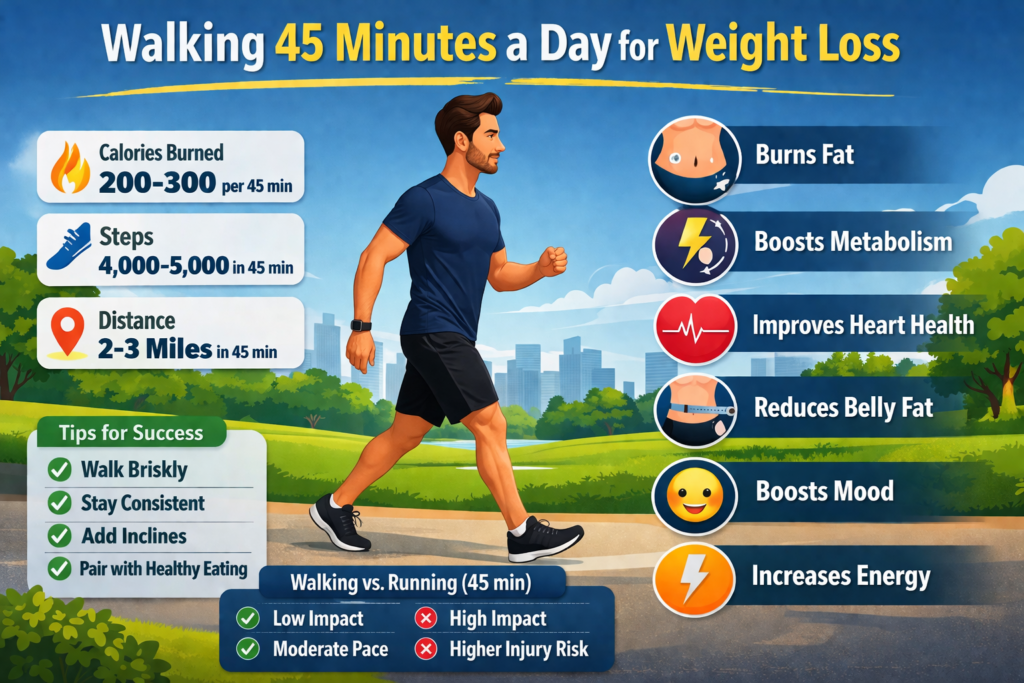
Walking 45 Minutes a Day: Weight Loss, Steps, Calories and Results
Walking for 45 minutes a day can improve your fitness, increase your daily step count and support gradual weight loss.
For most adults, a 45-minute walk covers approximately 1.9–3 miles, adds around 4,000–5,500 steps and burns roughly 130–420 calories. When the walk contributes to a consistent calorie deficit, it may produce a theoretical calorie equivalent of approximately 1–3 pounds of weight loss per month.
However, this is an estimate rather than a guaranteed result. Your body weight, walking pace, terrain, diet, sleep, fitness level, health, and consistency can all affect your progress.
For a broader explanation of the evidence, read our guide on how walking helps you lose weight.
Walking 45 Minutes a Day: Quick Answers
| Question | Practical answer |
|---|
| How many steps are in 45 minutes? | Usually around 4,000–5,500 steps |
| How many calories does it burn? | Approximately 130–420 calories |
| How far can you walk? | Around 1.9–3 miles or 3–4.8 kilometres |
| How much weight could you lose? | A theoretical calorie equivalent of around 1–3 pounds per month |
| Is 45 minutes enough exercise? | It provides substantial aerobic activity, but strength training should also be included |
| What is the best pace? | A brisk but sustainable pace at which you can talk but not comfortably sing |
| When might results appear? | Stamina may improve within 2–4 weeks, while visible weight changes usually take longer |
Walking for 45 minutes every day adds up to 315 minutes of weekly activity. This exceeds the general recommendation of 150–300 minutes of moderate-intensity aerobic activity per week. Adults are also advised to perform muscle-strengthening activity on at least two days each week.
If I Walk 45 Minutes a Day, How Much Weight Will I Lose?
Walking for 45 minutes daily may contribute to approximately 1–3 pounds of weight loss per month when it creates a consistent calorie deficit and your food intake does not increase.
This estimate should not be treated as a promise. Some people may lose more, some may lose less, and others may initially notice no change on the scale.
Your result will depend on:
- Your current body weight
- Your walking speed
- The incline and terrain
- Your total food and drink intake
- Your current activity level
- Your sleep and stress
- Medicines or health conditions
- Whether you also perform strength training
- How consistently you follow the routine
Physical activity increases the number of calories your body uses. Weight loss occurs when this increased expenditure, combined with your eating habits, creates an overall calorie deficit.
Learn more about what a calorie deficit means before trying to estimate your personal results.
A realistic weight-loss example
Suppose a person weighing approximately 155 pounds walks briskly for 45 minutes and uses around 250–270 calories.
That could add up to approximately:
- 250–270 calories per day
- 1,750–1,890 calories per week
- 7,500–8,100 calories over 30 days
Mathematically, this is roughly equivalent to two pounds of body fat. However, real weight change is rarely perfectly predictable.
Appetite may increase after exercise. Water retention, hormonal changes, digestion and changes in other daily activity can also affect the number shown on the scale.
Calorie calculations should therefore be used as planning estimates rather than guaranteed outcomes.
New to energy and weight management? Read our beginner-friendly explanation of what calories are and how they work.
Walking 45 Minutes a Day for One Week
You may not see a major change in body weight after only one week. However, the routine may already start producing positive changes.
You may notice:
- A better mood after walking
- More daily energy
- Improved sleep quality
- Less breathlessness
- Reduced stiffness
- A sense of accomplishment
- Greater awareness of your activity level
Do not judge the value of your walking routine only by your weight after seven days. Fitness, mood, sleep and consistency are also meaningful signs of progress.
Walking 45 Minutes a Day for One Month
After one month, you may begin to notice clearer changes in your fitness and daily routine.
Possible results include:
- Improved walking endurance
- A faster comfortable pace
- Less breathlessness
- A higher daily step count
- Improved sleep or mood
- A small reduction in waist measurement
- Gradual weight change
- Better exercise consistency
A theoretical loss of approximately 1–3 pounds in one month may be possible when walking creates a calorie deficit.
Someone who combines walking with sustainable nutrition changes may lose more. Someone who regularly replaces the calories burned through extra food or drinks may lose less or maintain the same weight.
Walking 45 Minutes a Day for Three Months
Three months is usually a more useful period for assessing progress than a few days or one week.
After three months of consistent walking, you may experience:
- Noticeably better stamina
- A faster average walking speed
- Easier completion of everyday activities
- Improved cardiovascular fitness
- Reduced waist measurement
- Better muscle endurance
- More noticeable weight or body-composition changes
- A stronger and more sustainable exercise habit
Weight loss is influenced by nutrition, activity, sleep, stress, age, medicines, health conditions and other individual factors. Gradual progress is generally more sustainable than rapid weight loss.
For a broader action plan, see our guide to losing weight by walking.
How Many Calories Does a 45-Minute Walk Burn?
A 45-minute walk generally burns approximately 130–420 calories.
The exact amount depends primarily on your body weight, speed and walking intensity. A heavier person normally uses more energy than a lighter person completing the same activity, while brisk or inclined walking usually requires more energy than casual walking.
The following figures are estimates calculated using walking-intensity values from the 2024 Adult Compendium of Physical Activities.
| Walking pace | Distance in 45 minutes | 125 lb person | 155 lb person | 185 lb person | 215 lb person |
| 2.5 mph, easy | 1.9 miles | About 134 calories | About 166 calories | About 198 calories | About 230 calories |
| 2.8–3.4 mph, moderate | 2.1–2.6 miles | About 170 calories | About 210 calories | About 251 calories | About 292 calories |
| 3.5–3.9 mph, brisk | 2.6–2.9 miles | About 214 calories | About 266 calories | About 317 calories | About 369 calories |
| 4.0–4.4 mph, very brisk | 3–3.3 miles | About 246 calories | About 305 calories | About 363 calories | About 422 calories |
These estimates may change according to:
- Treadmill incline
- Outdoor hills
- Grass, sand or uneven ground
- Wind and weather
- Your fitness level
- Walking efficiency
- Arm movement
- Carrying additional weight
- Whether you hold treadmill handrails
- Fitness-tracker accuracy
Avoid treating smartwatch calorie readings as exact. They are more useful for comparing your own activity patterns over time.
How Many Steps Are in 45 Minutes of Walking?
Most people complete approximately 4,000–5,500 steps during a 45-minute walk.
Around 4,500 steps is a practical estimate for someone maintaining a moderate cadence of approximately 100 steps per minute.
| Walking cadence | Steps per minute | Steps in 45 minutes |
| Slow | 80 | 3,600 |
| Comfortable | 90 | 4,050 |
| Moderate | 100 | 4,500 |
| Brisk | 110 | 4,950 |
| Fast | 120 | 5,400 |
Your result may differ because of:
- Height
- Leg length
- Stride length
- Walking speed
- Terrain
- Age and mobility
- Tracker placement
- Device accuracy
A taller person may take fewer steps to cover the same distance because each step is longer. A shorter person may record more steps while travelling the same distance.
Is 4,500 steps in 45 minutes good?
Yes. Completing around 4,500 steps in 45 minutes means you are averaging approximately 100 steps per minute.
For many adults, this represents a purposeful moderate walking cadence.
The effort is likely moderate when:
- Your breathing becomes faster
- Your heart rate increases
- You can talk in complete sentences
- Singing would be difficult
- The walk feels more purposeful than casual strolling
How many steps are in a 45-minute brisk walk?
A brisk 45-minute walk commonly produces approximately 4,950–5,400 steps when you maintain a cadence of 110–120 steps per minute.
Your actual result will still depend on your stride, height, terrain and tracking device.
People exercising indoors may also find it useful to learn whether walking in place counts as steps.
How Far Is a 45-Minute Walk?
Most adults can walk approximately 1.9–3 miles in 45 minutes, equal to around 3–4.8 kilometres.
| Walking speed | Distance in 45 minutes | Distance in kilometres |
| 2.5 mph | 1.88 miles | 3.02 km |
| 3.0 mph | 2.25 miles | 3.62 km |
| 3.5 mph | 2.63 miles | 4.23 km |
| 4.0 mph | 3 miles | 4.83 km |
Can you walk two miles in 45 minutes?
Yes. Walking two miles in 45 minutes requires an average speed of approximately 2.7 mph.
This is a comfortable-to-moderate pace for many adults.
Can you walk 2.5 miles in 45 minutes?
Yes. Walking 2.5 miles in 45 minutes requires an average speed of approximately 3.3 mph.
This is a purposeful exercise pace for many people.
Can you walk three miles in 45 minutes?
Yes, but you would need to maintain a speed of approximately 4 mph, equivalent to a 15-minute mile.
This is a fast walking pace. It may be challenging for beginners but achievable for experienced walkers.
Is walking four kilometres in 45 minutes a good pace?
Yes. Walking four kilometres in 45 minutes means you are moving at approximately 5.3 kilometres per hour or 3.3 mph.
This is a moderate-to-brisk pace for many adults and can provide a purposeful cardiovascular workout.
Is Walking 45 Minutes a Day Enough Exercise?
Yes. A brisk 45-minute daily walk can provide a substantial amount of weekly aerobic activity.
Walking for 45 minutes every day produces:
45 minutes × 7 days = 315 minutes per week
This exceeds the general recommendation of at least 150–300 minutes of moderate-intensity activity per week. However, walking alone does not provide every form of exercise your body needs.
Adults should also perform muscle-strengthening activity on at least two days each week.
Examples include:
- Squats
- Lunges
- Push-ups
- Resistance-band exercises
- Weight training
- Body-weight exercises
- Some forms of yoga
To create a more balanced routine, combine walking with one of these beginner weight-loss workouts twice per week.
Older adults may also benefit from exercises that improve balance.
What Happens When You Walk for 45 Minutes Every Day?
Walking for 45 minutes every day can gradually improve your stamina, cardiovascular fitness, mood, sleep and overall activity level.
When it contributes to a consistent calorie deficit, it may also support gradual body-fat and weight reduction.
Possible benefits include:
Improved cardiovascular fitness
Regular brisk walking challenges your heart and lungs. Over time, the same route may feel easier and you may be able to walk faster with less effort.
Better daily stamina
Walking regularly trains the muscles used during everyday movement. Activities such as climbing stairs, shopping or completing household tasks may begin to feel easier.
Support for weight management
Walking increases daily energy expenditure. When combined with appropriate nutrition, this can help create the calorie deficit needed for gradual weight loss.
Improved mood and sleep
Regular physical activity can support mental and physical health. It may improve mood, sleep and overall wellbeing.
Support for blood-sugar and heart health
Consistent physical activity is associated with important cardiovascular and metabolic health benefits.
For a deeper explanation, explore the benefits of walking every day.
What Is the Best Walking Pace for Weight Loss?
The best walking pace for weight loss is generally a brisk but sustainable pace.
For many adults, that may be around 3–3.8 mph, although the right speed depends on fitness, health and walking experience.
Beginners may need to start closer to 2.5–3 mph.
Use the talk test
You are probably walking at a moderate intensity when:
- You can talk in complete sentences
- Your breathing is noticeably faster
- Your heart is beating faster than normal
- You cannot comfortably sing
If you can speak only a few words before needing to breathe, the intensity may be vigorous.
If your breathing barely changes, the walk may be too relaxed to provide the same cardiovascular effect.
Moderate intensity is individual. A pace that feels easy to one person may feel challenging to another.
You do not need to maintain your fastest possible pace for all 45 minutes. A manageable pace that you can repeat consistently is more valuable than an exhausting pace that causes pain or makes you abandon the routine.
Learn how to increase your pace safely in our brisk-walking technique and benefits guide.
For detailed advice on posture, stride and foot placement, read the proper walking technique guide.
45-Minute Treadmill and Incline Walking Workout
A 45-minute treadmill walk can support weight loss in the same way as outdoor walking. It increases energy expenditure and may contribute to a calorie deficit.
Using an incline generally makes the session more demanding than walking at the same speed on a flat treadmill.
Beginner 45-minute treadmill workout
| Time | Speed and incline |
| First 5 minutes | Easy warm-up at 0–1% incline |
| Next 10 minutes | Comfortable walk at 1–2% incline |
| Next 15 minutes | Brisk walk at 2–3% incline |
| Next 10 minutes | Alternate 2 minutes at 3–4% incline with 2 minutes at 1–2% |
| Final 5 minutes | Easy cool-down at 0–1% incline |
Adjust the speed according to your current ability. You should feel challenged without losing control of your posture or stride.
Is walking at 3.6 mph and a 4% incline effective?
Walking at 3.6 mph with a 4% incline for 45 minutes is a challenging brisk session for many adults.
It normally requires more effort than walking at 3.6 mph on a level surface. The precise calorie expenditure depends on your body weight, fitness, treadmill calibration and whether you hold the handrails.
Holding the handrails can reduce the actual effort and change your natural posture. Reduce the speed or incline when necessary so that you can walk without leaning backwards or supporting your body weight with your arms.
Beginners should increase either speed or incline gradually rather than increasing both aggressively at the same time.
Does Walking for 45 Minutes Burn Fat?
Yes. Walking uses energy and can support a reduction in body fat over time.
During a walk, your body uses a mixture of fat and carbohydrates. The proportion varies according to:
- Exercise intensity
- Fitness level
- Recent meals
- Walking duration
- Individual physiology
For long-term fat loss, the key question is not whether every minute occurs in a specific “fat-burning zone.” The more important issue is whether your overall activity and food intake create a sustainable calorie deficit.
A slower walk may use a higher percentage of fat as fuel, but a faster walk may use more total energy per minute. Both approaches can support fat loss when included in a sustainable programme.
How to Make a 45-Minute Walk More Effective
Walk purposefully
Spend most of the session at a pace that noticeably raises your breathing and heart rate.
Add short intervals
Try this simple pattern:
- Walk briskly for three minutes
- Walk faster for one minute
- Repeat for 30–35 minutes
- Finish with an easy cool-down
Intervals can increase the average intensity without requiring you to maintain your fastest pace for the entire session.
Use hills or incline
Walking uphill requires more effort than walking on level ground.
Start with a gentle incline and increase it gradually. Avoid introducing a steep incline and a much faster speed during the same session when you are still a beginner.
Choose a convenient walking time
Morning, afternoon, evening and post-meal walks can all be effective.
The best time is usually the one that fits your schedule and allows you to remain consistent. Compare the options in our guide to the best time of day to walk.
Walk consistently
Completing manageable walks regularly is usually more valuable than doing one extremely demanding session and then remaining inactive.
Use this daily walking routine guide to organise your weekly schedule.
Include strength training
Add two full-body strength sessions each week to support your muscles and provide a more complete fitness programme.
Pay attention to food and drinks
Do not automatically reward every walk with a high-calorie snack, sweetened coffee or sports drink.
It can be easy to consume the calories used during a walk without realising it.
For practical eating guidance, read our beginner diet plan for weight loss.
Track more than body weight
Monitor:
- Walking duration
- Distance
- Average pace
- Daily steps
- Waist measurement
- Sleep
- Energy levels
- Number of completed walks
- How difficult the walk feels
Body weight naturally fluctuates because of water, food, sodium, hormones and digestion. Weekly trends are generally more meaningful than a single measurement.
Four-Week 45-Minute Walking Plan
You do not need to walk at maximum effort for 45 minutes from the first day.
Build your duration and intensity gradually.
Week 1: Build the habit
- 5-minute easy warm-up
- 25-minute comfortable walk
- 10-minute purposeful walk
- 5-minute cool-down
Complete this routine three to five times.
Week 2: Increase the brisk portion
- 5-minute easy warm-up
- 15-minute comfortable walk
- 20-minute brisk walk
- 5-minute cool-down
Complete this routine four to five times.
Week 3: Add intervals
- 5-minute easy warm-up
- 10-minute moderate walk
- 20 minutes alternating three minutes brisk with one minute faster
- 5-minute steady walk
- 5-minute cool-down
Complete this routine four to six times.
Week 4: Complete a purposeful 45-minute walk
- 5-minute easy warm-up
- 30-minute brisk walk
- 5-minute faster finish or gentle incline
- 5-minute cool-down
Complete this routine five to seven times according to your recovery, ability and schedule.
Once the programme feels comfortable, use these daily walking tips to maintain consistency.
Can you divide the 45 minutes?
Yes. You do not have to complete all 45 minutes at once.
Possible options include:
- 20 minutes in the morning and 25 minutes later
- Three 15-minute walks
- A 30-minute walk plus a 15-minute post-meal walk
- A 25-minute outdoor walk and a 20-minute treadmill walk
Physical activity can be broken into shorter sessions throughout the week.
Beginners may also start by exploring the benefits of a 30-minute walk before increasing the duration.
Common Mistakes That Can Prevent Results
Walking too casually every day
Easy walking is still valuable, but completing every session at a very relaxed pace may limit fitness progression and calorie expenditure.
Include some purposeful walking when your health and fitness allow it.
Believing calorie trackers are exact
Smartwatches and fitness trackers provide estimates. Use them to monitor trends rather than treating every calorie number as precise.
Eating back all the calories burned
A large snack or sweetened drink can quickly replace the energy used during a walk.
Walking should support a balanced eating plan rather than being treated as permission to overeat.
Expecting instant results
Visible fat loss rarely occurs within only a few days.
Give the routine several weeks and monitor fitness, waist measurements, sleep and consistency alongside body weight.
Ignoring strength training
Walking is primarily an aerobic activity. It should be combined with exercises that challenge the major muscle groups.
Increasing speed or incline too quickly
A sudden increase in duration, speed or incline can cause excessive soreness or overuse discomfort.
Increase one variable at a time.
Walking through persistent pain
Normal effort and mild temporary muscle fatigue are different from persistent or worsening pain.
Reduce your activity and obtain professional advice when pain continues or affects your normal movement.
Read how much walking may be too much for additional warning signs.
Comparing your progress with other people
Two people can follow the same walking plan and experience different results.
Compare your current performance with your own starting point.
Safety Considerations
Brisk walking is generally appropriate for many adults, but your routine should match your health, fitness and mobility.
Consult a qualified healthcare professional before beginning or substantially increasing exercise when you:
- Have heart disease, diabetes or another chronic condition
- Experience chest discomfort, dizziness or unusual breathlessness
- Have significant joint pain
- Have balance or mobility difficulties
- Have been inactive for a long period
- Are recovering from surgery or injury
- Are pregnant or postpartum and have medical concerns
- Plan to begin vigorous exercise after a long period of inactivity
People with chronic conditions should seek guidance about the types and amounts of activity that are appropriate for them.
Stop exercising and seek urgent medical attention if you experience chest pain, fainting, severe breathing difficulty or another sudden concerning symptom.
Frequently Asked Questions
How many calories does walking for 45 minutes burn?
Walking for 45 minutes usually burns approximately 130–420 calories. The result depends on body weight, speed, incline, terrain and fitness.
How many steps are in a 45-minute walk?
Most people complete approximately 4,000–5,500 steps. Around 4,500 steps is a useful estimate for moderate walking.
How many steps are in a 45-minute brisk walk?
A brisk 45-minute walk may contain approximately 4,950–5,400 steps when you maintain around 110–120 steps per minute.
How many miles is a 45-minute walk?
Most adults cover approximately 1.9–3 miles. At 3 mph, you will cover 2.25 miles. At 4 mph, you will cover three miles.
Is four kilometres in 45 minutes a good pace?
Yes. Four kilometres in 45 minutes equals approximately 5.3 kilometres per hour or 3.3 mph, which is a moderate-to-brisk pace for many adults.
Is walking 45 minutes a day enough to lose weight?
It can be enough to support weight loss when it helps create a calorie deficit. Diet, sleep, stress, health and consistency also affect your results.
How much weight can I lose by walking 45 minutes a day for one month?
A theoretical calorie equivalent of approximately 1–3 pounds may be possible for many people. Actual results may be higher, lower or unchanged.
Is 45 minutes of walking enough exercise?
A daily 45-minute brisk walk provides more than the general minimum recommendation for weekly aerobic activity. Strength training should still be completed on at least two days per week.
Is it better to walk for 45 minutes at once?
Not necessarily. You can divide the activity into shorter walks when that makes the routine easier to maintain.
For guidance on choosing an appropriate session length, read how long you should walk to lose weight.
Is walking outside better than using a treadmill?
Both can be effective.
Outdoor walking offers natural changes in terrain, while a treadmill allows precise control over speed and incline. Choose the option you can perform safely and consistently.
Can I walk for 45 minutes every day?
Many people can walk for 45 minutes daily at a moderate intensity. Beginners should increase their duration gradually and reduce their pace when they experience excessive fatigue or discomfort.
Will walking reduce belly fat?
Walking cannot force your body to lose fat from only one area. It may contribute to overall fat reduction when it helps create a sustained calorie deficit.
The Bottom Line
Walking for 45 minutes a day is a practical way to increase your physical activity, improve fitness, and support weight management.
A typical 45-minute walk may:
- Add approximately 4,000–5,500 steps
- Burn around 130–420 calories
- Cover roughly 1.9–3 miles
- Provide 315 minutes of weekly activity
- Contribute to gradual weight loss when it creates a consistent calorie deficit
For the best results:
- Walk at a brisk but sustainable pace
- Increase your speed or incline gradually
- Include strength training twice per week
- Keep your food intake aligned with your goal
- Track progress over several weeks
- Choose a routine you can maintain
Walking is not a quick fix. However, it is one of the simplest forms of activity to repeat consistently enough to produce meaningful long-term results.
Related Walking and Weight-Loss Guides
Sources and Methodology
The calorie estimates and walking-intensity categories in this article are based on MET values from the Adult Compendium of Physical Activities.
- 2024 Adult Compendium of Physical Activities
Used for estimated energy expenditure at different walking speeds. - CDC: Physical Activity Guidelines for Adults
Guidance on weekly aerobic and muscle-strengthening activity. - U.S. Physical Activity Guidelines
Recommendations for 150–300 minutes of moderate-intensity physical activity. - CDC: Physical Activity and Weight
Explanation of how physical activity, calorie intake and calorie deficits affect weight management. - CDC: Steps for Losing Weight
Information about gradual weight loss and factors that influence results. - CDC: Activity for People With Chronic Conditions
Safety guidance for people with chronic conditions or disabilities.
Medical disclaimer: This article is for general educational purposes and is not a substitute for personalised medical advice. Calorie, step and weight-loss figures are estimates. Individual results vary according to body weight, pace, fitness, diet, health and consistency.